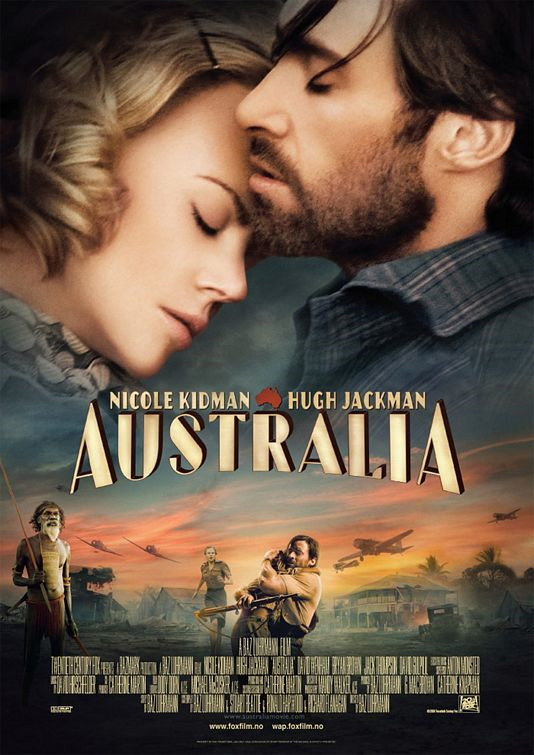
I haven’t hidden the fact that I’m in the tank for Baz Luhrmann’s “Australia,” or at least I hope to be — when we’re eventually allowed to see it. It is, bar none, my personal most-anticipated title of the next two months, sink or swim.
I am, however, beginning to get nervous about its Oscar chances, as troublesome buzz circulates about its down-to-the-wire editing and last-minute narrative changes. The Academy tends to shy away from anything that might be perceived — deservedly or not — as a grand folly, preferring works that play the publicity game a little safer.
A part of me has thought for some time that, should “Australia” overcome the naysayers, it could be welcomed by voters as a return to the more “traditional” model of Best Picture winner — sweeping, romantic, period-set and controversy-free — after four consecutive years of honouring bleak, un-pretty and (relatively) modern-day works. It’s argument that can also be made in favour of another unseen film widely presumed to be the one to beat: “The Curious Case of Benjamin Button.”
However, over at The Film Experience, Nat Rogers makes an excellent point to the contrary, suggesting that the romantic epic is less of an Oscar ‘gimme’ genre than we tend to presume:
My initial instinct, minus any research, was that Oscar loves to be romanced by beautiful people in period finery, their love story intertwined with famed world events. But is that really true? Perhaps it’s just that early Oscar champion “Gone With the Wind” casts a really long shadow …
Oscar isn’t always in the mood for retro loving. But even when they aren’t, the films can quite often emerge with Best Actress and Costume Design nominations and a stray nomination of some other sort. “Australia”‘s chances in a wide array of categories clearly hinge on how deep audiences fall into reciprocal love with Kidman’s aristocrat and Jackman’s cattle driver.
 The AFI Fest Jury Awards were dished out yesterday, and I don’t know if it says more about me or the awards that I’m just getting a post up today. The winners:

 I don’t generally throw myself full force behind a contender with the kind of FYC spirit I’m about to project. We all have our favorites and we all hope this person or that will finally get the recognition deserved, but it’s a different thing to full on advocate. But today, I just can’t help myself.
 Mickey Rourke fucked up his career. Who am I to say that though? I don’t get to chastise the guy, pass judgment, even comment really. It’s a cliche to say it, so why not be specific otherwise: Mickey Rourke had some shit to work out. Who doesn’t?
 Most biographical films tend to play like sort of a “greatest hits” of that person’s life, and sadly much of the negative of that life is left out. Sir Richard Attenborough is most guilty of this with “Gandhi,” his hugely overrated epic about the Mahatma, who did everything short of walking on water in the film. The man was human, and by all historical accounts, had his issues, yet not one of them is in the film.
 Remember “Falling in Love?” I wouldn’t blame you if you don’t. A modest join-the-dots 1984 romantic drama charting the will-they-won’t-they courtship between two married New York commuters, it should never have gone beyond the dimensions of a TV screen…

 Proof positive that 2008 is a banner year for Italian cinema: Matteo Garrone’s “Gomorrah” and Paolo Sorrentino’s “Il Divo,” both masterpieces of a very different stylistic ilk,