In Contention

Category: Daily

  • A taste of ‘An Education’

    Carey Mulligan and Peter Sarsgaard in An EducationOne of the more popular Oscar bets doing the rounds is that, along with rising star Carey Mulligan, writer Nick Hornby will find himself in the race for Sundance favorite “An Education.” (I have a hunch the film may do even better than that, but that’s me.)

    In contrast to the wealth of popular books reaching our screens this year, however, Hornby’s adaptation has taken a rather more circuitous journey: his script is a fictionalisation of journalist Lynn Barber’s autobiographical short story which appeared in Granta magazine a while back, but is actually just a taster for Barber’s full-length memoir, which is only being published later this month. Still with me? Good.

    I will of course be covering all this in a Page to Screen column eventually. For now, the Observer has helpfully provided a 6000-word extract from Barber’s memoir that essentially covers the events that inspired the film, wherein a wide-eyed 16 year-old girl experiences the rush of first love and heartbreak at the hands of an older man in early 1960s London. It’s a delightful read — warm, melancholy and streaked with acerbic humor — and gives some idea of what to expect from the film. I particularly liked this extract, which balances specific personal emotion and sly social critique quite beautifully:

    Events overtook me in the last few days of term. Miss R Garwood Scott the headmistress somehow got wind of my engagement and summoned me to see her. Was it true I was engaged? Yes, I said, but I would still like to take the Oxford exams. She was ruthless. I could not return to school (in those days you had to stay for an extra term to do Oxbridge entrance) if I was getting married. When was the wedding and which church would it be in? Not in church, I said, because my fiancé was Jewish. Jewish! She looked aghast – “Don’t you realise that the Jews killed Our Lord?” I stared at her. “So I won’t take the Oxford exams,” I said. My little gang was waiting for me outside her study. “I told her I was leaving,” I announced. “She tried to persuade me to stay but I refused.” They all congratulated me and begged to be bridesmaids. Then I went to the bogs and cried my eyes out.

    (more…)

  • Passing prettiness

    Amy Adams As I’ve mentioned before, David Thomson’s trademark star profiles can exert a kind of car-crash fascination these days, the result of a once invaluable critic giving in to his shallowest impulses. Flashes of insight still show through on occasion, but the navel-gazing (and often inappropriate fawning) of his pieces can be hard to take.

    One of the things that has always distinguished Thomson’s analysis of actors is his preoccupation with physicality. At his best, this manifests itself as artful articulation of the intangibles of screen presence. At his worst, this tilts into ‘dirty old man’ territory, as in his repulsive “biography” of Nicole Kidman, in which he waxes lyrical over her breasts and pubic hair.

    This week, the object of his physical scrutiny is Amy Adams, and this time, his gaze is a lot less admiring:

    If Adams is a star now, she had better make the most of it. This may sound harsh, but she has the kind of look that could shift from trifle to pudding by the time she is 40. You may rise up in wrath and say that a critic is not supposed to make personal remarks about an actor’s appearance – but if you really take away that appearance, there is precious little to talk about in acting.

    Ms Adams is where she is now because of a kind of passing prettiness that carries no threat. By contrast, Reese Witherspoon, Emily Blunt and Natalie Portman all carry the promise of intelligence, character and something to say that will trouble many men and the kind of society that relishes passive, pretty girls. That a movie career can still be made out of meek sweetness is a measure of how little progress we have made.

    (more…)

  • Live your life

    Rubina AliMake no mistake, I found 9 year-old Rubina Ali as adorable in “Slumdog Millionaire” as everyone else did. I also found her a rather more expressive actress than her elder incarnation, Freida Pinto. And I was as sad as anyone to hear of her home, along with those of many others, being bulldozed by the Indian government.
    But with all that said, I can’t summon much enthusiasm for the idea of her impending autobiography, even if it is for charity:

    Rubina Ali, one of the child stars of the Oscar-winning film Slumdog Millionaire, is to publish her life story.

    Madeline Toy at Transworld Publishers said on Friday that “Slumgirl Dreaming: My Journey to the Stars” will be published in Britain in mid-July. She said both Transworld Publishers and Random House Children’s Books will publish the book at the same time. Both companies are units of Random House Group Ltd. Toy said all royalties will go to Rubina and Médecins du Monde, a French medical aid organisation.

    I tend to be of the mind that people should have a bit more life under their belt before they commit it to paper. (Or rather, have some anonymous hack do so for them.) I get irked when 20-somethings publish their life stories (as is de rigeur for British celebs, be they footballers or former “Big Brother” contestants), but this is a whole new level of bizarre.

    Can the film adaptation be far away? Can the Academy resist the appeal of “Slumdog” redux, now with added biopic power? How meta would that be?

  • Floating Robinson

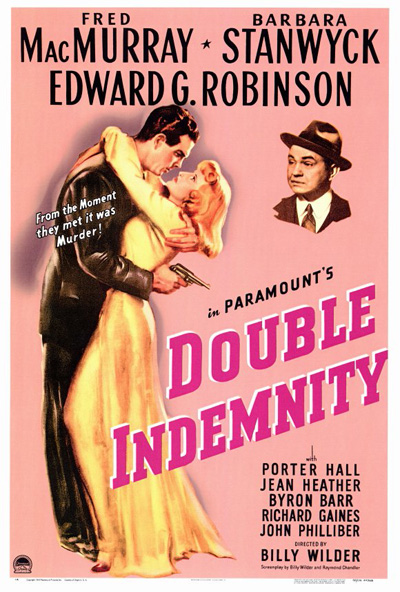
    I’ve had my eye on this “Double Indemnity” poster for the last few days.  I have a hole on my bedroom wall and it would work splendidly.  The colors, the contours, the smoothness goes well with the vibe I have going on in there.  But there’s something about that borderline-creepy floating bust of Edward G. Robinson that’s giving me pause.  And I’d be lying if I didn’t say the pink is a bit off.  But I like it otherwise.

    I’m also considering this “12 Angry Men” poster, but if I can ever find my friggin’ Italian “Midnight Cowboy” print, problem solved.  I’ve got this “Metropolis” poster and this “Citizen Kane” poster on the walls as of now, to give you an idea of what I’m going for.

    Double Indemnity

  • First look at Freeman as Mandela in ‘Invictus’

    To the best of my knowledge, this is the first time we’ve seen Morgan Freeman on the set of Clint Eastood’s “Invictus.”  Everything has been Matt Damon in rugby garb so far.

    Morgan Freeman on the set of Invictus

  • WEEKLY WRAP: ‘Invictus,’ ‘Bones’ and a billion remakes

    Matt Damon in InvictusSlipped my mind to do this on Friday, but better late…
    • We broke the news that Clint Eastwood’s upcoming Mandela film finally has a title: “Invictus.” (And if you’re wondering what it means, we explain that too.)

    • And with that, much “Invictus” talk ensued, as we learned that Eastwood directed the film at Morgan Freeman’s request, and that it’s going up against “The Lovely Bones” in December.

    • Speaking of “The Lovely Bones,” this week’s edition of Page to Screen put Alice Sebold’s bestselling novel under scrutiny.

    • Our slightly disappointing (to some, at least) poll of cinema’s most influential films entered its final stage.

    • With the news of a “Total Recall” remake the final straw, we got on Hollywood’s case for being so apparently allergic to original material.

    • This week’s list counted down the all-time greatest champs in the Best Foreign Language Film category. (Hint: The just-released “Departures” ain’t on it.)

    • We considered the wealth of female filmmakers in the mix for awards consideration this year.

    • A bit of respect for the great Elia Kazan.

    • “Up” stormed the box office, as we all knew it would.

    • Finally, in sadder, and much less expected, news, we said goodbye to actor David Carradine.

  • Tell us what you thought of ‘The Hangover’

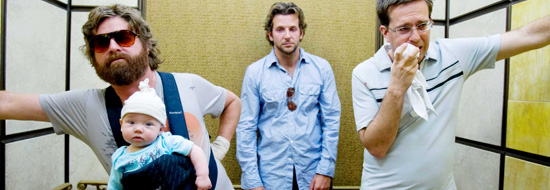
    The Hangover

    I figured I’d wait until Saturday to see what most folks are paying to see this weekend, and it appears “The Hangover” is taking the new release crown.  I never got around to a review of the film, though I offered some fleeting comments last weekend.  Tell us your thoughts in the comments section below.

  • Conan addresses the Super Mario thing

    Thursday we told you about the intriguing similarities between Conan O’Brien’s new “Tonight Show” backdrop and the art of the Super Mario Bros. video games.  I honestly didn’t expect O’Brien to address the matter but sure enough, one day later during the opening monologue, we got this:

    Of course, he doesn’t offer an outright confirmation or denial, but I think the fact that he took the time to do this says a lot.

  • Google wishes Tetris a happy 25th

    I always love it when the Google folks get crafty and offer up a logo redesign for a day or two.  Today marks the 25th anniversary of the Tetris video game, so when you head on over to the search engine, you get the following in the way of homage:

    Google Tetris

  • On TCM now…

    Richard Schickel’s documentary “Spielberg on Spielberg.”  Just finished talking about “Duel” (what I maintain to be a top five Spielberg effort to this day) and “Jaws.”  Ths is critical viewing to anyone interested in filmmaking.  It’s a treat to hear the director talking at length about his own work.  This is a guy who has never provided a director’s commentary track for a DVD release, so it’s a rarer treat than you’d expect.

    Speaking of “Jaws” (a personal all-time top 20er and a finalist in our influential films poll), I’ve always laughed out loud at Roy Scheider’s reaction to first seeing the shark.  You know it well, the “chum” scene.  That bolt-upright snap of his, cigarette sticking out, that unmistakable “holy shit” look of shock.  I don’t know, cracks me up every time.

  • Freeman tapped Eastwood to direct ‘Invictus’

    Morgan FreemanToward the top of this John Powers profile of Morgan Freeman (published in part online and appearing in full in the June issue of Vogue), the actor drops an interesting bit of information I wasn’t aware of until now.  Most people were (as always) quick to call Clint Eastwood an Oscar hound for his choice of material this time around.  Obviously a film featuring a revered individual such as Nelson Mandela and covering the historic events of John Carlin’s book “Playing the Enemy” sets off the Oscar bait alarm, but it appears Eastwood didn’t exactly go searching for his next big awards season get:

    Effortlessly dapper in a black jacket and a white polo shirt at breakfast in Beverly Hills, [Freeman] says that at this point in his storied career, “there aren’t many challenges in making movies.” Luckily, he’s about to embark on one of them—going to South Africa to produce and star in a big-budget Hollywood film about Nelson Mandela. “If you are playing a living figure who’s revered by the world, you’ve got yourself a major, major undertaking. You’ve got to do this without embarrassing yourself, your audience, and especially Madiba [Mandela’s nickname]. Knowing that, you can be entirely too self-conscious. There are pitfalls, but I am going to be working with Clint.”

    He’s referring, of course, to his good friend Clint Eastwood, who’s directing the film at Freeman’s request. “Morgan is just right for the role,” says the man who helmed Freeman’s Oscar-winning turn in Million Dollar Baby. “His stature in the acting world is like Mandela’s in his world.” (Eastwood’s confidence turns out to be well-founded. “Things are going fantastic here,” Freeman later tells me by phone from Johannesburg. “Everything has just fallen into place. The thing that’s surprised me is how easy it’s been to adapt to being Mandela.”)

    Also, I have to say, “Invictus” is growing on me. Even though it’s totally wrong for the scope of the film and isn’t commercially appealing, I think it’s a very attractive title.  Strong.  Confident.  I dig it.

  • Lasseter on his Disney ups and downs

    John LasseterTotal Film has done a notably thorough interview with John Lasseter, which takes the form of a chronological tour through the animation maven and “Toy Story” director’s career. It’s a fascinating read, particularly if you, like me, are not entirely au fait with the early history of Pixar and computer animation. I hadn’t realized how the dots all joined between Lasseter and such diverse figures as Steve Jobs, Tim Burton, George Lucas and Chris Wedge. Small world, and all that.

    The overarching narrative that emerges from the interview is Lasseter’s complicated history with Disney Animation Studios. He may run the place now, but getting fired by them decades ago has clearly left its mark. He’s too genial a guy to remain bitter, but he’s still frank about how unpleasant his early Disney days were:

    When I got there I found it was led by people who felt threatened by young talent. I kept suggesting stuff but I remember being told by one of them, ‘Look we don’t want to hear your ideas, just do what you’re told. There are plenty of guys who’d be happy to take your place.’

    In two sentences some guy made me not care about the studio; he made me not care about the project I was working on. And I thought to myself, ‘One day if ever I’m in charge I’m never going to say to a young person what that guy just said to me’. But it didn’t stop me, I just kept trying to push and make things better.

    When we showed the test and gave a pitch (for “The Brave Little Toaster”), the head of the film studio just said, ‘The only reason to produce this by computer is if it makes it cheaper and faster.’And he walked out. Within five minutes I get a call: ‘Your project is incomplete and your employment with the Disney Animation Studios is now terminated.’

    (more…)

  • Two sugars

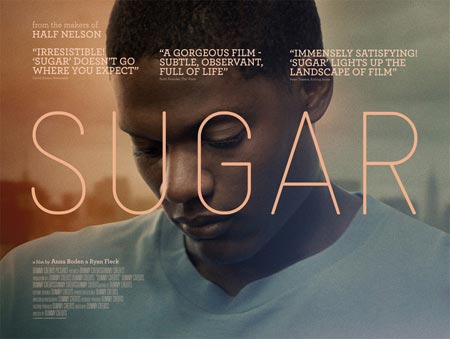
    As you know, we really love Anna Boden and Ryan Fleck’s “Sugar” here at InContention. The film opens today here in the UK, and I sincerely hope discerning Brit audiences can get past the unfamiliar baseball angle and see this for the lovely, universal character piece it is.

    Anyway, I thought I’d share this beautiful poster art from AllCity Design, easily the best in the game when it comes to UK release one-sheets. I love that they include rejected designs on their website — this one didn’t make the cut (the design they went with is pictured after the jump), but the elegance of its palette and composition caught my eye.

    Sugar

    (more…)

  • Elia Kazan sparks renewed interest

    Elia KazanSo many of today’s youth have not seen films made before the year they were born and they are missing so much. I remember being 18 and spending some time with my girlfriend at the time at her job, which allowed for me to get a lot of reading done. One of her co-workers expressed some surprise that I was reading Charlie Chaplin’s autobiography.  “Do you have to know everything about movies John?” Without hesitation I answered, “yes,” and still feel that way.  The great directors of cinema past and present knew as much as they could ABOUT cinema past and present.  Aspiring filmmakers should certainly take their cue.
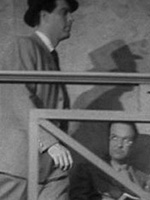
    Once, while showing “Psycho” in my film history class, a student suddenly shouted, “Marcellus Wallace and Butch…man Tarantino lifted this,” and he was right. There is a scene in the film where Marion Crane encounters her boss crossing a street in much the same manner Butch encounters Marcellus in “Pulp Fiction.”  It’s small but I’m so happy someone in that class picked it up.  You have to know where you’ve been to understand where you are and, certainly, where you’re going.

    There is a retro-interest in Elia Kazan, the great director of the 1950s, that I find quite thrilling.  Known as a bi-coastal director, Kazan enjoyed great success in film as well as stage, helming some of the first productions of the greatest plays of the 20th century, including “All My Sons,” “Death of a Salesman,” “A Streetcar Named Desire” and “Cat on a Hot Tin Roof.”  He would direct the film version of “A Streetcar Named Desire” in 1951 to great acclaim.

    No other director before Kazan so understood the art of acting and was able to work with actors in the manner he did. He was among the first directors to make the actor part of the creative team, listening to his or her ideas and admitting when he had actually been wrong. It was unheard of for directors such as John Ford, William Wyler, Chaplin or Orson Welles to admit being wrong — they never were in their minds — but Kazan had no fear, believing the creative process allowed for error.

    Having been trained as an actor befor he became a documentary filmmaker, Kazan understood the actor’s process, but as a director he wanted to be more than just the sort of director who blocked talent; he wanted to work with actors to create something as realistic as possible. Though he started his career as a director with Method Acting guru Lee Strasberg, the two parted ways when Kazan began evolving the style. Kazan went off to direct with his new ideas about the Method and found great success, winning two Academy Awards, Tony Awards and in 1999, under the cloud of controversey, an Academy Award for Lifetime Achievement.

    (more…)

  • Raymond Chandler’s secret ‘Indemnity’ cameo uncovered

    (from left) Fred MacMurray and Raymond Chandler in Double IndemnityI don’t dig into my list of all-time greatest films often beyond this brief mention/hint or that, though I regularly get emails and comments asking me to chart them out.  One of these days I’ll crank out the whole collective.  One fixture of the top 20, however, has always been Billy Wilder’s seminal film noir effort “Double Indemnity.”

    So it was with considerable surprise and enthusiasm that I stumbled across this Guardian story from Adrian Wootton that uncovers the until-now-undiscovered cameo from author Raymond Chandler in the film.  Chandler, of course, co-wrote the screenplay with Wilder, which was itself based upon the novel by fellow noir legend James M. Cain.

    The discovery comes 60 years after the film’s release and 50 years after Chandler’s death.  I’m stunned no one has uncovered it until now.  Author (and blogger) Mark Coggins is credited with the discovery (thanks to a tip from fellow author John Billheimer).

    Writes Coggins:

    The scene where Chandler appears comes relatively early in the move, just after Fred MacMurray, as insurance salesmen Walter Neff, leaves the office of Edward G. Robinson playing the character of claims adjuster Barton Keyes. Keyes has just told Neff that “his little man” tells him whenever a claim is crooked and Neff shines him on and then lights his (cheap) cigar with a kitchen match and walks out of the office.

    As he exits the office, he goes down a corridor, and there is Chandler waiting outside reading a magazine and smoking a cigarette.

    (more…)

  • No reason

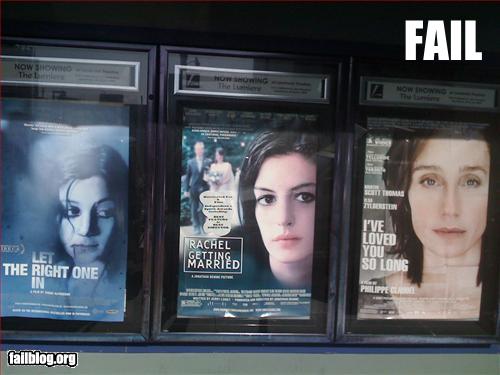
    A reader sent me this pic, it amused me, so I’m posting. Simple as that:

    (from left) posters for Let the Right One In, Rachel Getting Married and I've Loved You So Long

  • 6/5 Web Round-up

    James Cameron on the set of Avatar• Carmike Cinemas honcho S. David Passman III gets back to basics, like cleaning the bathrooms. (This story hits home with me because I grew up going to a shoddy Carmike theater.) [Company Town]

    • Headline of the month.  Not film related, but necessary for your morning LOL dose. [MyFoxBoston.com]

    • Drew McWeeny dives head-long into the tank for Ubisoft’s “Avatar” video game with a detailed description of what must have been a breath-taking E3 demonstration. [Motion/Captured]

    • Why Cannes awards mean squat for Oscar. [The Playlist]

    • How “Slumdog Millionaire” is changing filmmaking in India. [The Guardian]

    • Dumb list du jour… [Premiere]

    • Paul Dano, “prince regent of independent film,” rides the subway.  Just, you know, FYI. [The Times]

    • Sam Mendes drew on Hal Ashby for “Away We Go” (he just missed the poignancy). [The Hollywood Interview]

    • Searching for the Berkeley home that inspired Carl’s “Up” abode. [San Francisco Chronicle]

    • CAA reaches out to James Cameron to represent the director’s new Fusion Camera System technology. [Deadline Hollywood Daily]