
In Contention

Tag: Tulpan

  • Foreign film shortlist to drop soon

    Waltz with BashirI believe the 9-title shortlist for Best Foreign Language Film is due today, but details on the announcement are oddly hard to come by, so I could be wrong.

    In any case, it’s one I’m having a tough time calling. The new voting system should ensure that some of the year’s most acclaimed contenders are spared the indignity of being left off the shortlist (as happened, notoriously, to “4 Months, 3 Weeks and 2 Days” and “Persepolis” last year), so it’s difficult to see favorites “Waltz With Bashir” (fresh from its Globe win) and “Gomorrah” missing the cut. 

    I’d like to say that the best film of 2008, “The Class,” is similarly assured a spot, but it’s a risky, tough-minded docudrama, and I’m not sure how the committee (even the executive panel created to keep things in check) will respond to it — especially with “Gomorrah” and “Bashir” also occupying contemporary, genre-spanning territory. Fingers crossed. 

    Beyond that, my predictions get shaky. I think my projected list is a little heavy on European entries, but it’s hard to predict which one/s will miss. The Academy invariably throws a few less-heralded curveballs into the mix, but with 67 entries to choose from (and many of them fairly unknown quantities), it’s anyone’s guess which obscurities have caught the committee’s eye.

    (More thoughts, and my predicted shortlist, below the cut.)

    (more…)

  • Best Foreign Language Film: an alternative ballot

    Last month, I played devil’s advocate a little with the Best Documentary Feature category, suggesting five less-discussed titles from the shortlist of contenders as a potential counter to the dizzying advance of the clear frontrunner, “Man on Wire” — not as a slight on the film, which is terrific, but in the interests of diversity.

    Now, as we near the end of a busy first phase of precursors, I feel the need to make a similar effort in the Best Foreign Language Film category. It’s not that the names being mentioned as frontrunners for the Oscar aren’t worthy — oft-mentioned titles like “Gomorrah,” “The Class” and “Waltz With Bashir” are more than credible contenders, with the former two among my favourite films of the year. (More on that in a couple of days.) But we all know the Academy can frequently choose to ignore the obvious in this category — and with that in mind, I’d like to point out a few interesting directions in which they can go.

    The critics certainly aren’t helping them out, after all. Excellent film that it is, “Let the Right One In” has stomped all over the precursors almost as comprehensively as “Man on Wire” has: a consensus that strikes me as both surprising and a little disappointing, given what a rich and varied year it’s been for non-American cinema. Share the wealth a little, guys. However, the fact that the Swedish vampire film is ineligible for the Oscar means the Academy’s foreign-language committee is being given very few pointers at this stage.

    So, in the interests of rectifying that, I offer an alternative ballot: four under-the-radar titles from the 67-strong shortlist of foreign-language contenders that the voters would do well to consider. There are no doubt more — I’m drawing from the pool of contenders that I’ve actually seen — but any one of these would be a most worthy, and welcome, surprise:

    “TONY MANERO” (Chile): Pablo Larrain’s wicked little festival favourite first caught my eye at the London fest in October, and has crawled progressively deeper under my skin ever since. A tightly conceived and wholly unique hybrid of black comedy, serial-killer thriller and socio-political study, it takes its title from the character played by John Travolta in “Saturday Night Fever,” a figure worshipped to a disturbing degree by the film’s own protagonist, Raul, a socially inept lowlife eking out a bleak existence in 1978 Santiago, Chile.

    (more…)

  • LONDON: Gongs for ‘Mice,’ ‘Tulpan’ … and my own awards

    My last post on the London Film Festival brings some happy news, as one of my favourite festival titles was justly rewarded last night. The festival is not a competion-based one, but three prestigious awards are still handed out before the final screening.

    One of these is the global festival staple, the FIPRESCI International Critics’ Award. I’m thrilled to see it went to Australian multi-hyphenate Matthew Newton for his superb debut feature “Three Blind Mice,” which I already gushed over here. At only 31 years of age, I predict big things for Newton, both before and behind the camera.

    Meanwhile, the Sutherland Trophy for best debut feature went to “Tulpan,” the Kazakhstani entry for Best Foreign Language Film, beating such heavyweight contenders as “Ballast” and “Hunger.” It’s an auspicious award with a 50-year history: previous winners include “L’Avventura,” “In the Realm of the Senses,” “The Fabulous Baker Boys,” “You Can Count on Me” and “Persepolis.” I was rather taken with “Tulpan,” so I’m pleased to see this underdog come through — it’s a dark horse to crack the Oscar shortlist.

    Other winners included the Italian character drama “Mid-August Lunch,” which took the Satyajit Ray Award for “artistry, compassion and humanity” in a debut film, and “Victoire Terminus,” a study of female boxing in the Congo that took the Grierson Award for best documentary. I’m afraid to say I missed both films, though I particularly wanted to catch the latter.

    And with that, bearing in mind that I couldn’t see everything, I thought I’d hand out my own inaugural (and no doubt much-prized) awards for the best that I saw at the fest, starting with my own personal Top Ten:

    TEN BEST FILMS OF THE FESTIVAL: 1. “The Class”; 2. “Synecdoche, New York”; 3. “Il Divo”; 4. “Slumdog Millionaire”; 5. “Three Blind Mice”; 6. “Wendy and Lucy”; 7. “The Good, The Bad, The Weird”; 8. “The Wrestler”; 9. “Sugar”; 10. “La Belle Personne”

    (more…)

  • LONDON: ‘Tulpan,’ ‘La Belle Personne,’ ‘A Simple Heart’

    Continuing the discussion of yesterday’s London Film Festival offerings:

    Spearheaded by such titles as “The Class” and “Gomorrah,” the big story of world cinema this year appears to be the fusion of a documentary aesthetic with fictional storytelling, in many cases employing semi-improvised scripts and non-professional actors to create the spontaneous, slightly unnerving feel of watching life being lived. The latest in this cinematic line is “Tulpan” (***), a spare, sure-footed and thoroughly winning first foray into fiction film from documentarian Sergei Dvortsevoy.

    Since picking up the Un Certain Regard award at Cannes, the film has built up healthy buzz on the festival circuit, and was recently named Kazakhstan’s entry in the Best Foreign Language Film Oscar race. (Kazakhstan, incidentally, is seeking their second consecutive nomination in the category after the surprise success of 2007’s “Mongol” — for all the “Borat” associations, this country is no joke.)

    Part folk tale, part National Geographic-style environmental study, the film unfolds on the barren, windswept steppes of south Kazakhstan, a milieu familiar from 2003’s documentary “The Story of the Weeping Camel.” “Tulpan” actually resembles that film in more ways than one, employing a similarly  leisurely, observational shooting style with a keen eye for domestic ritual.

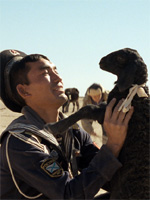
    The story, such as it is, concerns a socially awkward young man, Asa, who returns from naval service to settle on the deserted steppe with his sister and her sheep-herder husband. Determined to find a wife, he sets his sights on marrying Tulpan, the daughter of neighbouring herders, who remains an unseen presence in the film. However, as he fails to win her over, while his herding abilities prove inadequate, he comes to re-evaluate his goals.

    (more…)

  • LONDON: ‘Dean Spanley,’ ‘1234,’ ‘Goodbye Solo’

    Long day today, with some complicated scheduling: after a press screening of Atom Egoyan’s “Adoration” turned out to be full, I was presented with the choice of catching up with either “Miracle at St. Anna” or Kazakhstani Oscar submission “Tulpan.” I opted for the latter — well, it’s got more of a chance of getting an Oscar nomination than Spike Lee’s film, right?
    Anyway, as I have six films to discuss from today, for the sake of economy (and my own sleep requirements) I’ll look at three of them now, and deal with the rest early tomorrow. We’ll start with the English-language contingent.

    I missed tonight’s main attraction, Richard Eyre’s tepidly received “The Other Man.” However, Eyre’s film was preceded by another UK-set Toronto title, “Dean Spanley” (**), a sophomore effort from Kiwi helmer Toa Fraser, whose debut “No. 2” was, oddly, rather more ambitious than this amiable but over-extended skit.

    The ornate animated credit sequence and jaunty score announce upfront that the film demands high whimsy-tolerance levels from the audience. In the interest of full disclosure, mine are pretty low. Still, that doesn’t distract from the fact that the narrative is barely feature-film material. Set in London at the turn of the 20th century, the film focuses on the brittle relationship between mild-mannered gentleman Fisk (Jeremy Northam) and his batty, emotionally distant father (Peter O’Toole). Idly attending a lecture on reincarnation one afternoon, they encounter the enigmatic Dean Spanley (Sam Neill), whose own account of his imagined past life as a dog strikes an unexpected emotional chord with both father and son.

    (more…)

  • Foreign film watch: 67 entries, but how open is the race?

    Since my last update on the Best Foreign Language Film race, a further ten latecomers have entered films, bringing the number of entries to a record 67. (The full, updated list is here.)

    The new names in the derby are Afghanistan (“Opium War”), Albania (“The Sorrow of Mrs Schneider”), Azerbaijan (“Fortress”), Egypt (“The Island”), Georgia (“Mediator”), Kazakhstan (“Tulpan”), Latvia (“Defenders of Riga”), Lebanon (“Under the Bombs”), Ukraine (“The Illusion of Fear”) and, interestingly enough, the United Kingdom (“Hope Eternal”).

    The last-named title proclaims itself the first ever Welsh-African production, and features dialogue in seven languages — including Swahili and Afrikaans. Beyond that, I haven’t a clue what it is. Incidentally, I saw the Kazakhstani entry “Tulpan” this afternoon, and will review it in my next London Film Festival roundup.

    Reflecting on the race in his Notes on a Season column, Pete Hammond declares the race “wide open,” but I’m not sure I agree. After all, the new voting system — whereby the foreign film committee votes on six of the shortlisted titles, after which a smaller executive will add a further three — is specifically designed to ensure that the most acclaimed (and most expected) films make the cut.

    Under this system, you can bet a film like “4 Months, 3 Weeks and 2 Days” would have made the shortlist last year. Ditto “City of God” in 2002. Consequently, it seems safe to say that even if the general committee snubs high-profile critics’ favourites like “Gomorrah” or “Waltz With Bashir,” the executive committee will get them on the shortlist.

    (more…)