In Contention

Tag: Robert De Niro

  • Beyond the biopic

    Halfway through watching the recently uncovered trailer for Ron Howard’s “Frost/Nixon,” I felt my stomach sinking with involuntary dread, and it took me a beat or two to figure out why.

    The problem didn’t appear to be the film itself; in fact, the relatively zippy trailer promises something somewhat tighter and wittier than I’ve been expecting from the odd (to my eyes) pairing of Ron Howard and Peter Morgan.

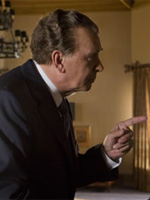
    No, what had me grimacing in anticipation of things to come were the glimpses we are offered of Frank Langella as Tricky Dick – a showcase that, in the space of two minutes, manages to tick so many Academy boxes that Langella could probably nab a nomination for the trailer alone.

    The studied gait, the mannered vocal cadences, the escalating, booming rage in his confrontations with Michael Sheen’s David Frost (anyone want to lay bets on the “when the president does it, it is not illegal” clip being used in the Best Actor presentation on Oscar night?) … all the elements appear to be in place for the kind of superficially impressive inhabitation of celebrity that has lately dazzled the voters on a yearly basis.

    Let it be said, I’m not dismissing Langella’s performance – he may be very good indeed. (Though now that The Guardian has pointed out the vocal similarities between Langella’s Nixon and Sean Connery, that discordant parallel will remain firmly lodged in my brain.) And after a long career with two recent near-misses at an Oscar nomination (“Good Night, and Good Luck” and the wonderful “Starting Out in the Evening”), I could hardly begrudge the man some recognition.

    But at the same time, if someone were to issue a moratorium on rewarding biopic performances for the next decade or so, I would be right on board. For the last ten years running, at least one of the four winning performances each year has been a portrayal of a real-life figure. Daniel Day-Lewis just broke a three-year biopic run in Best Actor category; over in Best Actress, a mere two of the last nine victors played fictitious characters.

    I’m not so contrary as to assert that none of them were deserving, but I don’t mind admitting that I’m a little fatigued. More than that, I’m exasperated at how easily, and consistently, impressed the Academy has been by this particular trick.

    (more…)

  • Peter Finch and the posthumous Oscar

    Peter Finch in NetworkPeter Finch’es wide-eyed, frantic performance as newsman Howard Beale in Sidney Lumet’s “Network” became a touchstone for North America in 1976 because we too were “mad as hell and not going to take it anymore.”

    Vietnam was over, though the vets were struggling with their various personal horrors.  Nixon had resigned, leaving a mistrustful America in his wake.  And up here in Canada, we were dealing with a Prime Minister who was often more playboy than politician.  Lumet’s searing film, from an original screenplay by Paddy Chayevsky, was timely indeed.

    Whispers of a posthumous Oscar have circulated Heath Ledger’s performance in “The Dark Knight” for weeks now, bringing Finch’s seizure of the Best Actor trophy back to the forefront of discussion.  But was Finch’s win a recognition of the performance or was it fueled by his unfortunate dead in January of 1977?

    (more…)

  • Uh…‘Good Shepherd’ was always part of something more

    Universal Pictures\' The Good ShepherdI’ve read three stories today indicating that Robert De Niro wants to spin “The Good Shepherd” into a trilogy.  This…is not news.  Not exactly.
    The first mention was an aside in this Variety story, which was simply a “by the way” kind of thing.  Then Cinematical got a hold of it and passed the news along, and now I see The Movie Blog is sourcing Rope of Silicon (should have sourced Variety, but there’s that whole boycott brouhaha), and suddenly a couple of comments have become a “news item” for the day.

    I’d like to, if I may, quote my own words from a New York Times story nearly two years old:

    But Mr. De Niro, who was developing a C.I.A. project of his own at Tribeca Productions, agreed to a deal that kept things moving: He would consider directing or starring in “The Good Shepherd,” if Mr. Roth would write the Tribeca film, which deals with the period from the Bay of Pigs invasion to the fall of the Berlin Wall.

    At least one other CIA film was always in the cards, though the reception of “The Good Shepherd” (for which I have great respect despite its flaws) may or may not have slowed that train a bit.  Eric Roth told me about the possibility of a trilogy in the above interview, but that didn’t make the edit.

    Anyway, looking back at the Roth piece, I’m reminded of two of his scripts that I desperately hope find traction: “Hatfields and McCoys” (with Brad Pitt chomping at the bit to make it a reality) and “Comanche” (pitting Roth with Michael Mann once again for a western that sounds like it could be out of the park).

    This year, of course, Roth will be pushing the envelope as always with “The Curious Case of Benjamin Button,” one of my most anticipated films of 2008.

  • Cimino and Oscar

    Lots of talk about deserving (and undeserving) directors in the Oscar chatting this week. Let’s take it to specifics with one race that stood out to a few commenters.
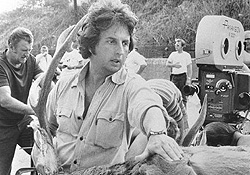
    It seemed in the spring of 1979, following the Oscar ceremony, there was a sense in the industry that if the Academy could have taken back their votes — which saw “The Deer Hunter” and director Michael Cimino winning for Best Picture and Best Director — they would have done so.

    The first screenings of “The Deer Hunter” had begun the summer before, when executives saw the film and were stunned by its raw, visceral power, leading to buzz within the business that a masterwork had been born. Execs at United Artists sought out Cimino and inked him to a contract to make a film before before the release of the Vietnam epic, a move they would live to regret.

    By the time the film was released in December of 1978, word of mouth was so strong Cimino seemed to be defying anyone to dislike the effort or say anything negative about it. Film critics awarded it best picture and director honors, except those in Los Angeles who gave “Coming Home” highest marks, while Cimino won the directing award. Nominated for nine Oscars, “The Deer Hunter” won five, adding Best Supporting Actor (Christopher Walken), Best Sound Mixing and Best Film Editing to the aforementioned Best Picture and Best Director trophies.

    (more…)

  • 1976: a great year and Oscar blew it

    Continuing the conversation on great years for movies (1974 being my pick for the best), I thought I’d dig into a season rich with material that slipped through Oscar’s fingers.
    The American bicentennial year was loaded with wonderful films — ground-breaking works that stunned both audiences and critics with their mastery. Three of them were nominated for Best Picture, some of the others were not, yet the eventual winner was a low budget love story about a boxer that wanted to prove he wasn’t just another bum from the neighborhood.

    The true greats of 1976:

    “All the President’s Men”

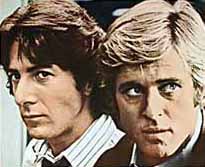
    Alan J. Pakula’s superb adaptation of the Pulitzer Prize-winning book written by Bob Woodward and Carl Bernstein about their investigation of the Watergate burglary was born out of an astonishing script by William Goldman. Making sense of the politics within a dense book, incredibly detailed, Goldman’s work had the good sense to make the film a detective-like thriller with well-defined characters.

    This could have been a dull, political film made to exploit the happenings in the United States at the time, but Pakula instead made one of the great films about journalism in the days before the Internet and e-mail. Robert Redford bought the rights to the book and produced the film, starring as Woodward, with Dustin Hoffman as Bernstein, both giving exceptional performances, but it was Jason Robards who blew them off the screen with his excellent performance as the crusty, wise, and ultimately loyal Washing Post editor Ben Bradlee.

    (more…)

  • Where have you gone, Al Pacino?

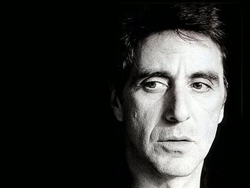
    It has been more than 30 years since Al Pacino gave his career-defining performance as cold blooded Michael Corleone in “The Godfather Part II.” He radiated quiet danger the moment he appeared on screen without ever raising his voice or allowing his mouth to wrap its way around words and spit them out like venom.
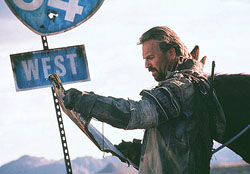
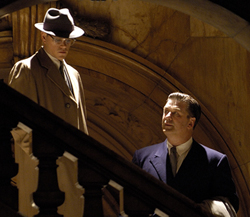
    While a one-two punch of “88 Minutes” and “Righteous Kill” slithers its way to theaters this year, audiences are reminded once again that one of the cinema’s all-time legends has immersed himself once again in either sub-par material or, as has become his cliche, the tendency to overreach and overact on his way to becoming a walking spoof of himself.

    There was a time when Pacino was thought of as one of the greatest American actors in movies…period. His work in the 1970s was nothing short of sublime, with strong performances in “The Godfather,” “Serpico,” “Scarecrow,” the aforementioned sequel to Coppola’s study of La Cosa Nostra and “Dog Day Afternoon.” In the latter he gave his most electrifying and properly energized portrayal.

    Along with many of the fresh-faced actors of the day, Pacino owned the decade. Sure he faltered with “Bobby Deerfield,” which meant he was not the type for romantic films…right? Or was this his limitations beginning to become apparent?

    (more…)

  • The LA Times points and laughs at poor bastards

    It looks like LA Times is still beating that Oscar drum for the old media sect. This week, Susan King writes up the lackluster career choices that followed a number of Academy wins throughout the years.

    Here’s a look:

    Just because you win an Oscar doesn’t mean that every subsequent film you make will be Academy Award-caliber stuff. In fact, Oscar winners inevitably make incongruous missteps in their career after they pick up an Academy Award.

    Just look at Kevin Costner. After being on top of the world when he won the best director Oscar for the 1990 best film, “Dances With Wolves,” he made the gargantuan turkey “Waterworld” and then directed a three-hour celluloid nightmare called “The Postman,” which was DOA with critics and audiences alike. No sooner did Julia Roberts earn an Oscar for “Erin Brockovich” than critics soured on her talents in the ill-fated comedy “America’s Sweethearts.” And what was Oscar-winner Tommy Lee Jones thinking when he signed up for the yawn-inducing comedy “Man of the House,” a film so tepid that it wasn’t even screened for critics?

    She goes on to pour salt on the wounds of Al Pacino, Halle Berry, Whoopi Goldberg, Robin Williams and Nicole Kidman, among others. But I’m left wondering what good a piece like this serves.

    Now I’m no elitist. I understand we all have to stretch for awards content and perspective from time to time. And typically, the LA Times and its awards site, The Envelope, nail down interesting subject matter in that regard. But this piece is like one of those throwaway photo galleries that land on a weekly basis over there on a weekly basis.

    Obviously this was a buttress piece for Patrick Goldstein’s latest think piece (regarding the downward spiral of Robert De Niro and Al Pacino), but I don’t know. It seems a little cheap and unnecessary to me.

    Check out the rest of King’s piece here.

  • Almost there

    shepherd.jpgRobert De Niro’s “The Good Shepherd” has been running on HBO this month. I stopped flipping to watch some of it this evening, kind of caught up in the brief year-ago nostalgia, but mostly transfixed with a film that is so close, yet so far.

    I remember when I first saw the film at the Clarity screening room in Beverly Hills in December of 2006, surrounded by a typically judgmental crowd of HFPA members. I had high hopes. It was, after all, the year’s most anticipated would-be Oscar film, much like 2007’s “Charlie Wilson’s War.” There was a hell of a crew assembled for what sounded like it could be a solid, dense, but meaningful effort. The catch was that I had read Eric Roth’s screenplay some months prior, and “dense” didn’t begin to cover it. I knew this was a script that demanded some sort of device to dig a story, not necessarily bogged down, but still somewhat abstruse, out of the literary and onto the screen in an authoritative manner.

    I had also just finished up a profile of Roth for The New York Times and had grown as fond of the man as I had his work throughout the years.

    (more…)