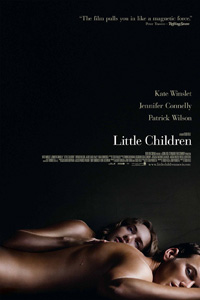
 Tom Perrotta’s novel “Little Children” is a visceral reading experience. A smart and casually brilliant work of fiction, the author’s characters exude a demand for understanding and compassion above all else in a narrative flow that is forgivably meandering.
Todd Field’s adaptation (co-written by Perrotta) in the form of New Line Cinema’s film of the same name keeps these crucial elements in tact during a transition to the screen, but the end result is sadly nothing approaching the exuberance of imagining Perrotta’s world in one’s mind. Questionable directorial decisions and, at times, a tendency to follow too close to the tread of Perrotta’s novel (yet straying much too far when the need arises) ultimately hinder “Little Children” from the suburban poignancy it aspires to be.
The story is one of contained souls desperate for alleviation. Sara Pierce (Kate Winslet) is a mother of one, visibly bored with the life she leads. Spending afternoons at a neighborhood playground with other mothers, representing varying degrees of personality disorder, Sara is the most homely of the bunch but the most irreverent all the same. Her daughter, Lucy (Sadie Goldstein), humorously reflects her mother’s irreverence.
Sara yearns for something more than the by the numbers set-up she has made for herself, along with husband Richard (Gregg Edelman), and this spark of disinterest makes itself visible in her consistent challenging of her acquaintances’ points of view, most notably lashing out intellectual artillery here and there on one of the typically bitchy, blonde-haired, blue-eyed sort.
Brad Adamson (Patrick Wilson), or the “Prom King,” as he has been dubbed by the troupe of housewives, is equally confused about his life having turned out so tedious and passionless. Having failed the bar exam twice and gunning for one more attempt in a do or die situation, Brad seems to be questioning not merely his desire to be a lawyer, but his desire to be who he is in any case.
His wife, Kathy (Jennifer Connely), wears the pants in the family leaving him as the primary caregiver to an adorable son, Aaron (Ty Simpkins).A casual meeting of the minds between Brad and Sara will spark light in their lives they each had thought gone forever, each seemingly the answer to the other’s personal doubts and emotionally dire circumstances; Sara, the frumpy, bushy-eye browed scholarly sort, Brad the golden bodied, handsome former jock: a mismatch made in heaven.
Meanwhile, Ronald James McGorvey (Jackie Earle Haley, who is likely to garner Oscar buzz for his performance), formerly convicted of exposing himself to a young girl, takes up residence in this otherwise quiet community with his mother, May (Phyllis Sommerville).
The news shakes the neighborhood to the core, the anger visibly presenting itself in the form of former cop Larry Hedges (Noah Emmerich), who frequently harasses the McGorveys and defaces their property with various forms of propaganda. Larry and Ronald have a delicate relationship, however, as a result, one reflective of the other’s inner turmoil in many ways, undoubtedly flawed humans each of them.
 All of this could certainly be gleaned from reading any synopsis of Perrotta’s novel, and obviously, the makings of a brilliant film are quite apparent. But somewhere along the way, “Little Children” lost its freshness.
Todd Field’s directorial debut “In the Bedroom” in 2001 was a brooding dissection of the nature of revenge, hatred, anger and despair. It seems to be territory in which the director is quite comfortable, as he takes Perrotta’s novel to darker levels than even the author might have intended on the page. He builds layers into the characters that are vibrant, but at many times, rather unnecessary, and his adaptation (again, co-authored by Perrotta) ultimately takes the story to a place far too dreary for its own good.
It is surprising that such an ending (which I dare not spoil) would have been deemed appropriate by the novel’s author, and the influence of Field’s darker tendencies seems to be the culprit of such a design. In fact, Field makes a number of directorial decisions throughout that impede the process of the story’s conveyance.
He chooses, for instance, to let his camera linger on his actors too long at times, capturing the awkward aspects of performance that are meant to be trimmed from a film product. He allows over-the-top characterizations to go undeterred, the most notable case being Noah Emmerich’s over-acting every scene when he very clearly has the ability to relay his character in much more appropriate ways.
The most disastrous decision was to employ the usage of a third party narrator, essentially reading the words from Perrotta’s page in a low, ironic voice. Anyone will tell you narration is the mark of an amateur, sure, but the decision was made here to be somewhat humorous. The effect is a maddening sense that the film is a work in progress with elements to later be filled in to satisfaction.
The performances are, by and large, lacking in some form or another. Whether it is Patrick Wilson’s apparent lack of understanding his own character’s motives (some might think this works for the part; I would disagree), Phyllis Sommerville’s questionable histrionics or Jackie Earle Haley’s awkward self-awareness, the actors seem to have what it takes, but apparently lack the guidance to reach that plateau.
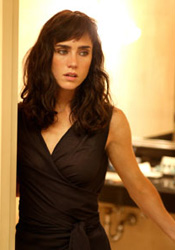 Jennifer Connelly threatens depth with her character, though a sub-plot involving Kathy’s mother was largely omitted which might have helped in that regard. Connelly is, as always, a beautiful and talented actress, but here she’s simply relegated to being a hottie. The role doesn’t call for much else.
Kate Winslet, however, is quite obviously incapable of poor acting. Her performance as Sara is one of her very best to date and one of the most believable characterizations of her career. Even surrounded by what feels like amateur night at a local acting theater, Winslet maintains a control over Sara that screams professionalism and artistry. She has to be considered one of the greatest, most fearless actresses of her generation.
Finally, Thomas Newman’s score is less derivative than normal, considering the source. The music works to the film’s favor, organic and apparent all the same. The cues recall his work in Sam Mendes’s “American Beauty,” in fact, a film of similar themes and characterizations.
This comparison to Mendes’s film will be drawn over and over again as critics begin reacting to “Little Children” in the coming weeks. However, while “American Beauty” ages quite poorly and never seems to retain the immediacy it boasted in 1999, it still remains something defining in a sub-genre that inherits a new entry every few years or so. “Little Children” fits this mold of suburban despair, its characters clenching to their youth, and it also brings more valid and insightful aspects to the table.
These are individuals discontent with their lives, but who travel hard and tiresome roads to discover they are in fact lucky to lead the subjectively boring existences they do. It’s a beautiful theme that seems to be of a piece with the majority of film product this year, if one were to thoroughly examine various entries.
However, the film is still an uneven exercise in frigidity, something Perrotta’s novel could never have been accused of. Field is certainly an interesting director who is sure to continue creating unique character studies, but one can only hope that “In the Bedroom” was no fluke. “Little Children” is something of a sophomore slump that I would still venture to say will be embraced by the critical masses. It seems sometimes simply being unique is good enough, no matter how second-rate the artistry.
 At Toronto today, a hand handful of distribution-seeking films hit and one potential cult favorite found a home. Let’s dig in…
 There is little doubt in my mind I am going to take some heat this week, so let’s kick it off right away with my belief that Sean Penn deserved his Best Actor Oscar for
 Michael Douglas was robbed.

 The Liam Neeson career revival