In Contention

Tag: Clive Owen

  • The Great Performances: 2004

    Paul Giamatti in SidewaysIn Alexander Payne’s “Sideways,” Paul Giamatti gave the best performance by an actor in 2004, so said the New York Film Critics Circle, and how right they were.  So why, why, why was the actor denied an Oscar nomination?  Granted, it was a strong year, but his work was at the top of that heap and that snub was one of the biggest shocks of the year.

    Here was a man giving perhaps the finest performance in a comedic film since Dustin Hoffman in “Tootsie.” His co-stars go were recognized, save for the equally deserving Sandra Oh, but the leading man, around whose performance the film stands, is snubbed.  All I can remember saying is: “Wow.”

    Certainly Jamie Foxx deserved the attention he received for “Ray” and Leonardo DiCaprio was astonishing in “The Aviator,” even though he drew some criticism for before too youthful in the role. Rubbish, I thought.  He was superb, inhabiting Howard Hughes as he must have been in those days, brash, cocky, wealthy and willing to do anything that interested him.

    Clint Eastwood was terrific in “Million Dollar Baby,” while Jim Carrey gave a wonderful performance in “Eternal Sunshine of the Spotless Mind” — a marvelous piece of acting, in fact.  Equally fine, and dark, was Kevin Bacon as a pedophile struggling to start anew in “The Woodsman,” which was one of the most daring American films in a long time.

    (more…)

  • 10/1 Oscarweb Round-up

    Karen O• “Up in the Air” gets a December release date to avoid Clooney vs. Clooney at the November box office. [Variety]

    • Karen O channels Daniel Johnston for “Wild Things” soundtrack. [The Playlist]

    • Steve Pond on the forthcoming Oscar short deadline. [The Wrap]

    (more…)

  • 9/25 Oscarweb Round-up

    Steven Spielberg• Pete Hammond suggests Steven Spielberg as Oscarcast producer. [Notes on a Season]

    • Steve Pond likes the idea, tries to turn over some news as to who might have been tapped, comes up with nothing. [The Odds]

    • Kyle Buchanan chats with “Coco Before Chanel” star Audrey Tautou. [Movieline]

    (more…)

  • WEEKLY WRAP: Swayze passes, Venice wraps, Toronto runs

    Patrick Swayze• Patrick Swayze left us this week, passing away of cancer at the age of 57.

    • The Venice Film Festival drew to a close, with Israeli war drama “Lebanon” taking top honors.

    • It was Colin Firth, however, who emerged with Oscar buzz for the Weinstein-acquired “A Single Man.”

    • Across the Atlantic, we kept you up to date with Toronto goings-on, as buzz for “Precious” continues to build.

    (more…)

  • INTERVIEW: Clive Owen

    Clive OwenToronto Film Festival

    “I have two lives, mate,” Clive Owen says with clear-eyed certainty. “My work, and when I am done, my home life. There is no question to me which is more important. My wife and children are everything to me.”

    Owen is as intense in person as he is in some of the roles he played on screen the last few years. Best known as a tough guy type in films such as “Sin City” and “Shoot ‘Em Up,” he is also brilliant without the edge, as evident in “Bent” and his Oscar-nominated turn in “Closer.” He sits close to me, his eyes never leave mine, and when I glance down to make a note he is still staring at me. But when he smiles his eyes smile as well. As Scott Hicks says, “Clive loves his life, he loves his family, his girls, his work, and his success…he loves his life.”

    I wondered how much that love for family and life allowed Owen to tap into the mind of the character he portrays so very well in “The Boys are Back,” the new film from Aussie director Hicks, who first made an impact here back in 1996 with “Shine.” Owen has emerged as one of the great British actors in recent years, his scalding performance in “Closer” an extraordinary poiece of acting that seemed to blow everyone else in the film off the screen, no mean feat considering the quality of the acting in the movie. Julia Roberts and Natalie Portman gave career best work in the film, many of their scenes coming opposite the actor in front of me.

    Owen’s road to this place began in television, with his first memorable film performance coming in the powerful drama “Bent,” based on the play by Martin Sherman about Hitler’s massacre of homosexuals during the Holocaust. It was “Gosford Park” that next earned him strong notices, followed by a role in “The Bourne Identity” with Matt Damon.

    After the box office failure of “King Arthur,” Owen was back in theaters with “Closer,” which changed the course of his career. Brilliant work in “Children of Men,” “Inside Man” and, more recently, the under-appreciated “Duplicity,” have made him one of the top stars working in film today, and among the busiest. At one time he was among the leading contenders for the role of James Bond, a role that eventually went to Daniel Craig. He possesses a Bogart tough guy persona, but with a soft side buried within. There is certainly an edge to his work, but there is a heart there as well.

    (more…)

  • The trades really like ‘Duplicity’

    I must say, I liked the look of Tony Gilroy’s “Duplicity” from the get-go. However, being a sucker for jazzy caper thrillers in the “Charade” vein, as well as for most things starring Clive Owen, I wasn’t sure whether to trust my instincts there.

    In any case, given the amiable slightness of the trailer and the indifferent release date (not to mention that awful title), I wasn’t expecting a critical hit — but going on the early trade reviews, it looks like that’s what we may have here. Todd McCarthy’s Variety rave gushes as follows:

    Smart, droll and dazzling to look at and listen to, writer-director Tony Gilroy’s effervescent, intricately plotted puzzler proves in every way superior to his 2007 success “Michael Clayton.” The twisty, time jumping narrative forces viewers to keep on their toes, and it could well be that “Duplicity” is too smart for its own good as far as the popcorn masses are concerned. Still, this is about as good as it gets these days for sharp-minded Hollywood entertainment made for an intelligent audience.

    Topping “Michael Clayton” isn’t the hardest of tasks in my mind, but given the devoted following the film enjoys, that’s no light praise: McCarthy invokes Lubitsch comparisons at one point. Meanwhile, nearly every major cast member and craftsman (a pretty dazzling array, it must be said, including Robert Elswit, Albert Wolsky and James Newton Howard) is singled out for kudos.

    (more…)

  • Berlin fest gets under way

    As far as press coverage goes, the Berlin Film Festival tends to get a bit drowned in the flurry of Oscar season, so you could be forgiven for failing to notice that it actually kicked off last night, with the world premiere of Tom Tykwer’s corporate thriller “The International.”

    Sadly, as I suspected, the film doesn’t seem to be much to write home about. Screen International describes it as “ploddingly talky,” describing stars Clive Owen and Naomi Watts as “leaden” and “struggling,” respectively. Variety is no more enthusiastic, deeming it a “mostly ho-hum” exercise. As a fan of both stars and the director, it’s disheartening to see them all punching so far below their weight; Owen, in particular, needs to have a word with his agent. (Why is one of the best actors of his generation stuck in a rut of identikit thrillers? Is “Inside Man 2” really called for?)

    Anyway, onwards and upwards. Tonight sees the premiere of “Ricky,” the new one from François Ozon, who is always interesting even when he misses the mark. (And I must admit that, after the unholy mess that was Ozon’s recent “Angel,” I don’t have the greatest of confidence in this new fantasy-comedy experiment.)

    The weekend will shed some light on two very intriguing titles. Sally Potter’s “Rage,” which features (amongst other things) Judi Dench, Eddie Izzard and Jude Law in drag, promises to live up to the batty eccentricity of Potter’s best work — check out Nat Rogers’ illustrated preview here. Meanwhile, Lukas Moodysson’s “Mammoth,” a seemingly “Babel”-flavoured story of families in crisis, stars Gael Garcia Bernal and Michelle Williams, and has long been one of my most anticipated films of the year. Fingers crossed.

  • ‘The International’ to kick off Berlin

    Screen International reports that Tom Tykwer’s latest, “The International,” has been named the opening film of next year’s Berlin Film Festival. The thriller, starring Clive Owen and Naomi Watts (now there’s a good pairing), will have its word premiere at the fest, screening out of competition on February 5.

    The trailer’s been out for some time, but if it passed you by, check it out below. Looks smart, slick and star-propelled, if hardly a reinvention of the wheel. I’d love to see Tykwer return to the heady formal ambition of “Run Lola Run” or the criminally underrated “Heaven” (Cate Blanchett’s best performance right there, folks), but after the disappointingly overcooked “Perfume,” I can’t blame him for playing it safe here.

    Meanwhile, with this and the recently previewed “Duplicity” marking back-to-back corporate thrillers for Owen, I wouldn’t mind seeing this fine actor take on something a bit more challenging. Solid-looking stuff nonetheless.

  • Something for spring

    Ever get taken completely unawares by a film’s existence?

    It’s no doubt my own oversight, but before happening upon this trailer, I had never heard of “Duplicity.” (In my defence, who would remember that title?) Kind of surprising considering it reteams “Closer” co-stars Clive Owen and Julia Roberts, and comes from the hand of recent Oscar nominee Tony Gilroy.

    It’s a pleasant surprise, though: from where I’m standing, it looks like a crisp, stylish divertissement in the “Charade” mold, which is good enough for me. (Owen’s presence is always a plus in my book. And bonus points for the Goldfrapp cue.)

    Am I the only one thinking this looks a lot more fun than “Michael Clayton?” Here’s hoping. (Apple version here.)

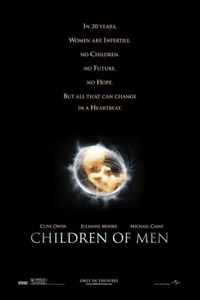
  • REVIEW: “Children of Men” (****)

    Universal Pictures' Children of MenAlfonso Cuarón’s is one of the most singular voices in the filmmaking community. Along with longtime collaborator, cinematographer Emmanuel Lubezki, the director has ushered forth textured visions of skewed fairytales for over a decade.

    With “A Little Princess,” he took audiences into the mind of a little girl and her trying tenure at a miserable boarding school. In perhaps his most underrated work, “Great Expectations” (a loose adaptation of the Charles Dickens novel), he unveiled the mysterious and fateful journey of a dreamer.

    “Y tu mamá también” brought the director’s choice of material into a more mature light, still keeping the exuberance of youth, while “Harry Potter and the Prisoner of Azkaban” became one of the most adult installments in a series aimed at a younger market.

    “Children of Men” fits rather paradoxically into these otherwise whimsical endeavors. Another sort of fairytale altogether, one cloaked in the mystique of dystopia, it is a film as unflinching in its bleakness as it is penetrating in its deep-seeded sentimentality. And in manifesting one of the most horrific visions of the future yet committed to film, Cuarón has given us his masterpiece, the crowning achievement of 2006.

    Adapted from the P.D. James novel of the same name (and, through much arbitration, crediting some five writers on the screenplay), “Children of Men” reveals the hellish world of 2027. Baby Diego has died, the affectionately labeled youngest person in the world -– 18 years old. Fertility is an aspect of the past, and humanity’s time is clearly borrowed. The world’s nations have crumbled to apocalyptic ruin. England remains the last refuge for potential stability and order…but those days are quickly slipping away.

    Theo Faron (Clive Owen) is a man lost in this sea of chaotic apathy, sliding amongst the beleaguered masses, one of the hordes, most concerned about his morning coffee and skipping out on work than with finding something of considerable happiness. His best friend, Jasper Palmer (Michael Caine), is a stoned hippie who listens to the oldies and laughs away the final years of human existence in the woods, surrounded by marijuana and nostalgia.

    An immigrants’ rights terrorist organization headed by the mysterious Julian Taylor (Julianne Moore) kidnaps Theo in broad daylight one day in order to attain transport papers for an unnamed woman. Julian and Theo, we learn, once had a child together, a child they lost and whose memory haunts them equally.

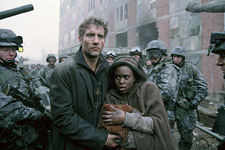
    Clive Owen and Clare-Hope Asitey in Children of MenThe unnamed woman is soon revealed to be Kee (Clare-Hope Asitey), a refugee holding the potential key (I feel as though I’ve just discovered the point of the character’s name) to the future of man: miraculously, she is pregnant, waiting to give birth to the first baby the earth has seen in 18 years.

    It soon falls to Theo to protect Kee and her unborn child, a veritable political football, and smuggle her to the Human Project, a scientist organization bent on curing the world’s infertility crisis.

    Through sheer drama and brutal tension, Cuarón sets about weaving a blistering yarn that draws parallels to current political climate. Truly penetrating visual cues bring the viewer’s mind to everything from ground assaults in Iraq to conditions at Abu Ghraib prison.

    Clive Owen’s portrayal is largely physical, as Theo is an elusive character (even by the actor’s own admission). Even still, this is one of the year’s great performances, an immediately believable portrait of a hero called to unconscionable task. Asitey is equal parts preciousness and irreverence as Kee, and Caine has far too much fun for his own good in the role of Jasper. Moore’s turn is fleeting, but elevated by her own angelic screen presence.

    Elsewhere, Peter Mullan has a great second act performance in store as one of Jasper’s amigos, while Chiwetel Ejiofor offers up yet another controlled supporting turn, this time as part of Julian’s terrorist organization. It is, however, the technical elements of the film that propel it head and shoulders above anything else in the market place this year.

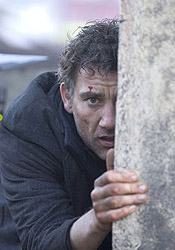
    Clive Owen in Children of MenSome of the set pieces Cuarón orchestrates are the most electrifying, living and breathing sequences ever imagined in the history of cinema. Much credit here is due to Lubezki and camera operator George Richmond, not to mention a meritorious technical and stunt crew who must have rehearsed these moments into the ground.

    You’ll hear it for the rest of the year, the cinematography on display in “Children of Men” is God-like in its skill and quality.

    Equally impressive is the production design of Jim Clay and Geoffrey Kirkland. Dreary, decaying urban landscape spans the frame. Graffiti and bullet holes decorate sets constructed with a defining clarity of intent, and ultimately the world envisioned on the drafting table becomes a character in its own right.

    The most interesting aspect of the mise-en-scène, however, has to be the director’s decision to litter the frame with various animals, usually dogs and cats. Representative of humanity’s longing and desperate need to replace children with something else, it is one of the more subtle aspects that isn’t brought out into the open for inspection, but upon examination is all too brilliant an element in the director’s arsenal for this, his finest film to date.

    “Children of Men” is a shocking portrait, indeed. From an opening scene that grips you by the collar and never lets you turn away, it is stomach-churning in its abjection, and it is resonant in its refusal to buckle under the cynicism with which Cuarón paints his canvas. It is stark and it is pointed, but it is warm and full of hope all the same. It is a miraculous achievement.

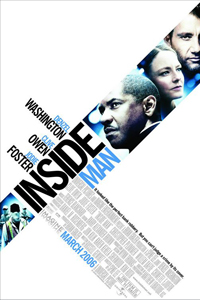
  • REVIEW: “Inside Man” (**)

    Universal Pictures\' Inside ManSpike Lee’s “Inside Man” is an embarrassment of devices from start to painstakingly anti-climactic finish. As a run-of-the-mill heist romp, it still falls prey to a dedicated intention to distinguish itself, both thematically and stylistically.

    Thinking it over, I’ve come to the conclusion that it is rather impossible to write a negative review of “Inside Man” without spilling the beans here and there, so I’ll leave it to you to decide whether to venture into the spoiler territory below. If you’re ducking out now, suffice it to say, Spike Lee picked a rather sluggish screenplay to be his first foray into mainstream genre fare, and leaves a bloated two plus hours on the screen that could have been much more effective at a slim, tight 90-100.

    So, you’ve been warned…

    SPOILERS BELOW

    What writer Russell Gewirtz is asking of his audience in his terribly contrived (though I can forgive contrivances alone) screenplay is to shift their sense of antagonism from the right place to the wrong place for the sheer reason that it makes for an intriguing turn of events in the third act.

    Christopher Plummer co-stars in the film as a philanthropist and owner/board director of the bank being robbed by Dalton Russell (Clive Owen) and his team of trim-the-fat operatives. We come to discover that one of his deep, dark secrets lies hidden in safe deposit box #392, and that it is enough of a concern for him to call upon the services of Madeline (Jodie Foster), a friends-in-high-places “glorious cunt,” as our screen mayor describes her, to assure its safe keeping.

    This “secret,” mind you, amounts to something major enough, but is still physically little more than documents in an envelope that, as Russell candidly observes, probably should have been burned. Let’s set aside the “probably.” A secret like this – you don’t leave it lying around in a safe deposit box. Why the hell would you? There is certainly no upside to such a thing, and while, as I said, contrivances and plot devices can be forgiven, in my book of brainless spring screen entertainment, they ought to be more cleverly thought through than this.

    Not to mention, Madeline’s efforts come up short to the point that her character could have easily been written out of the script and the dough tossed Foster’s way could have been spent on a few re-writes.

    Jodie Foster and Christopher Plummer in Inside ManOn top of it all –- and you’ll make your mind up for yourself on this one -– the secret, which Gewirtz feels is strong enough in and of itself to make the viewer root for Russell’s thief, doesn’t exactly do that job in full. I was left siding with Plummer’s philanthropist in some small way in the matter. Gewirtz gives us every reason to forgive him, to be honest, as he paints the character in a manner that is becoming of someone who has atoned. The sheer fact that he would expect me to turn an about face is somewhat insulting. The world isn’t black and white. But, again, you’ll make your mind up on this one.

    END SPOILERS

    But let’s get into what really makes “Inside Man” an empty romp as opposed to a satisfying one. If I had to really put a point on it, before the lapses in reason, before the unbearable pacing concerns, before the insulting expectations of the screenwriter, it would have to be the overall bland nature of the characterizations, from tone, to performance, to direction.

    Denzel Washington is one of the most charismatic actors of his generation. He has carved a niche of fandom for his stellar, rounded portrayals. Whether it is above-average work in “Malcolm X” or “Philadelphia” or by-the-numbers turns in “Crimson Tide” and “Out of Time,” Washington typically adds dimension to what’s on the page. The majority of his work lies in a middle ground between good and really good (saving the great stuff for here and there), an arena I would venture to say even includes his Oscar winning performance in “Training Day.” But he is regardless an actor who can find the intriguing emotional crevices of the most mundane of characters.

    Now in “Inside Man,” teaming with Lee (a director who has brought out the actor’s best) for the fourth time, Washington (as Detective Keith Frazier) seems to have hit the snooze button and lazily translated an already innocuous character to the screen in a sluggish fashion. His performance slips and slides from controlled and cocky to wounded and concerned, smart and assured to confused and lost, and not at all in the good, dramatic way. It’s evident that neither Lee nor Washington really have a hold on who Keith Frazier is, and the anchoring of the film suffers because of it.

    This brings me to the biggest waste of the film, and yet still, the best performance of the lot. Clive Owen is cold as ice, determined and unwavering. He’s everything you want out of a bank robber who is on top from start to finish. But why the hell is he doing this???
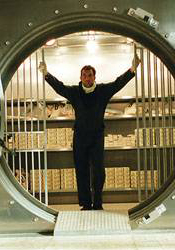
    Clive Owen in Inside ManThis is not nearly the sort of ambiguity and anonymity of intentions that speaks truths to the human condition or anything of that nature. This is a character, intriguing in his actions and objectives as it is, painfully lacking back story and motivation. There is no question that molding the character out somewhat in this regard would have done wonders for the overall thrust of the plot, but this is screenwriting 101 if you ask me.

    And don’t blink or you’ll miss Willem Dafoe picking up a paycheck as a uniform cop with little to offer other than the film’s funniest punch line.

    I have to say that, while Lee time and time again proves that he is quite uneven as a filmmaker, his work putting “Inside Man” together visually is absolutely commendable. I’m confident in saying he’d rival the greats of heist cinema (Lumet, Mamet, Mann) were he to springboard from a good screenplay. “Inside Man” pops and cracks and we can see he is confident in his direction, staying ahead of the game and not letting the audience catch on too easily. Outside of one terrible choice, the camerawork in the film accelerates from the first frame. With some of the more unnecessary fat cut from the gut of this bloated tale, at about 20-30 minutes shorter, it might have gone down a little easier.

    Lee uses Terence Blanchard again for scoring duties. As he did on 2002’s “25th Hour,” the composer lends a majesty and exuberance to Lee’s film that unquestionably makes it more operatic and fuller on the whole. Without it, the film would undoubtedly have been a lesser one.

    All things considered, “Inside Man” is going to do exactly what it is meant to do, and what Universal and Brian Grazer expect of it. It’s going to pull down a decent box office take and line the producers’ pockets nicely, as you can’t go wrong marketing something like this. It’s just foothills enough to satisfy the average moviegoer, even if it doesn’t do much in the way of a true cineaste’s desire for the towering peaks of the Rockies.