 • Todd Gilchrist talks to “The Goods: Live Hard Sell Hard” star Jeremy Piven. [Cinematical]
• Anthony Breznican has the scoop on Charlyne Yi and “Paper Heart.” [USA Today]
• Who’s your favorite cinematic psychopath? [Talking Movies]
• Todd Gilchrist talks to “The Goods: Live Hard Sell Hard” star Jeremy Piven. [Cinematical]
• Anthony Breznican has the scoop on Charlyne Yi and “Paper Heart.” [USA Today]
• Who’s your favorite cinematic psychopath? [Talking Movies]
One of the biggest drags in mainstream media presence on the internet has always been the Los Angeles Times website. In addition to being at times difficult to navigate, especially via older archives, the look has always been second rate and local-paperish (which might be an omen seeing as there are those who expect bureau after bureau to close, leaving the paper, eventually, a local piece of media at the end of the current newspaper holocaust).
Well it looks like a classy step in the right direction is afoot, as the site got a new redesign earlier today. I haven’t dug in to see if there have been any navigation remedies yet, but take a look:

 I’m as guilty as the next man of laughing off Sylvester Stallone in the face of his largely catastrophic latter-day film career, but I’m still willing to defend the man on a few counts.
“Rocky” has become one of those unfortunate good films needlessly punished for beating great films to the punch on Oscar night, and “Cop Land” isn’t so distant a memory that we should entirely dismiss his onscreen ability. Hell, some people I know were making similar claims recently for “Rocky Balboa.” (No comment.)
Nonetheless, I think the organizers of the Venice Film Festival may have taken such revisionist charity a bit far by awarding him the “Jaeger-Le Coultre Glory to the Filmmaker Award,” which is given annually to “an artist” (ahem) “who has left his mark in contemporary cinema.” Previous recipents include Abbas Kiarostami, Takeshi Kitano and Agnes Varda. I repeat: Kiarostami, Kitano, Varda … and Stallone.
If you think that’s bizarre, wait until you read the press release that delivered the news to my inbox this afternoon, excerpted after the cut.
 Thanks to The Film Experience for pointing out this news nugget: a month after Sri Lanka kicked off the convoluted, multi-tiered contest for Best Foreign Language Film by selecting their official entry, we have our first relatively high-profile submission, as Korea has entered Bong Joon-ho’s “Mother” into the race.
Some might be surprised that the country’s selectors passed over Park Chan-wook’s “Thirst” — which won the Jury Prize at Cannes and has received an interesting Stateside promotional push from Focus Features — but they shouldn’t be.
For one thing, the Koreans are probably as aware as any Oscar-watcher that the chances of the Academy blue-hairs going for an erotic vampire flick with healthy lashings of gore are, to put it gently, minimal. (It appears that “Thirst” was one of six films considered, however.)
 The opening graph of this Macleans piece on classic films losing their home video champions in studios is so depressing I’ll just let it speak for itself:
Though DVD sales are down, current movies are still guaranteed a DVD release. But for anything made earlier, collectors may be out of luck. Most of the studios have trimmed their schedule of classic movies on DVD to almost nothing; 20th Century Fox recently eliminated its Fox Classics website after cancelling plans for unreleased classics like A Tree Grows In Brooklyn. Even the prestigious Criterion Collection has cut back the number of classic foreign movies it releases, and brought out a much-derided current film, The Curious Case of Benjamin Button, to make extra money. George Feltenstein, a senior vice-president at Warner Home Video (which still has some classics scheduled), says that “most of the studios have pretty much said ‘Screw it, we’re out of here, we’re not going to do this.’”
Of course, the answer here, as the writer mentions briefly, is establishing an online home for these films. But I’m not so big on “burn on demand” as I am simply being able to stream the films at an outlet such as, say, The Auteurs. More of that, please. Though I’m sure studios will cork that up if they can’t find a way to monetize it.
Same as it ever was…
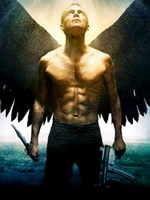 One of the things I didn’t actually report on in the madness of Comic-Con last month was the footage Sony unveiled for the upcoming religious horror flick “Legion,” starring Paul Bettany as an avenging angel of sorts assisting a stranded group of truck-stoppers after a legion of angels, having lost faith in humanity, descends upon the earth to bring about the apocalypse.
Sounds absurd. I know. But the trailer and footage they showed was so totally creepy and piqued my interest so that I made a mental “gotta check that out” note. A horror movie that effectively pits God as the villain? Sweet. Plus, I have a thing for Adrianne Palicki. What red-blooded hetero bloke doesn’t?
Anyway, the red band trailer is online now. Obviously not Oscar related in the slightest, but take a look after the jump and offer up your thoughts. The opening bit with Doug Jones is totally creepy, but it doesn’t hold a candle to the old lady later on…well, just check it out for yourself…
 It’s no shock that the first negative review of Neill Blomkamp’s “District 9” has come from the New York Press’s Armond White, chairman of the New York Film Critics Circle and all around crazy person when it comes to reviewing films.
I’m all for diversity, but seriously, there are times I wonder if White isn’t just out to be “that guy.” And I guess I’m not alone in those ponderings, as some folks are much more up-in-arms at the critic’s most recent review, taking to Twitter to blow off some steam.
Peter Sciretta of /Film film didn’t mince words. “Is there any way to get Armond White disqualified from the tomatometer for purposefully trying to upset the balance,” he asked. IC friend Dennis Tzeng of Think Hero offered similarly that White “should be taken off RottenTomatoes, because he’s not really giving his opinion he’s just being contrarian.”
Fox Searchlight gave People Magazine the exclusive on this new poster for “Amelia.” Unfortunately, the outlet couldn’t be bothered with including a link to a high resolution version (I imagine they received one), so the muted effect of the following image is the fanfare that greets last year’s Oscar victor’s 2009 awards season hopeful. Strike that. Searchlight sent over a high-res version:

 I’ll be posting my interview with “District 9” star Sharlto Copley later today or tomorrow, but in the meantime, I thought I’d pass along this Andrew O’Hehir interview with the film’s newbie director, Neill Blomkamp, over at Salon.
The piece is wide-ranging, moving from Blomkamp’s background in digital effects and advertising to Copely’s performance to racial issues raised in varrying ways by the picture. Indeed, one of the more obvious aspects of the film that taps into a grounded sense of human condition, and therefore helps the film to succeed as high science-fiction art among genre entries that largely miss such necessary nuance, is the parallel drawn between the ghettoized alien race of “prawns” and South Africa’s Apartheid system (the film is set in South Africa).
O’Hehir’s query turned into a nice springboard for Blomkamp to again discuss how important it was to set the film in Johannesburg, a perspective I haven’t properly conveyed in this space, despite the Comic-Con coverage.
When I posted the trailer for Richard Linklater’s “Me and Orson Welles” earlier today, I totally neglected to mention the following clip, which appears at the film’s official site:
 Things are slow today, so I thought I’d keep this conversation going. Jeffrey Wells has responded to Drew McWeeny’s piece about crotchety film critics calling foul on the American movie-going public (and the younger generation in particular). Click here for the background, then take a look:
McWeeny has argued against this, primarily, by playing the age card and describing what’s been written as the result of generational bias and illusion. The age-old “damn these kids!” phenomenon that every older generation has bitched about since the hey-hey day of the Greeks and the Romans, etc. Older farts do this so pay them no mind, etc. The title of the article is “Why do older movie critics suddenly want everyone off their lawn?” and the lead image is that of Clint Eastwood snarling in Gran Torino.
Playing the age card is easy, of course. Just point or allude to the ages of the people you’re disagreeing with and go “wow, crankheads!” and “these guys need to flush out their arteries” and so on. Throw in some patronizing attitude for emphasis and people your age and younger will buy it.
 It seems we’ve been waiting forever for Richard Linklater’s “Me and Orson Welles,” probably because the film and, to a greater extent, Christian McKay’s supporting performance as the legendary filmmaker stirred Toronto so last year. John (who will be covering the fest once again for us next month) was a big supporter of the film, calling McKays performance “miraculous” and that he had “never seen an actor portray this character with such confidence and authenticity.”
The film, considered by Roger Ebert to be one of the best movies about the theater he’s ever seen, revolves around a teenager (played by Zac Efron) cast in the Mercury Theatre production of “Julius Caesar” that Welles directed in 1937. You can check out the official site here. It features a hilarious quote from Ain’t It Cool News’s Quint: “That guy playing Orson Welles was genius!”
The film doesn’t have a US distributor yet (nearly a year since it went before audiences in Canada), but production company CinemaNX has put together a teaser trailer nevertheless. Unfortunately it focuses more on the presumed star appealk of Efron than it does McKay’s reportedly brilliant portrayal. Maybe a buyer will come a knockin’ before this year’s Oscar season gets too far gone. Check it out after the jump.
 Boy I really need to get on the ball when an idea crosses my mind these days. Earlier in the week, Guardian writer Paul Harris beat me to the punch on an article I was spinning around concerning Hollywood’s attraction to post-apocalyptic narratives as of late. Now HitFix’s Drew McWeeny has penned exactly the same kind of curious exploration of mainstream media critics’ views of the American film-going public that I was hoping to get to this week.
McWeeny nails it. In a nutshell, what the hell is it with the amount of hot air being blown by the self-important film criticism and journalism establishment toward audiences that have a right to go see what the hell they want lately? Roger Ebert, Jeffrey Wells (no surprise there), A.O. Scott and Patrick Goldstein have all recently tossed around the idea of a coming “dark age” of movie intelligentsia, arrogantly dismissed the preferences of American audiences, bemoaned an overall lack of interest in what critics have to say and, effectively, as McWeeny puts it, declared that you all get off their lawn.
I think there is a conversation to be had about American distaste in quality cinematic entertainment. I don’t think it begins with insulting working people with higher concerns than what to see on a Friday night, however. And I think the entire situation has pushed me that much further into an opinion I’ve held for a long time but never really had the guts to say in a public forum: Film criticism does not matter. Yours, mine, the next guy’s. It’s not precious, it’s not a commodity and it has slowly ruined the art of filmmaking by establishing a criteria of sorts and a hierarchy of perceived quality, boxing in what it sets out to celebrate.
I’m not claiming to know [Quentin Tarantino] personally either, but I know enough of him to assert that he simply makes the sort of movies he wants to see, and that the Hitchcock likening of films as “slices of cake” are more apt to his Tarantino’s filmography than any of that vitriol. He’s infectiously in love with the movies, he writes terrific dialogue and he does what makes him happy. You’re basically pistol-whipping a puppy when you so harshly attack a guy like that.
Commenter Robert Cameron, in response to yesterday’s item concerning a Jeffrey Wells skewering of Quentin Tarantino and “Inglourious Basterds.”
 • Kevin Kelly digs into the J.J. Abrams “Dark Tower” project. [Cinematical]
• In honor of “Julie & Julia,” 10 blogs that could be movies. [Film School Rejects]
• Liam Neeson walks his first red carpet since the death of wife Natasha Richardson. [Associated Press]
 indieWIRE has the full lineup for this year’s New York Film Festival, which runs from 25 September to 11 October, and at a glance, it looks remarkably like a greatest-hits lineup from May’s Cannes festival.
This year, both the NYFF’s opening and closing films have been plucked from the Croisette. Alain Resnais’s “Wild Grass,” for which the 87 year-old New Wave master received a special career-achievement award at Cannes, will kick off proceedings, marking the second year in a row that a French title has taken this high-profile slot.
Palme d’Or winner “The Class” opened NYFF last year en route to an Oscar nod. Whether a similar path awaits Resnais’s film, a high-flown romantic melodrama which was very warmly reviewed in Cannes, of course depends on what the French choose as their entry from a bumper crop of possibilities.
 It’s rather surprising that Philip Glass, arguably the foremost classical composer at work today (and, lest we forget, a three-time Oscar nominee), has never before been featured at The BBC Proms, the annual eight-week series of London concerts that essentially comprise the world’s largest classical music festival.
But good things do occasionally come to those who wait, and the 72 year-old Baltimore-born composer will finally get his first Prom tribute tonight at the Royal Albert Hall, as violinist Gidon Kremer reprises his original rendition of Glass’s signature 1987 Violin Concerto, while Glass’s 2004 Toltec Symphony will receive its first UK outing.
In honor of the occasion, The Times carries an interesting interview with Glass, as he talks through his early career (when he worked as a plumber to pay the bills, unbelievably enough), his four marriages, and his latter-day status as a doyen of the artform in multiple media.