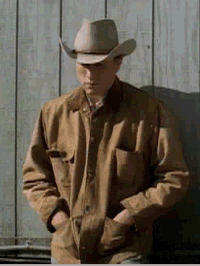
 2005 was the year of Heath Ledger’s beautiful, moving performance in “Brokeback Mountain,” which I saw for the first time in Toronto. It instantly became the talk of the festival, and the film became the one to beat for the Academy Award.
Ledger was astonishing as the taciturn cowboy who is more surprised than anybody when his soulmate turns out to be another cowboy, portrayed superbly by Jake Gyllenhall. If there is a more deeply felt moment in film history than Ledger gently adjusting Gyllenhall’s shirt at the end of the film, his eyes filled with tears, I don’t know what it is. That’s loss, that is absolute heartbreak, that is one of the greatest acting performances of the decade.
Phillip Seymour Hoffman would win the Oscar for his transformation into “Capote” and he’s very good, but just not in the same league as Ledger. I wondered from time to time if “Infamous” had been released earlier if Toby Jones might have won the Oscar instead of Hoffman. Each becomes Capote in a very different manner, and side by side it is difficult to choose the stronger portrayal. Certainly I prefer Hoffman’s as it is darker, and for me more realistic, but there can be no denying Jones.
 Let’s get this straight: an upset and an injustice are two very different things. When a nominee that isn’t widely expected to win beats one that is, that’s an upset. When a highly deserving underdog loses to a less deserving favourite, that’s an injustice. The latter arguably happens more frequently in Oscar history than the former, but that’s no reason to blur the line.

 I like the films of Oliver Stone, though I am acutely aware he tends to pound us over the head to get his message across, is known to bully his actors and audiences, and from time to time has bent history to suit himself and the film he is making.