In Contention

Tag: Julie & Julia

  • 7/21 Web Round-up

    Meryl Streep in Julie & Julia• The forthcoming release of “Julie & Julia” delays author Julie Powell’s follow-up book. [New York Observer]

    • Seth Rogen takes “Entourage” (which is slowly jumping the shark this season) and its creators to task. [Movieline]

    • Going to Comic-Con?  Download the official iPhone app. [Apple]

    (more…)

  • Finding trends in Oscar’s ten

    Ralph Fiennes in The English PatientOver at MCN, David Poland has offered his first formal Oscar column of the season (can we say “the season” in July?) and he has some strong points to make. Prediction junkies who just jump straight to his top 10 forecast for Best Picture will find some (delete according to taste) interesting/exciting/eccentric choices in the mix — he’s certainly the first pundit I’ve heard suggest that Michael Moore’s “Capitalism: A Love Story” is a frontrunner, while “Julie & Julia” hasn’t previously entered the discussion much either.

    But the column itself is of more interest, largely because he brings up a key (and I think under-discussed) point about the potential impact of a 10-nominee race: namely, that with such a broad field, it becomes much more difficult to pinpoint voter and industry trends from year to year:

    How will 10 nominees change the dynamic of desperate efforts to spin trend stories? How can it be The Year Of… anything with such inevitable diversity?

    It could, I guess, be The Year of Matt Damon, who has Invictus, The Informer!, the animated Miyazaki film, Ponyo, and maybe even Green Zone coming out. It could be The Year Of Not Bio-Pics, in spite of the Nelson Mandela film from Eastwood, Invictus, and Meryl Streep invoking Julia Child.

    Some will try to make it The Year of The Woman, with Nine leading the way for such hopefuls as Julie & Julia, Bright Star, Precious, An Education, Broken Embraces, the 2 SPC Coco Chanel movies, Amelia, Cheri, and even the female director of The Hurt Locker. And maybe they will have a point… there could be 5 nominations in that group.

    Or not.

    (more…)

  • 9/7 Web Round-up

    David Lynch• Jeffrey Wells offers his own mid-year assessment of 2009’s best and worst so far. [Hollywood Elsewhere]

    • How New Line mutated from house of horror to chick-flick central. [The Hollywood Reporter]

    • Memo to “Baywatch: The Movie” producers: it’s about the jugs, not the jokes. [The Guardian]

    • Too lowbrow for you? Here’s David Lynch on his unlikely collaboration with musos Danger Mouse and Sparklehorse. [Sight & Sound]

    • Apparently, Meryl Streep gained 15 pounds making “Julie & Julia.” Wow, she really does want that third Oscar. [Thompson on Hollywood]

    • Francis Ford Coppola talks movies, wine and why he wanted Scorsese to direct “The Godfather Part II.” Really. [Esquire]

    • An “Up” doubter (commercially speaking, anyway) eats his words. [The New York Times]

    • Not movie-related (yet), but a “Catcher in the Rye” sequel without J.D. Salinger’s involvement? Stop the madness. [The Wall Street Journal]

  • New Yorker semi-reviews ‘Julie & Julia,’ exalts Streep

    Meryl Streep in Julie & JuliaAs far as I know, Nora Ephron’s “Julie & Julia” is still under a reviewing embargo, but the New Yorker’s Ariel Levy has sneakily buried a brief, incisive critique of the film at the tail of a substantial profile of Ephron. (Thanks to Jeff Wells for pointing it out.) You’ll need a subscription to read the whole thing, but here are the juiciest bits on the film — which will no doubt please the numerous Streepophiles out there:

    The truth is, “Julie & Julia” is not a fair fight. For half he film we are in Paris with Julia Child played by Meryl Streep. It is pretty transcendent. For the other half, we are stuck in Long Island City, Queens, with the ‘lowly cubicle worker’ Julie Powell, a character who is immature, self-pitying, and frazzled (which is to say, an average human being). Powell is played by Amy Adams, who is a talented actress, but she is up against the queen herself.

    When Adams, as Julie, is on the screen, it necessarily means that Streep, as Julia, is not, and you come to resent her for this. It is possible that the film would not have worked if it were simply a biopic of Julia Child — that it derives its narrative thrust and commercial potential from the interplay between a young woman idolizing and relying upon Child in the more-or-less present and the splendid story of Julia Child’s past. Perhaps Child is able to emerge in this film as an almost mythical creature because she is presented in contrast to a mere mortal.

    But there may be another reason the Julia Child portions of “Julie & Julia” are so irresistably vivid and the Julie Powell bits feel a little flat. It is possible that Nora Ephron no longer understands half as well what it’s like to be ordinary as she understands being remarkable.

    (more…)

  • Passing prettiness

    Amy Adams As I’ve mentioned before, David Thomson’s trademark star profiles can exert a kind of car-crash fascination these days, the result of a once invaluable critic giving in to his shallowest impulses. Flashes of insight still show through on occasion, but the navel-gazing (and often inappropriate fawning) of his pieces can be hard to take.

    One of the things that has always distinguished Thomson’s analysis of actors is his preoccupation with physicality. At his best, this manifests itself as artful articulation of the intangibles of screen presence. At his worst, this tilts into ‘dirty old man’ territory, as in his repulsive “biography” of Nicole Kidman, in which he waxes lyrical over her breasts and pubic hair.

    This week, the object of his physical scrutiny is Amy Adams, and this time, his gaze is a lot less admiring:

    If Adams is a star now, she had better make the most of it. This may sound harsh, but she has the kind of look that could shift from trifle to pudding by the time she is 40. You may rise up in wrath and say that a critic is not supposed to make personal remarks about an actor’s appearance – but if you really take away that appearance, there is precious little to talk about in acting.

    Ms Adams is where she is now because of a kind of passing prettiness that carries no threat. By contrast, Reese Witherspoon, Emily Blunt and Natalie Portman all carry the promise of intelligence, character and something to say that will trouble many men and the kind of society that relishes passive, pretty girls. That a movie career can still be made out of meek sweetness is a measure of how little progress we have made.

    (more…)

  • ‘Julie & Julia’ trailer

    And with that, Meryl Streep’s journey to a Best Supporting Actress nomination is underway.  Unless, of course, the studio and/or producer Scott Rudin get greedy and take a stab at lead.  She’s certainly got the character down pat.  Here’s the teaser poster if you missed it.  And the trailer:

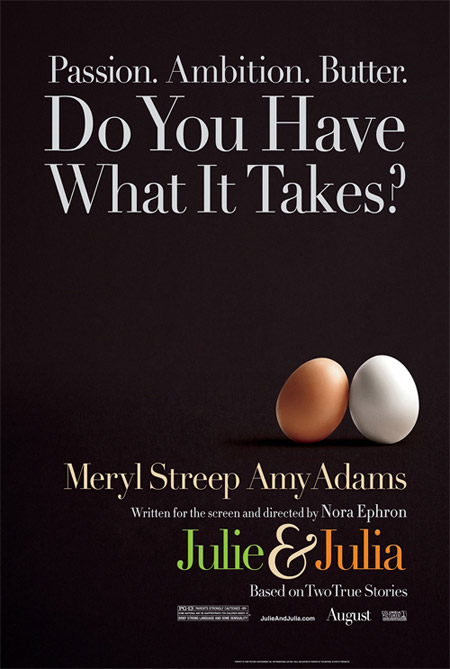
  • ‘Julie & Julia’ teaser poster

    I’m still hearing supporting from pretty much everyone on Meryl Streep’s awards hopes here, by the way.  One of three Scott Rudin projects that could find itself in the running this year (the others being “The Fantastic Mr. Fox” and the new Nancy Meyers flick — four if “Margaret” ever finds its way to the screen):

    Julie & Julia

    (Courtesy: First Showing)

  • TECH SUPPORT INTERVIEW: Alexandre Desplat

    Tech Support at In ContentionOver the last several years, Alexandre Desplat has gone from being a relatively unknown (in the United States anyway) French composer to emerging as one of the most acclaimed and sought after commodities in the business today.  Receiving his second Oscar nomination this year for “The Curious Case of Benjamin Button,” Desplat has continued to cement his place at the top of his field.

    Despite the acclaim, however, he remains very close to his home in European cinema.  “I have tried to keep as much of a relationship as I can with my French directors,” he says.  “I always try to go to do two or three French movies a year.  That’s a lot but I don’t want to lose that.”

    While there are certainly exceptions, there is definitely a difference in the manner that French and American filmmakers approach their work, Desplat says.  Being forced to think differently because of different filmmaking styles helps his creative resources.  “It feeds me,” he says.

    David Fincher’s “Button” posed unique challenges for Desplat.  “It doesn’t have a linear storytelling,” he says.  “It’s a complex puzzle and I’d ask myself, ‘How do you deal with this in music and deal with the main character when he is a passive character?’  It’s not easy to capture in music.”

    Describing the film as a “sound epic,” Desplat notes that the music had to be strong without being overly dramatic or imposing.  It was a crucial demand from Fincher that Desplat says he had to struggle with.

    The composer has worked with some of the world’s top directors in recent years – Ang Lee, Stephen Frears, Jacques Audiard — but despite Fincher’s unique perspective in the wake of those talent helmers, Desplat says certain professional similarities smoothed the journey.

    “He has an amazing quality as a collaborator,” Desplat says. “He’s very demanding but so am I so that’s fine.  He’s very detailed but so am I, so that’s also fine.  He wants his people to bring their own world, talents and colors into the film.  I think that’s the sign of a great director.  All the great directors I’ve worked with know that it is crucial that your creative energy is opened and not just restrained.”

    (more…)