In Contention

Tag: Elia Kazan

  • Fox and PBS open Scorsese’s ‘Letter to Elia’

    Reviewing “A Letter to Elia,” Martin Scorsese and Kent Jones’s loving documentary tribute to Elia Kazan, out of Venice on Sunday, I wrote that the 60-minute film was “clearly designed for a PBS-style TV airing.”

    Lo and behold, it was announced yesterday that the film, having been acquired by 20th Century Fox Home Entertainment, will premiere on PBS on October 4 — after having played the Venice-Telluride-Toronto-New York festival track.

    Furthermore, for those of us without the luxury of American television, the documentary will also feature in Fox’s 15-film DVD box set of Kazan’s work, due to hit shelves on November 9. I don’t know about you, but my Christmas list is being updated as we speak.

    Press release extract after the cut.

    (more…)

  • VENICE: ‘Potiche,’ ‘A Letter to Elia,’ ‘Robinson in Ruins’

    Hey, did you miss me yesterday? Don’t answer that. Sorry for the radio silence, but Saturday proved to be both my busiest and most rewarding day at Venice, serving up five films — none of them stinkers, and one of them perhaps my favourite of the fest so far.

    After capping the day’s viewing with a delightful pasta dinner in the company of two of Variety’s finest, I took the water-bus back to my San Marco hotel room in a pleasant fog of good feeling and red wine, only to find the wi-fi in my hotel room had taken the night off.

    As it turned out, it was just as well: today’s festival schedule being a lean and mostly unappetizing one, I rewarded myself with my first lie-in of the week (sorry, Tsui Hark) and began afresh in the morning. Late-night reviewing is fraught with hazard, anyway, as I’d learned the night before when I nodded off in the middle of writing up “The Sleeping Beauty.” (Before you say, “How apt,” let me remind you that there is no beauty in waking up at 5 a.m. with keyboard-face.)

    (more…)

  • Oscarcast nixes honorary awards

    Jerry Lewis accepting the Jean Hersholt Award at the 81st Annual Academy AwardsAnyone know the reason why the Academy is so restlessly change-happy this week? Not content with doubling the Best Picture field and potentially eliminating the Best Original Song category, they’ve also decided go ahead and cut all honorary awards from the March telecast.

    Instead, the hitherto irregularly awarded Honorary (AKA lifetime achievement), Irving G. Thalberg Memorial and Jean Hersholt Humanitarian Awards will be announced in September and handed out at a private dinner in November. AMPAS  president Sid Ganis explains in the press release:

    “For some years now, the Board has struggled to balance the desire to truly honor worthy individuals with the time limitations that the Oscar® telecast imposes on these honors … By creating a separate event for recognizing these outstanding people in the movie industry, we’re insuring that each honoree will be given his or her full due, without compromise.”

    (more…)

  • WEEKLY WRAP: ‘Invictus,’ ‘Bones’ and a billion remakes

    Matt Damon in InvictusSlipped my mind to do this on Friday, but better late…

    • We broke the news that Clint Eastwood’s upcoming Mandela film finally has a title: “Invictus.” (And if you’re wondering what it means, we explain that too.)

    • And with that, much “Invictus” talk ensued, as we learned that Eastwood directed the film at Morgan Freeman’s request, and that it’s going up against “The Lovely Bones” in December.

    • Speaking of “The Lovely Bones,” this week’s edition of Page to Screen put Alice Sebold’s bestselling novel under scrutiny.

    • Our slightly disappointing (to some, at least) poll of cinema’s most influential films entered its final stage.

    • With the news of a “Total Recall” remake the final straw, we got on Hollywood’s case for being so apparently allergic to original material.

    • This week’s list counted down the all-time greatest champs in the Best Foreign Language Film category. (Hint: The just-released “Departures” ain’t on it.)

    • We considered the wealth of female filmmakers in the mix for awards consideration this year.

    • A bit of respect for the great Elia Kazan.

    • “Up” stormed the box office, as we all knew it would.

    • Finally, in sadder, and much less expected, news, we said goodbye to actor David Carradine.

  • Elia Kazan sparks renewed interest

    Elia KazanSo many of today’s youth have not seen films made before the year they were born and they are missing so much. I remember being 18 and spending some time with my girlfriend at the time at her job, which allowed for me to get a lot of reading done. One of her co-workers expressed some surprise that I was reading Charlie Chaplin’s autobiography.  “Do you have to know everything about movies John?” Without hesitation I answered, “yes,” and still feel that way.  The great directors of cinema past and present knew as much as they could ABOUT cinema past and present.  Aspiring filmmakers should certainly take their cue.

    Once, while showing “Psycho” in my film history class, a student suddenly shouted, “Marcellus Wallace and Butch…man Tarantino lifted this,” and he was right. There is a scene in the film where Marion Crane encounters her boss crossing a street in much the same manner Butch encounters Marcellus in “Pulp Fiction.”  It’s small but I’m so happy someone in that class picked it up.  You have to know where you’ve been to understand where you are and, certainly, where you’re going.

    There is a retro-interest in Elia Kazan, the great director of the 1950s, that I find quite thrilling.  Known as a bi-coastal director, Kazan enjoyed great success in film as well as stage, helming some of the first productions of the greatest plays of the 20th century, including “All My Sons,” “Death of a Salesman,” “A Streetcar Named Desire” and “Cat on a Hot Tin Roof.”  He would direct the film version of “A Streetcar Named Desire” in 1951 to great acclaim.

    No other director before Kazan so understood the art of acting and was able to work with actors in the manner he did. He was among the first directors to make the actor part of the creative team, listening to his or her ideas and admitting when he had actually been wrong. It was unheard of for directors such as John Ford, William Wyler, Chaplin or Orson Welles to admit being wrong — they never were in their minds — but Kazan had no fear, believing the creative process allowed for error.

    Having been trained as an actor befor he became a documentary filmmaker, Kazan understood the actor’s process, but as a director he wanted to be more than just the sort of director who blocked talent; he wanted to work with actors to create something as realistic as possible. Though he started his career as a director with Method Acting guru Lee Strasberg, the two parted ways when Kazan began evolving the style. Kazan went off to direct with his new ideas about the Method and found great success, winning two Academy Awards, Tony Awards and in 1999, under the cloud of controversey, an Academy Award for Lifetime Achievement.

    (more…)
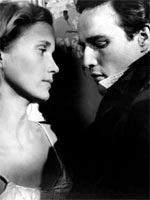
  • Revisiting the waterfront

    As Sunday’s Oscars bear down upon us with a measure of both inevitability and indifference, I can’t be the only one fed up of watching, talking or even thinking about certain 2008 nominees — even some of the ones I liked. The sooner we can begin putting some much-needed distance between ourselves and these films, the better, I say.

    So it was with great pleasure this evening that I plunged into the refreshing waters of both classic Oscar history and a different medium altogether — by going to see Steven Berkoff’s quite stunning reconceptualisation of Elia Kazan’s “On the Waterfront” on the West End stage.

    The source, of course, needs no introduction: Kazan’s searing 1954 study of corruption and violence amid the longshoremen of Hoboken boasts any number of immediately quotable lines, arguably Marlon Brando’s signature performance and, of course, eight Academy Awards. It remains, for me, one the Best Picture category’s finest hours.

    Turning such a flavourfully urban example of realist cinema into a heightened physical theatre exercise may seem a foolhardy task, but Berkoff’s interpretation is equal parts devoted tribute (Budd Schulberg’s original screenplay is transferred largely intact, while thumping jazz cues speak to Leonard Bernstein’s iconic score) and wildly stylised reinvention.

    (more…)