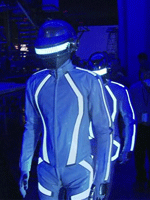
 For me, “TRON Legacy” is all about what you hear, and how you hear it. The team at Skywalker Sound did a hell of a job creating a dynamic and unique aural environment. In my opinion, it’s tops in both sound categories for the year.
So, naturally, I delighted in the SoundWorks Collection’s recent piece built around the principals on the crew, led by the likes of 13-time Oscar nominated sound re-recording mixer Christopher Boyes and supervising sound editor Gwendolyn Yates Whittle, herself a nominee last year for “Avatar.”
I’m holding out hope that the Academy at large can recognize this achievement over “Inception,” because it’s frankly a more involved and distinctive piece of work. Check out the SoundWorks Collection’s focus on the work, featuring interviews with Whittle, sound designer Steve Boeddeker and re-recording mixer Gary Rizzo, after the jump. (And yeah, there’s some Daft Punk talk.)
 Sound mixing has a lot in common with sound editing, but the distinctions are still critical. While both clearly relate to what we hear in the theater, sound editing specifically relates to the creation of artificial sounds (“sound effects”) while sound mixing brings everything together — from effects to music to dialogue (recorded on set or during post-production) to music – into the overall soundscape of a film.
 Last week we discussed how a movie’s soundtrack can be immeasurably improved by music. This week, we turn to the sound technicians. While next week will concentrate on sound mixing (the overall mix of effects, recorded sounds, dialogue and music), this week we look at sound editing, the creation of artificial sound effects to enhance a film’s aural impact.
 Now matter how many times I watch the Oscars, someone will always ask, “So what is the difference between the two sound categories?”
 This year marked the first year in recent memory that the Motion Picture Sound Editors offered up its list of nominees prior to the Oscar nominations announcement rather than after. Generally that batch of tea leaves is therefore elusive for those of us looking for indicators along the way.
 The year’s sound mixing category had relatively few surprises, just glancing at the tea leaves of the season. There was a typical 4/5 crossover between the Cinema Audio Society and the Academy, with