In Contention

Blog

  • WEEKLY WRAP: Newman remembered, Rudin/Weinstein, Foreign film race

    Paul Newman in HudAs we head into the weekend, here’s a quick overview of what we (and you) have been talking about at In Contention this week:

    • Kris paid tribute to the incomparable Paul Newman, as well as rounding up some of the man’s greatest performances.

    • As the Scott Rudin-Harvey Weinstein soap opera continues, Kris wonders where this leaves “The Reader” in the race.

    • John Foote contemplated the screen’s greatest leading ladies, past and present.

    • Matteo Garrone presented his red-hot foreign-language contender “Gomorrah” in London. I was impressed with the film.

    • Speaking of which, all the submissions for Best Foreign Language Film are in.

    • In the wake of a sensational new trailer, Apple takes a mouthwatering look at the tech credits of “Australia.”

    • Continuing the technical conversation, Gerard previewed the runners and riders in the Best Sound Mixing race.

    • Clint Eastwood scooped the first in what could be yet another run of awards for him this season.

    • And finally, in case you weren’t aware awards season has started, the people behind “Frozen River” and “Elegy” would like to remind you otherwise.

  • Peter Bart weighs in on ‘W.’

    Well, it isn’t really a review, but:

    Last week I saw Oliver Stone’s “W.,” an engrossing film which reminds us that the man who made “Platoon” hasn’t lost his edge. Part polemic, and part parody, “W.” explores the love-hate relationship between George Bush senior and junior.

    Alrighty.

  • Foreign film watch: all the contenders

    The race starts here. With the deadline having passed on Wednesday, 53 67 countries have submitted a candidate for the Best Foreign Language Film award.

    Now it’s all in the hands of the Academy’s notoriously obtuse foreign film committee. Under a new system aimed to avoid embarrassing exclusions like last year’s snub of “4 Months, 3 Weeks, 2 Days” and “Persepolis,” the committee will vote on a six-film shortlist, while a smaller executive panel will add three extra titles afterwards.

    Looking down the list of titles, there aren’t any glaring omissions so far — and it’s nice to see left-field festival successes such as “Tony Manero” (Chile) and “Eldorado” (Belgium) in contention. There is still the problem of the ‘one film per country’ rule which means exceptional films such as “Il Divo” and “I’ve Loved You So Long” can’t compete. From a personal perspective, I’m also a little disappointed to see only two African entries: I fully expected Ethiopia to submit the much-acclaimed Venice success “Teza,” but it wasn’t to be.

    As I’ve said before, making predictions in this category is nigh-impossible, but for the hell of it (and so you can jeer at my foolishness come January), I’m hazarding a guess as to what the nine semi-finalists will be. My predictions, and a full list of the contenders, after the jump:

    (more…)

  • SHORT TAKE: “Religulous” (***)

    Lionsgate Films\'s ReligulousI went into Bill Maher and Larry Charles’s “Religulous” expecting the usual close-minded schtick from Maher.  It seems the comedian is given to rational discourse on any topic except for religion where, indeed, it is the very notion of rationality that enjoys his full concentration.  He sticks his fingers in his ears and screams “La, la, la, la, I can’t hear you” and, for the most part, would prefer to relegate the subject to the extreme rather than see the gray area.

    To some extent, that is exactly what we get with “Religulous.”  Maher shoots fish in a barrel all across the globe, prejudice toward no specific faith; he runs the gamut.  Christianity, Judaism, Orthodox Judaism, Islam, all are accounted for.  But Maher does reach for a certain balance by kicking his journey off with a peek into his own religous background, which can go far toward explaining his detatchment from it all.  He was raised in a household that was 50 percent Jewish, 50 percent Catholic, and one that soon enough saw the error of organized religion.

    Maher finds a handful of level-headed practitioners of faith, from a kooky but understandably fatalistic priest outside the Vatican to a thoughtful, doctorate-holding Catholic who heads up an observatory and has plenty to say about the value of science.  But where Maher does his thesis of rationality a disservice is in his preference to go out and shoot those fish in a barrel rather than spend some more time exploring the thoughtfulness of these individuals .  It is clear their screen time serves only to buttress his account in some small way, but he has no interest in the idea that they, too, have a level of faith that deserves respect.

    It is, in many ways, the same frustration that played itself out on his program a few weeks ago, and here, it is prevalent throughout.

    But “Religulous” is a fun movie.  There are plenty of insane believers out there and for the most part, they have claimed a considerable ownership of this country’s progress.  As Maher said when he earnestly introduced the film to a modest crowd in Century City on Wednesday, we need to take our country back from these people.  There is something to that, even if he carries the reverse fire-and-brimstone over the top as his film concludes.  The attempt was noble, even if somewhat in the vein of expectation.

  • The evolution of the actress, part two

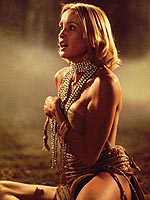
    Jessica Lange in King KongThis is the second of a two-part study of legendary screen actresses through the years.  Click here for part one.
    Diane Keaton and Sally Field emerged at the end of the 1970s with strong performances that defined them as actresses of the future. Keaton won an Oscar for her kooky “Annie Hall” and became a regular performer  for Woody Allen. But she was also taking risks with other filmmakers, giving a darkly brilliant performance, for instance, in “Looking for Mr. Goodbar” as a promiscuous young teacher.

    Keaton gave a sublime performance in “Shoot the Moon,” a critically acclaimed box office failure, and was excellent in “Crimes of the Heart,” “The Little Drummer Girl,” “Marvin’s Room” and most recently, “Something’s Gotta Give.” Equally at home in comedy or drama, Keaton never ceases to amaze.

    Sally Field’s career is a bit more bizarre.  A two-time Oscar winner for genuinely brilliant performances, she truly arrived with “Norma Rae,” claiming all major lead actress awards.  Five years later she won again for a wonderful performance in “Places in the Heart,” which yielded the infamous “you like me” speech.  In the years since, she should have been nominated for “Forrest Gump,” but was not, and now she’s an Emmy Award winner on television. Easily miscast, though, Field can come across as too earnest in some roles, as she was in “Murphy’s Romance.”  But in the right material, she is terrific.

    (more…)

  • Bad…ass…

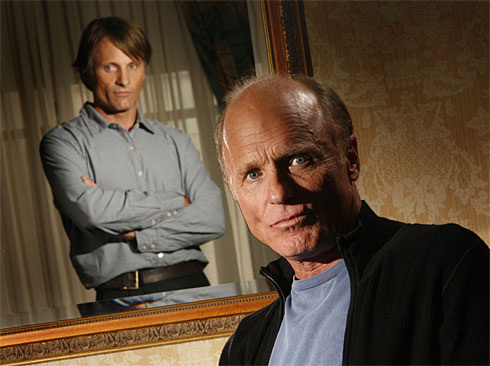
    (from left) Viggo Mortensen and Ed Harris

    From yesterday’s feature with Viggo Mortensen and Ed Harris at USA Today.  I think Ed is literally staring through my soul.

    Oh, and an FYI, keep an eye out later today for our interview with Jeff Beal, composer of “Appaloosa.”  Lots to chew on there from a nice 45-minute discussion last week.

  • 10/3 Oscarweb Round-up

    WALL-E• A clip from “Changeling.” [Oscar Watch]

    • And another. [The Envelope]

    • Or, if you prefer, the first five minutes of “Blindness.” [Yahoo! Movies]

    • David Poland breaks the news that “Che” will get its U.S. debut at AFI Fest here in Los Angeles — at the Grauman’s Chinese Theatre. [The Hot Blog]

    • Tom O’Neil makes it clear that “Elegy” screeners only went to the AMPAS acting branch. [Gold Derby]

    • Rounding up the 50 greatest animated films of all time.  Further into the tank for “WALL-E.” [Rotten Tomatoes]

    • Famous cameos.  I heart the first one on the list. [The Independent]

    • David Thompson chats it up with “Burn After Reading” star Tilda Swinton. [The Guardian]

    • Has Dirty Harry become anti-cop? [The Big Picture]

    • Ed Harris and Viggo Mortensen continue to make the rounds on “Appaloosa.” [USA Today]

    • Emily Parker goes head-to-head with a thoughtful Fernando Meirelles. [Wall Street Journal]

    • Glenn Kenny doesn’t care about what you don’t care about. [Some Came Running]

    • The Big Apple’s finest thespians. [New York Magazine]

  • Release date for ‘Nothing But the Truth’

    Yari Film Group has locked in the release date of December 19th for Rod Lurie’s “Nothing But the Truth,” hoping to cash in on the awards season on the heels of mainly positive reaction at this year’s Toronto International Film Festival.  My thoughts are here.

    In my opinion, the film’s best chances at nominations are Kate Beckinsale for lead actress and Vera Farmiga for supporting.  The former will have to duke it out in a tight category while the latter has the luxury of an empty one.  But hopes are also high for Alan Alda’s prospects, who delivers the heart of the film in a quality monologue in the third act.

  • I don’t know about you…

    …I just hope it doesn’t look like a grizzly fighting a rabbit out there.  The last thing we need is grist for the empathetic mill.

    T-minus 32 minutes.

  • The evolution of the actress, part one

    Ellen Burstyn in Requiem for a DreamThis is the first of a two-part study of legendary screen actresses through the years.  Stay tuned tomorrow for part two.

    We often hear about the great actors in movie history: Brando, Nicholson, Duvall, Hoffman, Hackman, Washington, Freeman and DeNiro, men who advanced the craft into an art of the highest order.

    But what of the women? They have never really been taken seriously in Hollywood as trend-setters.  Historians have even documented the genuine shock by studio heads when they realized that a woman, Vivien Leigh, had carried “Gone with the Wind” for its more than three-hour running time.

    Leigh, Bette Davis and Katherine Hepburn were the greatest of classic Hollywood, and certainly Elizabeth Taylor’s astonishing performance as Martha in “Who’s Afraid of Virginia Woolf?” broke ground for women in terms of what they could portray on screen and get away with. A genuine movie star, Taylor gained a great deal of weight for the film and was willing to play down her stunning good looks in the name of her art.

    Brash and loud, vulgar and sexual, Martha was the greatest challenge of Taylor’s career, to which she responded with one of the cinema’s great performances. This was years before Robert De Niro in “Raging Bull,” which received substantially more attention. But all of the aforementioned actresses in one way or another broke ground for the fairer sex.

    (more…)

  • TECH SUPPORT: Best Sound Mixing — Volume One

    Tech Support at In Contention“Wait a minute, wait a minute.  You ain’t heard nothing yet!”

    Those words from Al Jolson forever changed filmmaking in 1927, ushering in “talkies” and bringing about the beginning of the end of the silent film era.

    The Academy Award for sound mixing recognizes the artists who fashion a film’s audio side.  It must be distinguished from Best Sound Editing, which is the integration of artificially created sound effects into the mix.  Mixing is the blending of those effects, along with dialogue, music and any other noise captured during filming.  The Oscar awards the sound re-recording mixers in this category, who do the blending, as well as the production sound mixer, who captures the sounds on the set.

    Blockbusters, action flicks, war films and musicals usually do particularly well in this category, given the extent to which the sound tends to draw attention to itself in these sorts of films.  It’s somewhat difficult to project the category this far in advance, however, as the sound mixers for many of the films are difficult to pinpoint; mixing is one of the last tasks done on a film.  But that’s not going to stop me from trying to handicap potential contenders!

    Jon Favreau’s “Iron Man” is the sort of film that has virtually everything this branch normally goes for.  The film is filled with action and high-profile sound work.  Plus, it kicked off the summer blockbuster season with not only lots of dough for producers, but also lots of raves from critics.  Veteran Oscar winner Christopher Boyes is in charge of this crew.  I’d say a nomination is quite likely.

    (more…)

  • Edward Zwick gets some ShowEast respect

    Edward Zwick on the set of The Last SamuraiThe press release, in part:

    Academy Award® winner Edward Zwick has been selected to receive “The Kodak Award for Excellence in Filmmaking” at the 2008 ShowEast convention in Orlando, it was announced by Mitch Neuhauser, Co-Managing Director of the convention. Zwick will be on hand to receive this honor at the ShowEast Final Night Banquet and Award Ceremony on Thursday, October 16th at the Orlando World Center Marriott in Orlando, Florida.

    “Edward Zwick is one of the most talented and respected multi-hyphenates working in the film industry today,” noted Neuhauser. “Not only is he an accomplished filmmaker in American cinema, but he is also a veteran of television, responsible for some of the most groundbreaking shows of our generation, and he frequently juggles movies with television as he works. From a film standpoint, Edward Zwick’s body of work is diverse, accomplished and acclaimed and to be able to honor him at ShowEast this year is truly a great privilege.”

    Zwick has been getting more and more press leading up to the fall release of “Defiance,” which was announced last month as the closing night gala of the AFI Fest here in Los Angeles.

  • Page to Screen has officially closed

    Sorry for the column to go out with a whimper like that, but the more things piled on, the less time I had to read William Monahan’s “Body of Lies” and offer up the final column.  I’m seeing the film on Monday, so by now it’s a bit moot, so I just wanted to note that this season of Page to Screen came to a close with Brian’s review of Peter Buchman’s “Che” two weeks back.

    I’m thinking about revamping the column next year, perhaps taking it back to it’s source material commentary roots (a concept that has been lifted elsewhere in the interim, as we went the script review route for the last two years).  But I’ll cross that bridge when I come to it.

    We hope you’ve enjoyed the reviews and gathered some helpful insights along the way.  If you want to read back over our series of seven screenplay reviews this season, have a look here.

  • Vantage Guilds goes live

    VantageGuilds.comParamount Vantage has proven year in and year out that it has a commitment to all of its Oscar hopefuls, from the most recognizeable of stars to the most obscure craftsmen, via the Vantage Guilds website.  This year’s rendition has finally goes live and it shows a lot of promise.

    At the moment it’s just trailers for the studio’s three contenders (and I bet three is a welcome reduction from the slates of recent years over on Melrose).  Soon enough there will be features on costume design, screenplays uploaded, scores to listen to, etc.

    Check out the early stages here.

  • REVIEW: “Gomorrah” (****)

    IFC Films' GomorrahThe title “Gomorrah” is at once metaphorically apt and tonally misleading. In referencing the Biblical city destroyed by God for its sinfulness, Roberto Saviano’s best-selling non-fiction posited its own setting, Naples, as some kind of present-day equivalent.

    A city ruled and consequently ravaged by the Camorra, the notoriously brutal crime syndicate that has reportedly been responsible for over 4,000 deaths since the 1970s, it is also suffering for its sins — though in this case, the destruction comes entirely from within.

    The weightiness of the Biblical allusion, however, implies a fire-and-brimstone subjectivity that is refreshingly absent in Matteo Garrone’s thrilling remixing (adaptation is too cautious a word) of Saviano’s book. Marked alternately — and, in its best moments, simultaneously — by jolting violence, poetic kitchen-sink realism and blacker-than-black humor, this is first and foremost a work of social observation.

    As he repeatedly emphasized in his recent Q&A at London’s ICA, Garrone is more concerned with truth than tract.  Though the film lays the grim consequences of organized crime bare for all to see, his primary interest is in how such horrors complicate the everyday lives of those who live within and without the Camorra’s snare.

    The film’s social consciousness and dense, initially disorienting multi-narrative structure has earned comparisons with such recent crime sagas as “City of God” and “Traffic,” though it’s not as cinematically self-aware as the former, nor as narratively diagrammatic as the latter. (Neither term is meant pejoratively.)

    Garrone instead cites neo-realist doyen Roberto Rossellini as a key influence, and this provides a far clearer reference point: Garrone may have far busier story material here than exists in “Paisan” and “Open City” combined, but he shares Rossellini’s most academic qualities as a filmmaker, patiently following his characters through everyday domestic exchanges, and noting the physical and social textures of his story world with an anthropologist’s eye. In doing so, he further mines territory initially opened by such works as “The Sopranos” to offer up the least glamorous Mafia film ever made.

    (more…)