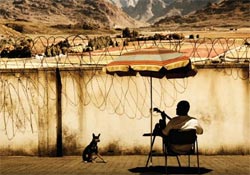
 “As long as one is alive, one is all right.”
These words, spoken with pithy irony by John Malkovich halfway through Steve Jacobs’s brilliant, bruising adaptation of J.M. Coetzee’s novel “Disgrace” — which opens Stateside tomorrow — encapsulate a post-apartheid South Africa more riven by crime and inequality than the bandages of democracy can cover. It’s a world where survivor’s grief is constantly chased by the threat of a more fatal occurrence; where, with no commodity more valuable than security, ugly human compromises must be made.
Published in 1999, Coetzee’s novel was a well-aimed bullet to the heart of a nation still negotiating its social and racial prejudices, laying them bare with few pointers towards reconciliation. Denounced as racist in some quarters of the ruling African National Congress, it doesn’t cast any social group in a particularly flattering light. Rather, it focuses on individuals, and the very different ways they manage their escalating mistrust of the other.
The story’s dependence on the country’s multi-splintered cultural differentiations makes the outside-in achievement of Australian director Jacobs (and his wife Anna Maria Monticelli, who wrote the screenplay) all the more miraculous. I can’t recall another feature film that so tangibly evokes the country that I grew up in, from its point-on account of lingering (and shifting) master-servant acrimony to minute details of production design.
Coetzee may be the world’s greatest living writer, but but his prickly, interior prose is a challenge to enliven with overdramatizing. Jacobs and Monticelli have enough confidence in the power of their material to keep the film as quietly oblique as its source: although the narrative hangs on two major misfortunes, the bulk of the drama concerns the mostly unexpected ways in which characters respond to them, caught between external calm and internal rage.
In a startling performance that both accommodates his mannered terseness and undercuts it with hollowing desperation, Malkovich plays middle-aged Cape Town academic David Lurie, whose inscrutable, seemingly remorseless admission of an affair with a young bi-racial student loses him both his job and his social standing; aimlessly seeking a new start, he begins by visiting his lesbian daughter Lucy (newcomer Jessica Haines) on her remote Eastern Cape smallholding.
Father and daughter enjoy a tacit mutual understanding until suffering a violent attack at the hands of a gang of local black youths, upon which their conflicting impulses to avenge and tolerate the crime force their differences into very sharp relief, as Lucy’s ambitious black co-landowner Petrus (Eriq Ebouaney) looks to mine this vulnerability.
With a meticulous accent and shorn blond locks, Malkovich offers one of his most fascinating portrayals as a man driven so long by his own desires that his capacity for empathy has been severely curtailed; infuriatingly implacable on the surface, Malkovich gradually unwraps Lurie’s insecurities to alternately moving and frightening effect.
In a just world, Malkovich would be leading the pack of Best Actor contenders, but still the true revelation of “Disgrace” is Haines. Taking a role lobbied for by Cate Blanchett, the young South African matches Malkovich scene for scene, locating, and then remasking, the fear and weariness in Lucy’s gentle speech patterns and pragmatic demeanor. Her scene in the immediate aftermath of the attack — caught between paralyzing shellshock and practical domestic concerns — alone merits awards attention.
Some will find “Disgrace” a difficult sit, though its exquisitely judged conclusion allows flashes of healing amid the despair. Coetzee himself once stated that South African artists are “burdened by too much reality,” which may or may not be why it’s taken a pair of outsiders to bring his most seminal work to screen. Either way, their remarkable take on “Disgrace” proves reality a most beautiful burden.
Comments
10 responses to “SHORT TAKE: “Disgrace” (***1/2)”
Great review of a truly great film. I loved it, it hit me, it made me emotional, it made me really think about what it had to say.
Malkovich is truly amazing and his scenes with Haines are indeed amazing. I absolutely agree both should be big players in the upcoming Oscar race. Hell the whole film deserves to be up there with the 10 BP’s.
South Africa looks like the country of the year in American film: District 9, Disgrace, Invictus…
This is an excellent review. I didn’t know you grew up in South Africa, Guy.
Yep, Johannesburg-born and (mostly) raised.
Bill,
Don’t forget “Skin,” too!
South Africa offered Lara Logan and Charlize Theron to the world as well. Thank SA for that !
I loved this movie – it’s hard to believe it’s actually an Australian movie with South Africa depicted so vividly.
A very interesting movie. I think Jessica Haines and John Malkovich are amazing.
Yes, yet another example of the amazing cinema Australia has produced this year. Such a good movie and Malkovich is phenomenal.
Hmm, I trust your opinion Guy but the trailer for this was a god awful mess.
The trailer is a little all over the place … it makes the film look a lot more cluttered than it is.