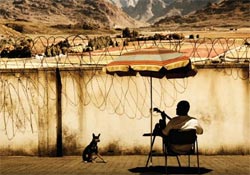
 “As long as one is alive, one is all right.”
These words, spoken with pithy irony by John Malkovich halfway through Steve Jacobs’s brilliant, bruising adaptation of J.M. Coetzee’s novel “Disgrace” — which opens Stateside tomorrow — encapsulate a post-apartheid South Africa more riven by crime and inequality than the bandages of democracy can cover. It’s a world where survivor’s grief is constantly chased by the threat of a more fatal occurrence; where, with no commodity more valuable than security, ugly human compromises must be made.
Published in 1999, Coetzee’s novel was a well-aimed bullet to the heart of a nation still negotiating its social and racial prejudices, laying them bare with few pointers towards reconciliation. Denounced as racist in some quarters of the ruling African National Congress, it doesn’t cast any social group in a particularly flattering light. Rather, it focuses on individuals, and the very different ways they manage their escalating mistrust of the other.
The story’s dependence on the country’s multi-splintered cultural differentiations makes the outside-in achievement of Australian director Jacobs (and his wife Anna Maria Monticelli, who wrote the screenplay) all the more miraculous. I can’t recall another feature film that so tangibly evokes the country that I grew up in, from its point-on account of lingering (and shifting) master-servant acrimony to minute details of production design.
 As I’ve said
 With the Toronto festival