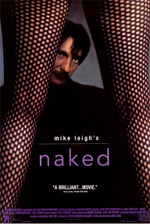
 I’m pleased that at least one person correctly identified Tuesday’s mystery quote (despite my initial absentminded misquoting) as coming from Mike Leigh’s 1993 film “Naked,” a brilliant, bruising urban portrait that still stands, for this writer, as the auteur’s finest film to date. It won Leigh and lead actor David Thewlis richly deserved awards at Cannes, though unsurprisingly, its talkiness (the film is less a narrative than it is a series of ingeniously constructed conversations) and unrelenting pessimism never really caught fire with audiences, least of all Stateside.
Incredibly, it is only this week that the film has been released on DVD in its home country – a move that, however overdue, at least cunningly coincides with the local DVD release of Leigh’s latest, “Happy-Go-Lucky.” Bringing them out simultaneously is a clever move, not least because the films complement and inform each other so nicely. Very much two sides of the same coin, the films examine the fragile moods and tensions of middle-class London society through the eyes of two protagonists (dissolute bum Johnny in “Naked” and cheery schoolteacher Poppy in “Happy-Go-Lucky”) poles apart in terms of perspective and ideology.
Watching the films together, as I did back in April (thanks to the wonder of VHS), puts into quite striking relief the changes (physical, political and sociological) that Britain and its capital have endured in the space of fifteen years. Some would say the contrast points to a change in Leigh himself, though I’m not so convinced – partly because “Happy-Go-Lucky” isn’t as optimistic in its worldview as the title suggests, and partly because “Naked” was preceded by the infinitely warmer and gentler “Life is Sweet,” the closest tonal match for the new film in Leigh’s oeuvre. Like any artist, the man’s moods don’t follow a regular arc.
Anyway, the re-emergence of “Naked” has prompted two rather nice interview pieces in the last week. The Guardian spoke to both Leigh and Thewlis, and a number of interesting anecdotes emerge from the conversation. Fresh analysis of the film itself is scarce – Leigh is notoriously cagey about discussing his process or his work, as I learned first-hand at the London Film School – but we are given some nice insight into the workings of Leigh’s famous workshop style of character creation:
I started thinking about the millennium and the end of the world. In 1992 the millennium was impending, so I brought that idea to the film … (But) with all of my films, the idea bears only a little relation to the finished film, which is always a character-driven drama. What always happens is that I’ll get an actor to come along, and I’ll say: ‘I can’t tell you what the film is going to be about, but we will collaborate on the creation of a character.’ Some actors run a mile.
Thewlis responds with:
When we first met for “Naked,” Mike asked me to list men I’d known or met and to tell him everything about them,” Thewlis says. “I told him about 150 different people. Mike asked of each one: ‘Does he drive? When did his parents die? How does he prefer to have sex?’ And then you narrow the list down. It’s like a beauty contest, and by the end of it I was rooting for the guy we chose, because I knew that I could do something with that role. But I also remember thinking, ‘Jesus, not him,’ because there was a lot of darkness there, which I knew that for the next eight months would be my life.
Many more fascinating nuggets besides – fans of Leigh would be well-advised to check out the full interview here. Meanwhile, Time Out London spoke to Thewlis, covering similar territory to the Guardian piece, with an extended description of Leigh’s directorial methods:
It’s very hard to explain Mike’s process. It would be interesting for a psychiatrist to sit in on his rehearsals because where your head goes is quite extraordinary. Without wanting to sound wanky, you feel like you’re channelling something. I remember coming out with stuff and not even thinking it. My mouth just said it.
There are very strict rules. You’re not allowed to come out of character, unless Mike says so, no matter what is happening, short of it getting too violent in a way that Mike may not realise.
And on the collaborative nature of Leigh’s “scripts,” such as they formally exist:
Most directors don’t work that way because they don’t need to. If you already have a script, you don’t need to do all that work. It’s said I was unhappy at not getting a writing credit for “Naked” but that was blown out of proportion. But, you know, the actors in Mike’s films contribute an enormous amount to what they say. And that’s not just me, but every actor who’s ever worked with him.
That’s no secret. Though it points to Leigh’s own peculiar genius, this does serve as a reminder of the abnormal level of challenge posed to any actor in a Mike Leigh film – they very literally have to build their characters from the inside out. It’s something I hope awards bodies bear in mind this year when evaluating the work of Sally Hawkins and Eddie Marsan in “Happy-Go-Lucky” – the performance goes far beyond the screen.
Check out the rest of the Thewlis interview here.
Comments
2 responses to “Revisiting ‘Naked’”
Oddly enough, I just saw “Naked” for the first time yesterday, so it was good to see recent discussion of the film out there. Of course I had no idea it hadn’t been released on DVD in the UK yet. It boggles the mind.
This is the first I’ve seen your blog, and I am enjoying it.
Welcome, Beverly – we’re glad to have you. Lots of good stuff to come as we head into awards season, so keep visiting.
Glad you’ve discovered Naked — hope you liked it as much as I do. Have you had a chance to see Happy-Go-Lucky yet? They really make a great double bill.