In Contention

Tag: David Thewlis

  • Cohen Media Group nabs Besson’s ‘The Lady’

    Everyone’s just been waiting to see who would pick up Luc besson’s “The Lady” out of Toronto, just for an excuse to go ahead and shuffle Michelle Yeoh over to the pile of likely Best Actress contenders. Yeoh stars in the film as Burmese opposition politician Aung San Suu Kyi and David Thewlis has a meaty part as her husband. Well, Mike Fleming reports at Deadline that a deal has been struck:

    The Oscar race just got a little more interesting. EuropaCorp has made a U.S. distribution deal with Cohen Media Group for the Luc Besson-directed The Lady…to release the film for an Oscar-qualifying platform release late this year.

    (more…)

  • Emmerich surprises with ‘Anonymous’

    I have to say, quite unexpectedly, I really liked Roland Emmerich’s “Anonymous.” I think it’s his best work yet. Having busied himself with matters of the apocalypse for the better part of two decades in films like “Independence Day,” “The Day After Tomorrow” and “2012,” it’s fair to say few would expect him to have something toned-down in him. So perhaps on one hand, lowered expectations play a hand here (despite the fact that, quite frankly, I very much enjoy Emmerich’s singular brand of entertainment).

    Regardless, the film is an elaborate piece of work (from an engaging screenplay by John Orloff), dense but rewarding, smart but entertaining, and Emmerich pulls it off without a hitch. In fact, while the effort is surely stylized, Emmerich gets out of his own way here, leaving no real trace of his typical leanings — anonymous, you might call the work. That’s impressive for a guy who has made his living basically just destroying the world on celluloid.

    (more…)

  • LIFE WITHOUT OSCAR: 1993 and 1994

    Catch up with the idea behind this series here.

    1993 was the year I first became interested in making movies and tracking box office. There are two words responsible for both and they rhyme with Yourassic Lark. The director of that beast would also helm our Best Picture winner that year, finally earning the Academy’s respect. I’m talking about Steven Spielberg and “Schindler’s List” of course, but if you ask me, “Jurassic Park” is the better film.

    Tom Hanks won Best Actor in both 1993 and 1994, becoming the first person since Spencer Tracy to take the prize two years in a row. I’d begrudge him the honor, but he’s just so darn likable. Honestly though, Denzel Washington should have gotten some love for “Philadelphia” too. This win marks the only time an acceptance speech was adapted into a movie (“In & Out”).

    1993 is also personally notable as the first time I had seen one of the Best Picture nominees by the time of the ceremony (“The Fugitive”).

    1994 was easily won by “Forrest Gump,” despite the presence of what IMDb users consider the greatest movie of all-time being in the mix. Really, IMDb users? “The Shawhsank Redemption?” It was also David Letterman’s one and only shot at hosting, which has been much-maligned but remains one of my favorite turns at the gig. Infinitely better than Whoopi Goldberg in 1993.

    Uma. Oprah.

    (more…)

  • PAGE TO SCREEN: “London Boulevard” by Ken Bruen

    When Oscar-winning screenwriter William Monahan (“The Departed”) brings Irish crime writer Ken Bruen’s 2001 novel “London Boulevard” to screen in his directorial debut, he won’t be adapting the text so much as returning it to its natural source.

    A short, sharp, deliciously black-hearted thriller that reads not unlike a readymade screenplay in its brisk, dialogue-dominated prose, Bruen’s novel makes its debt to Hollywood clear not only in its construction (brief, propulsive chapters of only a couple pages’ length resemble individual cinematic scenes) and its assorted winking namechecks of bygone films and stars, but in its very conception.

    The title – not a location (locals will know that there is no London Boulevard in the British capital) but a metaphor of sorts – is our first clue to what Bruen is up to: the novel is itself an adaptation, and Billy Wilder’s gothic Hollywood noir “Sunset Boulevard” is the source material.

    The novel’s allusions to the 1950 classic aren’t exactly subtle. Where Wilder’s film gave us Joseph C. Gillis, a destitute L.A. screenwriter who seeks shelter in the mansion of faded movie goddess Norma Desmond to escape the repo man, “London Boulevard” crosses the Channel, jumps a half-century forward, and replaces Gillis with Mitchell, a middle-aged ex-con who dodges the ghosts of his past (and his own compulsive criminal urges) by shacking up in the plush Holland Park pad of Lillian Palmer, a washed-up theater diva plotting her triumphant West End return.

    (more…)

  • Revisiting ‘Naked’

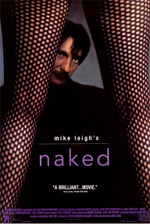
    I’m pleased that at least one person correctly identified Tuesday’s mystery quote (despite my initial absentminded misquoting) as coming from Mike Leigh’s 1993 film “Naked,” a brilliant, bruising urban portrait that still stands, for this writer, as the auteur’s finest film to date. It won Leigh and lead actor David Thewlis richly deserved awards at Cannes, though unsurprisingly, its talkiness (the film is less a narrative than it is a series of ingeniously constructed conversations) and unrelenting pessimism never really caught fire with audiences, least of all Stateside.

    Incredibly, it is only this week that the film has been released on DVD in its home country – a move that, however overdue, at least cunningly coincides with the local DVD release of Leigh’s latest, “Happy-Go-Lucky.” Bringing them out simultaneously is a clever move, not least because the films complement and inform each other so nicely. Very much two sides of the same coin, the films examine the fragile moods and  tensions of middle-class London society through the eyes of two protagonists (dissolute bum Johnny in “Naked” and cheery schoolteacher Poppy in “Happy-Go-Lucky”) poles apart in terms of perspective and ideology.

    Watching the films together, as I did back in April (thanks to the wonder of VHS), puts into quite striking relief the changes (physical, political and sociological) that Britain and its capital have endured in the space of fifteen years. Some would say the contrast points to a change in Leigh himself, though I’m not so convinced – partly because “Happy-Go-Lucky” isn’t as optimistic in its worldview as the title suggests, and partly because “Naked” was preceded by the infinitely warmer and gentler “Life is Sweet,” the closest tonal match for the new film in Leigh’s oeuvre. Like any artist, the man’s moods don’t follow a regular arc.

    (more…)