In Contention

Tag: Todd Field

  • Cormac McCarthy on adaptation and ‘The Road’

    Cormac McCarthyAs much as John Hillcoat’s filmization of Cormac McCarthy’s “The Road” didn’t work for me, I think it remains one title that could spring a surprise or two this awards season. Though the film has some high-profile detractors including Todd McCarthy and Roger Ebert, many have been profoundly affected by the film, while its prestigious cache is beyond dispute.

    Helping the cause is that Cormac McCarthy, the estimable author of the Pulitzer Prize-winning source novel, is fully behind the film.

    Today’s online must-read is an extensive Wall Street Journal interview with McCarthy, in which he discusses his own personal investment in the novel — much of which is directly inspired by his own relationship with his son — and the decade-long relationship between Hollywood and his writing.

    McCarthy has a healthily hands-off approach to adaptations of his work, bluntly stating that once the rights have been sold, “you don’t embroil yourself in somebody else’s project.” Claiming to have had confidence in Hillcoat from the outset, he goes on to say that the filmmakers “absolutely” caught the spirit of his novel.

    (more…)

  • SANTA BARBARA: ‘Truth,’ Winslet light up the town

    Kate Winslet receives the Montecito Award at the 24th Annual Santa Barbara International Film FestivalI’ll dig into individual film reviews in due time.  It’s been a slow start up here in Santa Barbara but the first two nights have been charming enough.

    Rod Lurie’s “Nothing But the Truth” gets better and better each time I see it, particularly where Lurie’s work as a writer is concerned.  Some beats are on the nose, perhaps too much for some people’s tastes, but I think he’s really developing as a filmmaker.  And the flick went over like gangbusters with the crowd at the packed Arlington Theatre opening night gala yesterday.  All the clever jokes found a home.  The performances caught their stride with the viewers, it seemed, and everyone seemed to be in tune with the film’s tight rhythm.  Most of all, the message seemed to settle (not surprising in a town this left of center), and that’s encouraging.

    Jeff Bridges and James Cromwell were among the A-listers who came out to celebrate the film, which has been all but smothered by an untimely Yari Film Group bankruptcy.  And the after-party at Paseo Nuevo up the street was slammed — too slammed.  But, as always, upstairs in a V.I.P. setting is the place to be, and that’s where Lurie and his sharp college-bound son yukked it up with Bridges and “Truth” star Noah Wyle, among others.

    Here’s my brief one-off on the film from back in September when it was playing Toronto.

    Tonight, Kate Winslet was in town to accept the Montecito award, becoming the first person in the history of the Santa Barbara International Film Festival to be awarded twice.  With that in mind, festival director Roger Durling took playful umbrage on stage with her remarks at the Golden Globe ceremony a week ago when she claimed she never wins anything.

    Film critic and historian Leonard Maltin sat down with Winslet for a two-hour conversation through her career that I frankly expected to be a bore, but it was a lively and candid chat.  Clips from her wide ranging portfolio were peppered in here and there, but the cutest moment came when the actress couldn’t stop chuckling at the “Titanic” clip.  “It’s so funny because I don’t see me and Leo playing Jack and Rose,” she said.  “It’s just me and Leo.  What are we doing there?  It’s so funny to me that we were in ‘Titanic,’ I don’t know how to explain it.”

    (more…)

  • Can ‘Revolutionary Road’ be too good for film?

    It’s a slow month for news, so I understand that film bloggers’ minds can wander. I sympathize with that. But even taking that into account, Jeff Wells’ recent post outlining his doubts over the upcoming ‘Revolutionary Road’ struck me as pretty tenuous. Wells’ essential argument is that the film’s stumbling block looks to be the sheer brilliance of Richard Yates’ source novel:

    The more formidable the reputation of the book that’s been made for the big screen, the greater the odds that the film will have problems of one kind or another. The motto, in short, is that it’s not the beauty of the prose but the strength of the bones that counts.

    Truthfully or not, fairly or unfairly, that’s the general belief. And given this, it’s hard not to feel a little queasy about Sam Mendes’ “Revolutionary Road,” the forthcoming Leonardo DiCaprio-Kate Winslet drama that’s based upon Richard Yates’ hugely respected novel about suburban middle-class malaise in the 1950s.

    In response, let me begin by offering offer a subjective, by-no-means comprehensive selection of exceptions to Wells’ stated theory – literary adaptations that are in equal proportion of greatness to their source material. “One Flew Over the Cuckoo’s Nest,” for one. “The Unbearable Lightness of Being” is another. “To Kill a Mockingbird” was okay, and “A Clockwork Orange” didn’t totally suck either. “The Grapes of Wrath,” “LA Confidential,” “Tess,” “Trainspotting,” “Kes,” “Howards End” … you get the idea.

    (more…)

  • INTERVIEW: Patrick Wilson

    Patrick Wilson’s star has steadily been on the rise following an on-screen debut in the 2003 mini-series “Angels in America.” Consistent work in John Lee Hancock’s “The Alamo” and Joel Schumacher’s “The Phantom of the Opera” have kept him in the game, but 2006 might be his year to really shine. Currently receiving considerable acclaim for his work opposite Kate Winslet in “Little Children,” the actor is entering a defining stage that could perpetuate that rise. I had the opportunity to sit and chat with Wilson while he was promoting “Little Children” at the Toronto International Film Festival.

    After earning a BFA at Carnegie Mellon University in 1995, Wilson, an unabashedly friendly and humble man, quickly made a name for himself as a stage performer. Only recently has he found his way to the film industry. Director Mike Nichols happened to catch Wilson in the Broadway production of “The Full Monty” in 2002, which inspired the filmmaker to cast him in the award-winning HBO mini-series, based on Tony Kushner’s revered play.

    “The transition from stage to screen was a smooth one,” Wilson explains. “Though for a while on ‘Angels in America,’ I did find myself asking the cinematographer where I should be in the picture. But I was fortunate enough to have an acting style already well-suited for cinema”.

    Though his segue from the stage to the big screen came relatively without fuss, Wilson admits considerable differences between the two mediums that remain striking.

    “With stage, you do it and it’s there. Watching ‘Little Children’ now, I’m seeing work I did a year ago”. The experience must certainly contrast with the immediate audience interaction he experienced on stage.

    Calling theater “the actor’s medium” with film being “the director’s medium,” Wilson praises filmmaker Todd Field for his work on “Little Children,” specifically admiring the editing of the film “to create a tension that was not there on the page”. And though acknowledging Field is obviously attracted to drama, he also says this was in many ways a departure for the director of “In the Bedroom.” “Some of the hardest laughs I have had came on the set of his movie,” Wilson reminisces. “Like Todd, I personally consider the film to be a satirical melodrama.”

    Satirical or not, “Little Children” boasts delicate subject matter that might have worked against the film without the proper care. While infidelity is surely an issue front and center in the screenplay (adapted from author Tom Perotta’s novel of the same name), the story also revolves around a convicted sex offender, portrayed in the film by former child actor Jackie Earle Haley.

    “I was never afraid of how the film would handle the subject matter,” Wilson explains. “Jackie was fantastic in the role. But even before that, Todd and Tom created a human out of a subject abhorrent and tough to watch.” And regardless of controversial elements, as he told the audience at the premiere the night before we spoke, “five, six, seven dynamic, intertwining characters is rare in a film.”

    Much of the buzz surrounding “Little Children” following showcases at the Telluride and Toronto Film Festivals has specifically been aimed at Wilson’s co-star, four-time Oscar nominee Kate Winslet. An actress Wilson acknowledges for continually taking roles to challenge herself, Winslet certainly has a clear trajectory for Oscar consideration once again. Wilson is clearly grateful for the opportunity to have worked with her on “Little Children.”

    “The great actors are the great actors because they want to become even better actors,” he begins, speaking fondly of his co-star. “We sat down together for several days before shooting started, getting to know each other and going over the script. Her dedication was infectious.”

    So where does Wilson hope to go from here? When asked if he has any desire for truly mainstream endeavors, his response is “a great part is a part. I go to movies all the time.” He also points out Russell Crowe’s Maximus, from Ridley Scott’s “Gladiator,” as being an example of a great role in what is clearly a mainstream movie.

    “I’m not at the top of the pecking order,” he continues. “Usually a role gets turned down before getting to me. ‘Little Children’ is the rare example of a director wanting me for the part from the get-go. But I’m fortunate that the opportunities I have had have been great ones. Some roles I have been intrigued by, and not been offered, have ended up being in less-than-great films. But I think I know where my strengths are.”

    No matter what roles Wilson ends up taking as his career continues to blossom – in film, television or stage – I have no doubt we’ll be seeing more of the already accomplished 31 year-old thespian in the future. Releasing this Friday and sure to make a mark on this year’s film awards season, “Little Children” could be that early turning point that keeps him on our radars for years to come.

  • REVIEW: “Breaking and Entering” (***1/2)

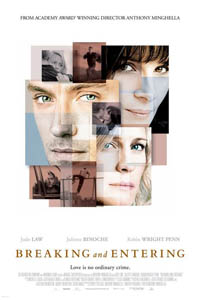
    The Weinstein Company\'s Breaking and EnteringAnthony Minghella’s “Breaking and Entering” is one of the most sincerely penetrating films of the year.  It’s most unique quality is the sense of legroom it provides, a healthy stretch of a film with deep breaths and drawn out considerations, as opposed to the typical anxiety of temperamental manipulation (which all film tends to be by nature).

    The film cannot be approached by the director’s past offerings, most of them over-reaching in their intentions and ultimately short of greatness as a result.  “Breaking and Entering” is not a masterpiece, but it certainly treads such waters as an honest and tangible portrayal of mid-life confusion and crisis.

    In the film, Jude Law stars as Will, a London architect and head of a somewhat unorthodox household.  He lives with his girlfriend of ten years, Liv (Robin Wright Penn), yet they remain unmarried.  The two are at that point in a relationship when the boredom of familiarity have finally given way to something else, something utterly lacking and altogether confusing.

    Together, Will and Liv have raised Liv’s daughter, Beatrice (Poppy Rogers), a behaviorally dysfunctional teenager very representative of the trauma Will and Liv’s emotional schism has imposed on the family.

    Will’s company has recently set up new office space in a seedy district of London.  After receiving a large shipment of computer components, the office is burglarized one night by a team of acrobatic youngsters.  One such child is Miro (Rafi Gavron), a Bosnian refugee living with his mother, Amira (Juliette Binoche).

    Miro lost his father before fleeing his homeland, and his own story is not an unfamiliar one, one of longing and despair manifested in his getting himself into frequent trouble with the authorities.  He now thieves for his dead father’s brother, perhaps to keep some sort of touch with his former, all but forgotten life.

    Amira, meanwhile, is as sick with worry as one can imagine.  Making ends meet as a seamstress, she frequently expresses disgust with Miro’s extracurricular choices, but overshadowing that disappointment is an unwavering love for her child.

    Binoche’s more playful scenes with Gavron are the emotional center of the film, representative of a spirited devotion and affection that seems missing from Will’s life, and a sham if ever apparent therein.

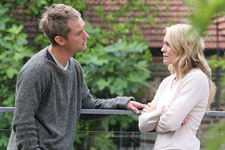
    Jude Law and Robin Wright Penn in Breaking and EnteringAfter a series of such robberies, Will begins staking out the building with partner Sandy (Martin Freeman) and an inquisitive prostitute, Oana (a humorous and insightful Vera Farmiga).  He finally catches Miro in the act one night, and in chasing him he follows the boy to his home.  There Will encounters, from a distance, Amira and her concern for her son.

    The moment is the beginning of an emotional whirlwind that will become increasingly confusing before clarity will be restored.  Will ultimately engages in an affair with Amira, perhaps searching for love as he later will claim to Liv, but more likely discovering a void to fill, one he cannot seem to fill at home.

    “Breaking and Entering” is an awakening experience.  At its core, the film is about honesty.  It is about being truthful to yourself, your needs, your desires, your love, your family and your impulses.

    Will is a man turned around and without direction.  His confusion is not his fault, nor is it his family’s.  It is our very nature to search out our boundaries and our limitations.  It is also our very nature to seek assurance in where we find ourselves.

    In that light, “Breaking and Entering” has much in common with Todd Field’s “Little Children.”  Both films speak to mid-life indecision and discomfort, and both films weave tales of lost souls finding their way back to their life roles.

    Jude Law’s performance as Will might be the greatest performance of the year.  It is a textured and nuanced turn that has a blistering emotional veracity.

    I would perhaps go so far as to call it his best work to date, but his is still a resume bursting with diverse portrayals throughout.  In “Breaking and Entering,” however, Law has tapped into the leading man potential he has only threatened in efforts such as “Cold Mountain” and the phenomenal “Closer.”

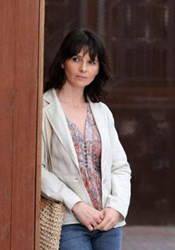
    Juliette Binoche in Breaking and EnteringJuliette Binoche is appropriately self-aware and headstrong in her performance as Amira.  Driven yet still full of the youth she had ripped from her through tragedy, Amira is an extremely interesting creation and a vibrantly unique character.

    No one has carried across beautiful and tired so capably since Meryl Streep in “The Bridges of Madison County.”  She also works quite beautifully off of the balanced anxiety and mother-love of Rafi Gavron’s performance.

    Elsewhere, Ray Winstone turns in a cheeky performance as investigating CID officer Bruno, while Martin Freeman’s brief stint as Sandy is further proof he deserves more roles with meat on them.  Poppy Rogers has some integral scenes as Beatrice, but if there is a weak link in the cast, it pains me to say it might be Robin Wright Penn.

    Some may find her emotional recoil fitting and appropriate, but something about the performance feels as though the actress doesn’t fully understand her character.  The work recalls Patrick Wilson’s ambivalence in “Little Children.”

    The technical aspects of the film deserve accreditation of the highest order, most especially Gabriel Yared’s piano-infused original score and Benoît Delhomme’s subdued cinematography.  Each element goes toward making the piece a truly unique experience, and certainly a unique Minghella experience.

    “Breaking and Entering” really feels like Anthony Minghella’s most personal and convincingly sincere film yet.  It boasts a lived-in quality making it feel like a story the writer/director has been playing over and over again in his head, perfecting every glance and sigh, tuning every emotional pitch to tonal superiority.

    From an opening shot bleeding subtext and sporting an initial narration more enlightening than most, it is a film and, more importantly, a screenplay, that commands respect and appreciation.  In a year exploding with accomplished filmmaking, “Breaking and Entering” fits right in.

  • REVIEW: “Little Children” (**)

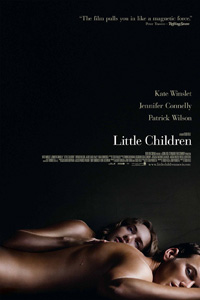
    New Line Cinema\'s Little ChildrenTom Perrotta’s novel “Little Children” is a visceral reading experience.  A smart and casually brilliant work of fiction, the author’s characters exude a demand for understanding and compassion above all else in a narrative flow that is forgivably meandering.

    Todd Field’s adaptation (co-written by Perrotta) in the form of New Line Cinema’s film of the same name keeps these crucial elements in tact during a transition to the screen, but the end result is sadly nothing approaching the exuberance of imagining Perrotta’s world in one’s mind.  Questionable directorial decisions and, at times, a tendency to follow too close to the tread of Perrotta’s novel (yet straying much too far when the need arises) ultimately hinder “Little Children” from the suburban poignancy it aspires to be.

    The story is one of contained souls desperate for alleviation.  Sara Pierce (Kate Winslet) is a mother of one, visibly bored with the life she leads.  Spending afternoons at a neighborhood playground with other mothers, representing varying degrees of personality disorder, Sara is the most homely of the bunch but the most irreverent all the same.  Her daughter, Lucy (Sadie Goldstein), humorously reflects her mother’s irreverence.

    Sara yearns for something more than the by the numbers set-up she has made for herself, along with husband Richard (Gregg Edelman), and this spark of disinterest makes itself visible in her consistent challenging of her acquaintances’ points of view, most notably lashing out intellectual artillery here and there on one of the typically bitchy, blonde-haired, blue-eyed sort.

    Brad Adamson (Patrick Wilson), or the “Prom King,” as he has been dubbed by the troupe of housewives, is equally confused about his life having turned out so tedious and passionless.  Having failed the bar exam twice and gunning for one more attempt in a do or die situation, Brad seems to be questioning not merely his desire to be a lawyer, but his desire to be who he is in any case.

    His wife, Kathy (Jennifer Connely), wears the pants in the family leaving him as the primary caregiver to an adorable son, Aaron (Ty Simpkins).A casual meeting of the minds between Brad and Sara will spark light in their lives they each had thought gone forever, each seemingly the answer to the other’s personal doubts and emotionally dire circumstances; Sara, the frumpy, bushy-eye browed scholarly sort, Brad the golden bodied, handsome former jock: a mismatch made in heaven.

    Meanwhile, Ronald James McGorvey (Jackie Earle Haley, who is likely to garner Oscar buzz for his performance), formerly convicted of exposing himself to a young girl, takes up residence in this otherwise quiet community with his mother, May (Phyllis Sommerville).

    The news shakes the neighborhood to the core, the anger visibly presenting itself in the form of former cop Larry Hedges (Noah Emmerich), who frequently harasses the McGorveys and defaces their property with various forms of propaganda.  Larry and Ronald have a delicate relationship, however, as a result, one reflective of the other’s inner turmoil in many ways, undoubtedly flawed humans each of them.

    Jackie Earle Haley in Little ChildrenAll of this could certainly be gleaned from reading any synopsis of Perrotta’s novel, and obviously, the makings of a brilliant film are quite apparent.  But somewhere along the way, “Little Children” lost its freshness.

    Todd Field’s directorial debut “In the Bedroom” in 2001 was a brooding dissection of the nature of revenge, hatred, anger and despair.  It seems to be territory in which the director is quite comfortable, as he takes Perrotta’s novel to darker levels than even the author might have intended on the page.  He builds layers into the characters that are vibrant, but at many times, rather unnecessary, and his adaptation (again, co-authored by Perrotta) ultimately takes the story to a place far too dreary for its own good.

    It is surprising that such an ending (which I dare not spoil) would have been deemed appropriate by the novel’s author, and the influence of Field’s darker tendencies seems to be the culprit of such a design.  In fact, Field makes a number of directorial decisions throughout that impede the process of the story’s conveyance.

    He chooses, for instance, to let his camera linger on his actors too long at times, capturing the awkward aspects of performance that are meant to be trimmed from a film product.  He allows over-the-top characterizations to go undeterred, the most notable case being Noah Emmerich’s over-acting every scene when he very clearly has the ability to relay his character in much more appropriate ways.

    The most disastrous decision was to employ the usage of a third party narrator, essentially reading the words from Perrotta’s page in a low, ironic voice.  Anyone will tell you narration is the mark of an amateur, sure, but the decision was made here to be somewhat humorous.  The effect is a maddening sense that the film is a work in progress with elements to later be filled in to satisfaction.

    The performances are, by and large, lacking in some form or another.  Whether it is Patrick Wilson’s apparent lack of understanding his own character’s motives (some might think this works for the part; I would disagree), Phyllis Sommerville’s questionable histrionics or Jackie Earle Haley’s awkward self-awareness, the actors seem to have what it takes, but apparently lack the guidance to reach that plateau.
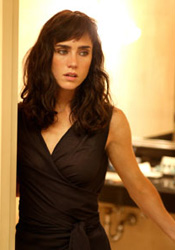
    Jennifer Connelly in Little ChildrenJennifer Connelly threatens depth with her character, though a sub-plot involving Kathy’s mother was largely omitted which might have helped in that regard.  Connelly is, as always, a beautiful and talented actress, but here she’s simply relegated to being a hottie.  The role doesn’t call for much else.

    Kate Winslet, however, is quite obviously incapable of poor acting.  Her performance as Sara is one of her very best to date and one of the most believable characterizations of her career.  Even surrounded by what feels like amateur night at a local acting theater, Winslet maintains a control over Sara that screams professionalism and artistry.  She has to be considered one of the greatest, most fearless actresses of her generation.

    Finally, Thomas Newman’s score is less derivative than normal, considering the source.  The music works to the film’s favor, organic and apparent all the same.  The cues recall his work in Sam Mendes’s “American Beauty,” in fact, a film of similar themes and characterizations.

    This comparison to Mendes’s film will be drawn over and over again as critics begin reacting to “Little Children” in the coming weeks.  However, while “American Beauty” ages quite poorly and never seems to retain the immediacy it boasted in 1999, it still remains something defining in a sub-genre that inherits a new entry every few years or so.  “Little Children” fits this mold of suburban despair, its characters clenching to their youth, and it also brings more valid and insightful aspects to the table.

    These are individuals discontent with their lives, but who travel hard and tiresome roads to discover they are in fact lucky to lead the subjectively boring existences they do.  It’s a beautiful theme that seems to be of a piece with the majority of film product this year, if one were to thoroughly examine various entries.

    However, the film is still an uneven exercise in frigidity, something Perrotta’s novel could never have been accused of.  Field is certainly an interesting director who is sure to continue creating unique character studies, but one can only hope that “In the Bedroom” was no fluke.  “Little Children” is something of a sophomore slump that I would still venture to say will be embraced by the critical masses.  It seems sometimes simply being unique is good enough, no matter how second-rate the artistry.