In Contention

Tag: Tim Robbins

  • SANTA BARBARA: Four Vanguards and a Virtuoso

    Christoph Waltz at the 25th annual Santa Barbara International Film Festival“Precious” star Gabourey Sidibe couldn’t be here last weekend for the Virtuosos presentation, which recognized her, Carey Mulligan, Saoirse Ronan, Emily Blunt and Michael Stuhlbarg, so she was in town this evening as part of the Vanguard presentation.  Stanley Tucci, meanwhile, couldn’t be here this week to accept his Vanguard prize, so he was here last week and filmed a video acceptance.

    They roll with the punches here in Santa Barbara.

    The four Vanguard award winners this year, which is the first year that saw more than one recipient, were Tucci, Christoph Waltz, Peter Sarsgaard and Vera Farmiga.  The award recognizes an actor (or actors) who has forged his/her own path, taking artistic risks and making a significant and unique contribution to film.

    It fits the quartet.  These actors has found their way to this point in their careers in baby steps, Waltz’s career actually the most extensive of the four, ironically enough, regardless of his new appeal in the states.

    (more…)

  • The Great Performances: 2003

    Sean Penn in Mystic RiverThere is little doubt in my mind I am going to take some heat this week, so let’s kick it off right away with my belief that Sean Penn deserved his Best Actor Oscar for “Mystic River,” a performance of overwhelming ferocity and staggering emotional power.

    Yes, I too loved Bill Murray in “Lost in Translation,” and would have loved to have seen him win, but he didn’t, and frankly he lost to a stronger performance (in my opinion). I know it is a cliche to say the nomination is the reward, but I would hope that Murray would be happy with that.

    But there were so many great male performances in 2003!

    Robert Duvall was superb in “Open Range” as the wily old rancher who ends up in a gunfight for his life with his friend, played by the also fantastic Kevin Costner, by his side. Tom Cruise gave a great performance in “The Last Samurai” for director Edward Zwick, while Russell Crowe was again brilliant in “Master and Commander: The Far Side of the World,” adding to his string of stunning performances.

    (more…)

  • Sean Penn might be the greatest living actor

    After writing my piece on the recent Best Actor winners and non-winners I was rather shocked at the number of comments on Sean Penn’s astounding performance in “Mystic River,” a performance I believe to rank with the best of Brando, Duvall, Nicholson and De Niro.

    I love debate, I love to talk film, and best of all I love debating the merit of performance as I studied method acting in the hopes of becoming an actor before I fell in love with film criticism.

    For the record, I was terrible, but remained fascinated by those who could do it, and Mr. Penn might just be the very best at what he does. Far too often his off-screen antics have over-shadowed his brilliant work as an actor, and while he has mellowed in his later years, he is still every bit as surly and rebellious as he ever was, though as a father and husband perhaps he understands the need for boundaries these days. I had the pleasure of interviewing Penn at the Toronto International Film Festival a few years back, and always believe that there should be no trace of the characters he portrays in his films for him to be judged a great actor. There were none. The person sitting across from me, relaxing when he seemed to know I was here to discuss acting as an art and craft, was not anyone I had seen on film, nor the hot-tempered photography beater of his youth.

    We all became aware of Penn in “Taps” back in the early 80s, but it was his hysterical turn in “Fast Times at Ridgemont High” that made him a star. I find it difficult sometimes to connect the actor who portrayed the doomed killer in “Dead Man Walking” and the deeply distrubed man in “The Assassination of Richard Nixon” to the actor who portrayed the goofy, sunny, surf-loving Jeff Spicoli. Pauline Kael said Penn had the sort of talent that bites you on the nose and she was not off the mark at all.

    (more…)

  • Clint Eastwood — anything he does grabs Oscar’s attention

    Let me begin with something very personal, something I prefer not to do in this column. Movies have not mattered much this past week, as my wife of 18 years, the love of my life was diagnosed with a malignant brain tumor. This Thursday we journey to Sunnybrook Hospital in Toronto to allow the finest surgeons in the country to go in and take the tumor out, with the hope she does not have to have chemotherapy or radiation. There is a chance I could lose her, and that I couldn’t bear. The past few days have been a blur, and yet it is her who urged me back to the computer, with a gentle, “You can’t let the movie writing stop because of this…please…write…” God I love that girl. She is at this moment snoozing behind me as I write this.

    Later this year we will see the release of “Changeling,” the latest from Clint Eastwood who over the last 16 years has become one of the finest directors working in movies. Now seriously, had anyone ever told me in the 70s that one day I would be celebrating the works of Eastwood the director by writing a book about him and his work, I would have laughed in their face at the thought.

    Dirty Harry, the man who acted with apes, becoming a world class director? Yet here we are in 2008 and Eastwood has won two Academy Awards for Best Director, twice been honored by the Directors Guild of America, and won countless critics prizes for his work. Revered by actors, beloved by the studios for whom he works, and respected by his colleagues, he has quietly risen to the very peak of the directing world, sitting alongside Steven Spielberg and Martin Scorsese. His films have the lean feel and look of the best work of John Huston and Howard Hawks to whom story was paramount.

    (more…)

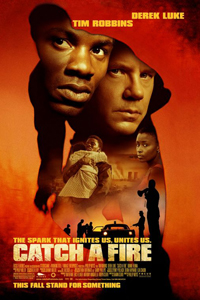
  • REVIEW: “Catch a Fire” (**)

    Focus Features\' Catch a FirePhillip Noyce has made a relatively stealthy career of tackling political subject matter without being a blatant mouthpiece for the issues with which he sides.  Endeavors like “Patriot Games” and “Clear and Present Danger” approached agendas from a more entertaining standpoint, both being based on Tom Clancy best sellers.

    Meanwhile, “The Quiet American” and “Rabbit-Proof Fence” were more specific and cultured in their perspectives of Vietnam and Australia respectively.  Now the director takes on the South African atrocity that was Apartheid in “Catch a Fire,” a film that seems too boiled down and ultimately resembling the shell of something much greater.

    “Catch a Fire” is the true-life story of Patrick Chamusso (Derek Luke), an oil refinery worker who witnessed a political awakening when his family was violated by government-sanctioned terror squads in 1980.  Misunderstanding him as a political enemy, the government created in Chamusso what they wrongly feared he might have been from the start: a driven and violent opponent of their racist regime.

    Under the guise “Hotstuff,” Chamusso joined a legion of freedom fighters led by collaborator Joe Slovo and wreaked havoc on the refinery that once employed him.  He was eventually apprehended and served ten years of a 25-year sentence, finally gaining passage back to his country when Apartheid disintegrated in 1991.

    The story is obviously a grand and epic one, yet the screenplay by Shawn Slovo (daughter of Joe), seems to be aiming for much more majesty than it ultimately reaches.  “Catch a Fire” actually feels like the first two acts of something larger and more cultivated, while various characterizations lie contradictory on the page.

    Nic Vos (Tim Robbins), for instance, is an immediate paradox.  Vos is presented as the anti-terrorist agent responsible for Chamusso’s apprehension.
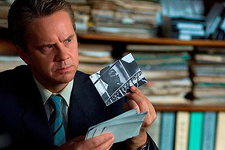
    Tim Robbins in Catch a FireIn the beginning, Slovo attempts to place a sympathetic face on Vos, a man who supposedly sees his prey as human beings above and beyond terrorists.  Early scenes with his family reveal Vos as the diplomatic sort.

    But as the narrative moves forward, the screenplay takes the easy route and Vos winds up considered a two-dimensional “monster,” in the words of Luke’s narration in the denouement.  The result is a rather unbelievable character all around.

    Chamusso’s wife, Precious (Bonnie Henna), also feels ill conceived as a woman ultimately pitted against her husband and responsible for turning him into authorities.  This honest and human frailty doesn’t come across, and a simple “I’m sorry” in the end, even matched with the power of Chamusso’s own personal apology for past wrongs and dishonesty, does not feel satisfying in the least bit.

    Noyce does make a number of directorial choices that are interesting, however.  There are many moments equally promising in majesty and purpose that feel like portions of another movie entirely, building suspense with creative editing and thematic resilience.

    He utilizes Ron Fortunado’s camera in specific and unique ways as well, capturing performances from striking perspectives with surprising style.  But on the whole, the director’s creativity seems oddly stifled.
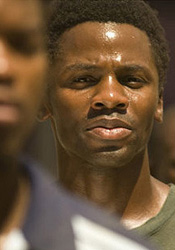
    Derek Luke in Catch a FireAs for performances, Tim Robbins feels terribly miscast in an underwritten role, while Bonnie Henna handles her own half-baked responsibility with a delicate ease.

    But Derek Luke is the real shining grace of the cast, proving that he is still one of the cinema’s best-kept secrets, waiting for a pivotal role in a special project that will place him on the A-list.  His layered and emotional portrayal of Chamusso lives and breathes on the screen as an efficacious representation, and likely the film’s solitary hope for film awards attention this year.

    If anything can be said of Slovo’s debut screenwriting effort, it is that she does a fine job of presenting a political awakening and qualifying that transition throughout.  Chamusso is a well-rounded character who has a very specific and thematic arc.

    But beyond her main character, the writer seems to push through the tale with reckless abandon, leaving a definite sense of want.  The script is certainly a labor of love, being based on recollections passed to Slovo from her father (to whom the film is dedicated).

    But labors of love can all too often blind the artistic eye to further potential or necessary restraint.  Such is the case with “Catch a Fire.”