In Contention

Tag: Stephen Frears

  • 2/5 Oscarweb Round-up

    New Boy• Patrick Goldstein, in a well-reasoned piece that even I — a dedicated Boss fan — can’t disagree with, says Bruce Springsteen “had to stoop to conquer” Sunday night. [The Big Picture]

    • Jeffrey Wells bizarrely reviews Best Live Action Short nominee “New Boy.”  Beware careless spoilers. [Hollywood Elsewhere]

    • Michael Cieply, reports on the on-going discussion of how to handle the Best Original Song performances, from a cost stand-point, of course. [The Carpetbagger]

    • David Carr, meanwhile, in addressing the Christian Bale situation, takes another swipe at “The Dark Knight.”  But he should really watch the film again and understand that the ending isn’t “unsatisfying,” but merely poorly integrated into the whole. [The Carpetbagger]

    • Speaking of Bale, Tom O’Neil wonders if the actor threw away his Oscar hopes for “Public Enemies” by shooting off at the mouth. [Gold Derby]

    • Dave Karger previews Saturday’s WGA awards.  “Milk” and “Slumdog” have it in the bag, right?  Anyone expecting an upset? [Entertainment Weekly]

    • Three weeks in the life of an Oscar ballot. [Little Gold Men]

    • David Fincher: “‘Benjamin Button’ was a semi-confection that became resonant.” [The Guardian]

    • Treading waters we were swimming through back when the film was set for a 2008 bow, Brad Brevet wonders if Stephen Frears’ “Chéri” is an Oscar contender.  Considering it’s Miramax’s best bet, then yeah, it probably is a contender. [Rope of Silicon]

  • Crikey

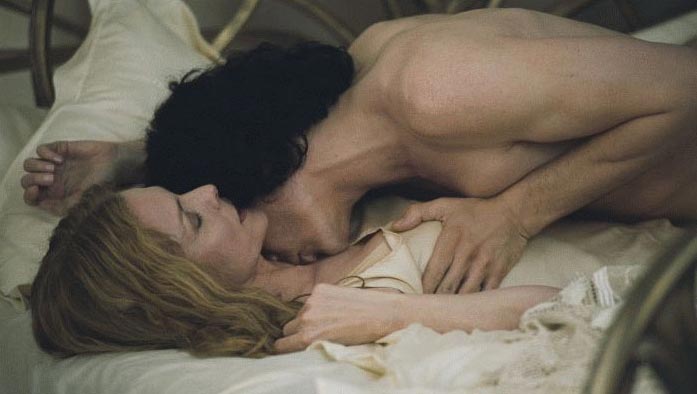
    Thanks to The Film Experience for pointing out this tease of a still from Stephen Frears’ Berlin-bound period romance “Chéri,” which promises something of a return to form for star Michelle Pfeiffer. (IMDB tells me she’s 50. You kidding me?)

    More stills can be found at this fansite, showcasing what looks to be predictably lavish production design and costuming by Oscar nominee Consolata Boyle (“The Queen”). Do we have a 2009 craft-category contender already?

  • Frears’ ‘Chéri’ to premiere at Berlin

    New works from Costa-Gavras, Bertrand Tavernier and Andrzej Wajda are among the 14 titles that have just been added to the Competition programme at next month’s Berlinale, meaning 25 of the 26 slots have been confirmed.

    The most high-profile inclusion, however, is Stephen Frears’ period romance “Chéri,” which was at one point mooted as a 2008 release with an eye on awards season, before getting bumped. It’s a film I’ve been excited about for some time, not least because it’s something of a “Dangerous Liaisons” redux, reuniting the director, writer (Christopher Hampton) and star (Michelle Pfeiffer) of that 1988 Oscar-winner, again within the context of a French-set costume drama.

    An adaptation of Colette’s novella about an affair between a young man and a decades-older woman in 1920’s Paris, it strikes me as an ideal proposition for both director and star. A new Frears film is always worth noting, but I find his work rather more interesting  when he’s visiting themes of taboo and desire (the aforementioned “Liaisons,” “Prick Up Your Ears,” “The Grifters”).

    Meanwhile, Pfeiffer — still, I think, arguably the greatest of her generation — hasn’t had a project equal to her gifts in over 15 years. Could this be one to keep an eye on for next year’s awards derby? It’s ridiculously early to be thinking about such things, but don’t forget that one of the big winners at last year’s Berlinale was a certain Ms. Sally Hawkins. However oddly positioned, it’s always a festival worth paying attention to.

    Among the other intriguing titles set to bow at the fest, which will be opened by Tom Tykwer’s “The International,” is “Rage,” the latest from avant-garde UK auteur Sally Potter, with an eclectic cast including Jude Law, Judi Dench and Steve Buscemi. Another impressive ensemble (Robin Wright Penn, Alan Arkin and Julianne Moore, to name but three) features in Rebecca Miller’s “The Private Lives of Pippa Lee,” while Lukas Moodysson’s “Mammoth,” starring Gael Garcia Bernal and Michelle Williams, has long been one of my most eagerly anticipated films of 2009.

    For a complete list of the Competition entries so far, check out the press releases here and here.

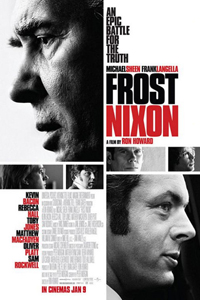
  • REVIEW: “Frost/Nixon” (**)

    Universal Pictures\' Frost/NixonLondon Film Festival

    For director Ron Howard and screenwriter Peter Morgan, “Frost/Nixon” was always going to be a tricky beast to handle. A film adaptation of Morgan’s own stage play that was itself very much about the powers of television, the relationship between text, medium and audience has shifted in ways I’m not sure the film’s makers have fully accounted for.

    It is one thing to portray a momentous televisual event on the stage, where the intimacy and crackle of live human interaction allows for a very different, and rather more immediate, experience of the proceedings. It is quite another to recreate said event for  television’s closer cousin — with the legendary interviews between David Frost and Richard Nixon that form the spine of the narrative widely available, the film has to recreate the spontaneous feel of history in progress, and in doing so, reveal something in a 30-year-old document that we haven’t already seen.

    It’s a tall order, and with Morgan’s script hewing closely to its source, Howard responds to it in the manner he knows best: with the most prosaic of visual aesthetics to hand, a doggedly linear approach to storytelling and the spotlight thrust squarely on a reliable pair of actors. The approach only gets him so far.  Howard’s hands-off direction makes for an oddly bloodless viewing experience, with a lot of talk standing in for any fresh perspective (or frankly, much of a perspective at all) on the events.

    To be honest, we could have seen this coming. It’s difficult to think of a director less-suited to take on the intricate, minutiae-obsessed writing of Peter Morgan than Howard — a director who, even in his finest films, has always been interested in the big picture first, with characters serving history rather than the other way round.

    (more…)

  • ‘Cheri’ to be released in 2009

    In response to the most recent Oscar update I received a note from Miramax publicity this afternoon, regarding Stephen Frears’s “Chéri.”  It seems the film is staying in 2009, narrowing the studio’s awards hopefuls to Mike Leigh’s “Happy-Go-Lucky” and John Shanley’s “Doubt.”

    The critically thumped “Blindness” is still lingering as a possibility, while Julian Jarrold’s “Brideshead Revisited” needs to overcome the widespread opinion that Evelyn Waugh’s novel has already been filmed definitively.

    As for the current Oscar charts, I’ll update them at some point this week to strike “Chéri” from the record.  Tell a friend.

  • ‘Happy’ season for Miramax?

    I’ve been meaning to write about Mike Leigh’s “Happy-Go-Lucky” ever since I saw it some three weeks ago, but I haven’t found a window until now. I’m off to Berlin on the weekend and I’d really like to get this off my plate before I leave, so amid all the packing, I thought I’d hammer out some brief thoughts.

    I’m never really let down by a Leigh film. Even his lesser efforts seem to exist on some simple but probing level that makes argument a fool’s errand. More often than not, his work sparks appreciation during the awards season, and he even managed a second Best Director nomination for “Vera Drake” in 2004, which surprised more than a few people.

    “All or Nothing” was one of my absolute favorite gems of 2002, yet it was ignored completely, while going back to the epic year in cinema that was 1999, we find perhaps Leigh’s most ambitious effort in “Topsy-Turvy.” Then, of course, there was “Secrets & Lies,” which captured the hearts of many in an Oscar year dominated by independent film.

    Leigh’s pre-“Secrets & Lies” work is a slightly different breed, but still fundamentally the work of the same artist and, at times, the same vision of the world. And he has come back to it with “Happy-Go-Lucky,” the shrewd observation of which Guy made in his April review of the film.

    Something feels even more off-the-cuff about “Happy” than Leigh’s recent films. There is an even greater sense of spontaneity and improvisation lurking between the frames that can be both exciting and off-putting, but the purpose is served throughout: bringing the audience into the devil may care world of a woman hell-bent on saving the drama for your mama.

    (more…)

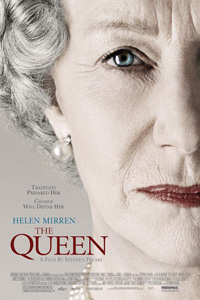
  • REVIEW: “The Queen” (***1/2)

    Miramax Films\' The QueenStephen Frears is one of the most versatile working directors in the industry.  With that versatility comes the inevitable misstep from time to time, sure.  But also with it comes a high order of professionalism and a certain amount of confidence that can manifest the most precise of cinematic creations.

    “The Queen” is just such a film.  Carefully calibrated and wound to a specific 103 minutes, it is a modest and fine hour for a director who has been cranking out work of the highest quality for over two decades.

    “The Queen” tells the behind-the-veil story of the days following Princess Diana’s tragic death in August of 1997.  As the world mourned the passing of one of the most important political figures of the 20th century, Queen Elizabeth II (Helen Mirren) and her family holed up in their Scotland compound, choosing to handle matters with restraint, dignity and in privacy.

    Newly appointed Prime Minister Tony Blair (Michael Sheen), with his sites set on modernizing the outdated government and bringing it back in touch with the people of the land, felt the decision to refrain from public access was detrimental to a country that desperately needed guidance and to share in the grief.

    The “black sheep” opinion the family had of Diana was an unpopular stance to say the least.  While they always saw her as a blight on the crown, the citizens of England saw her as the people’s princess, one of their own, and a woman unwavering in her desire to make the world a better place.

    Only a year divorced from Prince Charles (portrayed in the film by dead ringer Alex Jennings) when she died, Diana had endured public embarrassment after Charles’s well-publicized, long-term affair with Camilla Parker-Bowles.  Diana herself admitted to her own extra-marital affair as well, but it goes without saying, the marriage was an unhappy one.

    Hounded by the media and ultimately the most photographed person ever, Diana’s life was never her own.  That turbulent year was perhaps the most difficult for her in that regard and it might be too easy to say the media killed her in the end.  It may be more applicable to say the very nature of celebrity killed her, but regardless, even in death, she would rally the attention of a billion people who tuned in to view her public funeral (a festivity proposed by Tony Blair and fought against by the Royal Family).
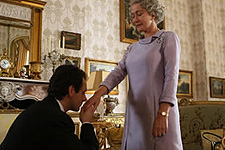
    Michael Sheen and Helen Mirren in The QueenThe relationship established between Elizabeth and Blair is a delicate one, and certainly a dramatic one.  It might be the oldest story in the book, but it is still one of the most relevant.  The clashing of policies is something the world will struggle with until we are no longer the dominant species.

    Blair’s progressive ideas about leading with the people, not ahead of them, was outlandish to the Queen and, most especially, to Prince Phillip (James Cromwell).  Those disagreements truly came to a head that week, and their focus was rightly on the well-being of William and Henry, two boys who lost their mother and should be shielded from the poisoning words of the media.  But as they retreated, their country grew impatient and, ultimately, aggressively disappointed.

    Dame Helen Mirren is absolutely irresistible in the role of Queen Elizabeth II (she ironically just won an Emmy for portraying Elizabeth I).  Though it is not the powerhouse, Oscar-lock performance that shatters perceptions and announces itself with determination, it is nevertheless a collected and well-maintained turn.

    The stiff upper lip of the Royal Family really is carried across well in this regard.  James Cromwell’s Prince Phillip is specific in his conservatism, while the humor of Charles’s paranoia provides a nice balance.

    As Prime Minister Tony Blair, Michael Sheen does a capable job of conveying a political figure who would become increasingly controversial himself.  Frears’s film hits a thunderous note in that light during a coda in which Elizabeth looks Blair square in the eye and tells him his country will turn on him, too, one day, “Quite suddenly, and without warning.”

    These are the delicate touches of meaning that go toward crafting an exemplary film.  The screenplay was penned by Peter Morgan, who also co-wrote the amazing adaptation of Kevin Macdonald’s “The Last King of Scotland.”  His work comes as a result of extensive interviews and information from discreet, informed sources inside the momentous event.
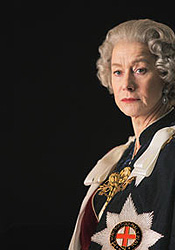
    Helen Mirren in The QueenStephen Frears does what he is best at in “The Queen.”  He steps aside and lets the story tell it self.  He has always been what I consider a “screenwriter’s director,” as he seems ever capable of letting the writer’s words play on the screen as they should.  He never leaves a fingerprint, other than the strong scent of competence that can be found even in his lesser efforts.

    He also handles the material without fuss, getting out of dodge when the work is complete.  You’ll never find a Frears film meandering or losing itself, and that’s a trait most directors never exhibit with such consistency.

    Though it revolves around an event that occurred nine years ago, and prior to the post-9/11 environment we endure today, “The Queen” is very much a current piece of filmmaking.  It is about the necessity for a leader to be in touch with his or her people.  It is about respecting tradition while understanding the need to extinguish it all the same.  It is about finding a balance and, if not maintaining that balance, at the very least striving for it at all costs.

    “The Queen” could be seen as quite applicable to our current domestic political environment, or it could simply be enjoyed as an airy, pleasant endeavor with no frills.  But isn’t it the best of cinema that finds <em>that</em> balance?