For the those rocking out an Oscar party this evening, be sure to print out your official ballot for a high stakes pool. (Thanks to Awards Daily for the tip.)
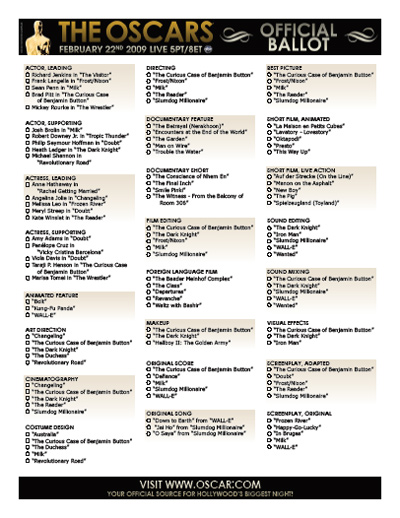
For the those rocking out an Oscar party this evening, be sure to print out your official ballot for a high stakes pool. (Thanks to Awards Daily for the tip.)
The Los Angeles Times wanted Tom O’Neil out and about and live blogging the Oscars as early as 11:45am this morning. God bless him…
Not long to go here, so I figured in the way of novelty I’d toss up a list of all 36 nominated feature films as I would personally rank them. Feel free to do the same with what you’ve seen, if you’re as bored as I am, that is:
1. “Slumdog Millionaire”
2. “Bolt”
3. “The Dark Knight”
4. “The Wrestler”
5. “The Curious Case of Benjamin Button”
6. “Trouble the Water”
7. “Vicky Cristina Barcelona”
8. “Revolutionary Road”
9. “Milk”
10. “Iron Man”
Anyone want to come clean on soft spots for this contender or that? Here’s just another space to get all of that off your chest. You all know who I’m pulling for, probably to a fault.
Alright, I figure I might as well open up a thread for everyone to really go on the record. If you haven’t already joined our Oscar poll, go do it. In the meantime, and maybe for those not participating in the poll especially, crank out your lists of predictions in the comments section below and we’ll see who was closest to the mark when the dust settles.
 Well, this is what it all boils down to. I almost DON’T want to go on the record, but I kind of have to, right?
Anyway, this is the first year I’ve actually seen every single nominated frame of film before the big night so these will either be the most educated guesses I’ve ever given or the most unfortunately influenced, one can’t be too sure. Sometimes it’s better to predict in a void, other times not. I did pretty good last year (after a wicked slump for a few years), largely because I succumbed to inevitability more than I have in the past, but I don’t want to be all douchey and put forth my record. We all have ups and downs. I’m not personally convinced of probably half of these predictions, so you certainly shouldn’t be either.
One thing that catches my eye as I go through my “will wins,” “could wins” and “should wins” is that in many cases, I’m predicting the contender that I also feel delivers the best work in the category. But really, only in one arena could that stink of hopeful expectation (Best Actor). The rest is just reflective of how this weak, thin season trickled down. I almost always have a different preference than what actually wins, so I wouldn’t call me the wishful thinking sort when it comes to hammering these out.
Anyway, you’ll find category-by-category analysis throughout, but I have to say, those sound categories are fuckers this year. Pardon the vulgarity. It seems there are limitless possibilities. I’m of the mind that one film takes both, so take your pick: “Dark Knight,” “Slumdog” or “WALL-E.” I think the Academy at large doesn’t understand the subtlety of “WALL-E” (much like “No Country for Old Men” last year) and giving “Slumdog” a clean sweep seems to be too much. But I’ll get into those categories, and more, after the jump.
There is a slight possibility I’ll stick my head back in here to adjust this prediction or that before Sunday. If I do, I’ll be sure to draw your attention to it in this space. Check back later today with a look at all out contributors’ predictions. For now, here are mine…
I have to say, it’s a stroke of luck that the most predictable Oscar race in some years at least happens to conicide with the most unpredictable Oscar ceremony. It’s as if Bill Condon and Laurence Mark knew that they had to pull out all the stops in reconfiguring the show to make up for a slate of nominees that could not have been more cautious. The few hints that have been dropped so far (including a radically altered stage design) suggest that, whether it sinks or soars, something very different is in store.
Pete Hammond has written an interesting piece in which he considers the information we have so far, and wonders what bearing this year’s ceremony might have on the Oscarcast’s long-term future. He acknowledges the canniness of Condon and Mark’s semi-veiled strategy thus far (suggesting, I suspect accurately, that the “leaked” news of Robert Pattinson and Zac Efron as presenters was in fact calculated to lure in younger viewers), and drops this tantalising bit of gossip:
Oscar director Roger Goodman has worked with the new producers the past few weeks. A friend who sat with him the other night at the Scientific and Technical Awards ceremony said Goodman was characterizing Condon as a certified genius.
OK, maybe this is a lot of hype. But … Oscar-nominated producer, Bruce Cohen said he had heard the same kind of talk. He mentioned that Condon and Mark had presented their plans for the show to the academy’s board of governors two weeks ago and the board was blown away. If you can wow this crowd, you must be on to something.
The Guardian’s Peter Bradshaw has rounded up a morbidly fascinating collection of the all-time most awkward performances by an Oscar presenter — a remarkable study in the multitude of ways in which one can fail at reading a teleprompter and opening an envelope with any semblance of panache.
They’re all fun in their variously excruciating ways (I love Jill Ireland’s thoroughly zombified reading of the 1973 Best Supporting Actress nominees), but I have to agree with Thomson that the most “cant-look-can’t-look-away” presentation is that of the 1972 Best Actor Oscar.
Of course, the moment is already infamous for Marlon Brando’s choice of proxy to accept the award, but even before we get there, classic status is assured by the surreal pairing of Roger Moore and Liv Ullmann to present — and their painful lack of chemistry together. Whatever has been lined up for Sunday, it can’t go worse than this. (Check out Bradshaw’s full list here.)
Any last words to the prognosticating voters who’ll be hustling their ballot to officials today?
So this is the apparent pay-off for all the cloak and dagger mystery surrounding this year’s Oscar presenters? So that, as we wait with bated breath, the curtain can rise on the heartstoppingly awe-inspiring likes of — golly, gosh, wow, gee, etc — Robert Pattinson?
Okay, I’m not a pre-teen girl, so forgive me if I didn’t just wet my pants in anticipation. But I hope Bill Condon and Laurence Mark have some more interesting aces up their sleeves than the stars of “Twilight.” Otherwise, y’know, why all the secrecy?
 Hugh Jackman talks Academy Awards here, admitting he’s a little biased towards Heath Ledger in this year’s race (though frankly, who isn’t?), and dropping more hints about the more intimate atmosphere promised at this year’s Academy Awards:
Obviously I’m not a standup comedian and generally there’s been comedians who are actors as well (who) have been doing it for the last however many years. So there’s not the same pressure. I don’t think people expect me to come out and do seven minutes of bang-bang-bang jokes. … They really just encourage me to do what I feel I do best. It’s a night to have a feeling of celebration, of community.
The look of the theater is very different. It’s more like the nightclub of your dreams. It’s very intimate. … It’s got to be a lot closer. It’s been a little austere in the past. You know, there’s that stage, the host being up above the stalls, looking down at everybody. … But this is a lot more intimate. It’s still spectacular, being in the Kodak Theatre. But it’s a real difference in the way things are laid out.
It sounds like a lovely set-up for the guests. I just hope they’ve given enough thought to how it plays on TV — what feels “clubby” to people in the room could feel remote to those watching at home. I do trust Bill Condon and Laurence Mark, of all people, to retain a sense of glamour and spectacle. And I still believe Jackman has the star magnetism to bring it home. But the sheer amount of changes proposed this year gives me the feeling this is either going to be a roaring success or a crashing failure. Fingers crossed.
 I do love a good rant about the Academy Awards. And Ryan Gilbey is, for my money, one of the sharpest, most entertaining film writers around these days. So it figures that a Gilbey-written attack on the Oscars, in the lefty political mag the New Statesman, should make for good reading.
Gilbey cheerfully admits that he “hates” the Oscars, even as they fascinate him by “systematically disparag(ing) the creativity and alchemy of filmmaking.” And as in David Denby’s own recent rant, he dislikes all of this year’s Best Picture contenders save for “Milk,” though he still thinks Gus Van Sant’s film “pales beside” the likes of “WALL-E.” (I particularly like the accuracy with which he skewers “Frost/Nixon,” arguing that it is “built like a sitcom — every joke has its payoff in the following shot.” Bingo.)
But he also offers some ideas for how to fix the supposedly broken machine that is the Oscars. And while some of them are typically playful and even perverse (ban Ron Howard and Meryl Streep from future nominations, he pleads), some of them (to me, at least) really make a lot of sense. I particularly like his two-birds-with-one-stone approach to rectifying the embarrassing foreign-language situation, starting by abolishing the Foreign Film category altogether:
Scrap the only award specially designed to allow a sliver of glory to fall on cinema from other cultures. Why? Well, it’s patronising, for a start. Not quite as bad as the Best British Film Bafta, I’ll grant you, but still only a hair away from being termed The Special Needs Award For Hopeless Cases. It’s nothing short of insulting to see Laurent Cantet’s The Class and Ari Folman’s Waltz With Bashir consigned to this subsidiary category when there is more accomplishment in one frame of those films than in the entirety of most of this year’s Best Picture contenders. An awards system that does not consider The Class good enough to compete with Frost/Nixon or Slumdog Millionaire deserves to be a laughing stock.
So how will foreign-language films get a look-in? Call it positive discrimination or affirmative action, but from now on, the total number of Best Picture nominees should be raised to six, of which two must come from non-English-speaking countries. There is simply no other way to redress the balance than to force Academy voters to consider films that are not being screened at the local mall. Let’s put The Reader up against Waltz With Bashir and then we’ll see some real tears from Kate Winslet.
Good stuff. The rest here.
And in case you missed the nifty new “biggest movie event of the year” website, have a look here.
 Five years ago, the Academy whittled a schedule some complained was too long down a bit, chopping off a month at the end of the process and bringing the annual Oscar ceremony into late February rather than late March. It was something of a significant event, if you didn’t happen to be watching back then, and the question has circulated ever since: did it really help?
A bevy of reasons was dished out by the organization at the time: “It’s for the films,” “It’s for the ratings,” etc. But a lot of folks in the industry, certainly those who cover this racket, have since belly-ached over how much of an exhausting sprint the season seems to be now.
For me, I used to hate how drawn out the process was. It seemed to go on for too long and the next year’s crop was REALLY in our face before you knew it. But I will admit that the new schedule has been equally problematic. I begin to crash right around this time of year, because the entire awards schedule shifted to accommodate the Oscar move, of course. There are a lot of shows, a lot of key dates crammed into one really tight space, one already dominated by the holiday season. I long for the end nowadays for different reasons than before: it puts you on the verge of collapse.
Well Variety’s Tim Gray has written a piece addressing this issue. The unsurprising verdict: he doesn’t like the shortened schedule. I say unsurprising because an outlet that just laid off a chunk of its workforce and found itself struggling for the expected advertising revenue would like nothing more than another month of ad sales this time of year.
If you saw his TV chat with Charlie Rose and A.O. Scott, you won’t be surprised to read that critic David Denby doesn’t think much of this year’s Oscar crop. (And if you didn’t, you could probably guess.) Anyway, in this very lucid New Yorker piece, he expands on the points he raised on the show, tearing apart every Best Picture nominee but “Milk,” and lamenting the exclusion of “Happy-Go-Lucky” and “Rachel Getting Married.” I don’t agree with everything he says (and I do think he’s unnecessarily cynical about “Slumdog Millionaire”), but he’s bang on-target here:
In the well-acted “Frost / Nixon,” a nice journalistic coup—David Frost’s pushing Richard Nixon into semi-confessional mode, in 1977—has been elevated to a great transformative moment in history, which, alas, it was not. These two films (“Frost/Nixon” and “The Reader”) may have been controlled more by their directors and their writers than by their studios, but they’re still the kind of middlebrow pictures that the Academy used to nominate in the bad old studio-dominated days—the contemporary equivalents of “Judgment at Nuremburg” and “Guess Who’s Coming to Dinner?” They are “important” pictures that “say” something about public issues. They’re good for the industry’s image.
Note the quotation marks. The rest here.
 “Pictures at a Revolution,” Mark Harris’s smart, keen-eyed study of the cultural implications of the 1967 Best Picture race, is without a doubt one of the best books ever written on the subject of the Academy Awards. So it’s hardly surprising that Harris, in a piece for yesterday’s Observer, has provided the most intelligent take on this year’s awards race to date.
What’s particularly interesting is that, while he just wrote an entire volume on the countercultural meaning of a Best Picture race in a pivotal year in Hollywood history, he’s quick to avoid such a unified reading of this years nominees — effectively and wittily debunking several trends that many Oscar-watchers have attempted to glean from the crop:
1) The Academy has a new, more global outlook, represented by the 10 nominations given to Danny Boyle’s Slumdog Millionaire. Alternatively, the Academy suddenly has a new, more insularly American outlook, as evidenced by the fact that 17 of the 20 acting nominees are from the US, the most since the early 1990s.
2) The “gay mafia” in the Academy, outraged by the passage of the anti-gay marriage amendment Proposition 8 in California, powered the gay-rights drama Milk into the race with eight nominations. However, it will never win, because the Academy is hopelessly homophobic, as we all are presumed to have learned when Brokeback Mountain lost to Crash.
3) In a time of great economic uncertainty for the major studios, Hollywood reasserted its authority by bestowing 13 nominations on the high-grossing, high-budget product of two conglomerates, The Curious Case of Benjamin Button. But the Academy simultaneously renounced any interest in supporting studios or representing popular taste by snubbing Christopher Nolan’s blockbuster The Dark Knight, excluding it from consideration for best picture, director or screenplay.