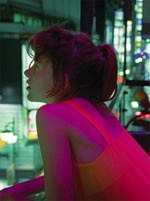
 That’s it — all 20 Palme d’Or contenders have now screened for critics, and the final deliberations can begin. Most of the media attention in the past two days has focused on Gaspar Noé’s new film “Enter the Void,” though it hasn’t aroused anything like the firestorm of controversy that his “Irréversible” did in 2002. (Perhaps the media simply hasn’t the energy for a fight after “Antichrist.”)
Although reportedly as violent and sexually explicit as one would expect from Noé, the film, which screened at the Croisette in still-unfinished form, seems to have prompted more confusion than outrage from the press. The critical response, meanwhile, is more positive than might have been expected. Manohla Dargis leads the cheer team for the film:
An exceptional work, though less because of its story, acting or any of the usual critical markers. What largely distinguishes it, beyond the stunning cinematography, is that this is the work of an artist who’s trying to show us something we haven’t seen before, even while he liberally samples images and ideas from Stanley Kubrick and the entirety of American avant-garde cinema. The grungy milieu and calculated shocks might have been designed to make you flee – even while your attention is tethered to the camera – but, really, these aren’t the point. The point is the filmmaking.
ScreenDaily’s Mike Goodridge is somewhat awed, describing the film as “a wild, hallucinatory mindfuck” that is “nothing short of hypnotic,” even suggesting the film as a future staple for narcotic-fuelled viewings — though like Dargis, he dismisses the characterisation and narrative as being of secondary quality and importance. Variety is less forgiving, labelling the film “tiresomely gimmicky” and implying it is less “pure cinema” than “pure trash.”
Doesn’t sound very much like a Palme d’Or possibility to me, though there may be some technical recognition for the apparently gorgeous lensing. (Seriously, check out the stills here.)
Nonetheless, I would wager Noé stands more of a chance than poor Isabel Coixet, whose “Map of the Sounds of Tokyo” looks set for a critical mauling after being showered with boos at its press screening. Variety’s damning review variously calls the film “pretty to look at but largely vacuous,” “like a perfume ad without a product” and “excessively precious” — none of which surprises me, since those are all phrases I’d apply to Coixet’s last effort, the absurd Philip Roth adaptation “Elegy.”
On a more positive note, my early pick for the Palme, Elia Suleiman’s “The Time That Remains,” has been warmly embraced by critics. Though an expansive, personal account of Palestinian history with a serious undertow, the film has inspired repeated comparisons to the droll physical comedy of Buster Keaton or Jacques Tati, with hardly a negative review to be found. The Telegraph’s Sukhdev Sandhu names it, together with “Antichrist,” the standout of the competition lineup, while the A.V. Club’s Mike D’Angelo declares it his personal favorite. Screen Daily’s Howard Feinstein calls it “an impressive film” from “a master stylist,” though does admit to finding it a little wearying in the latter stretch.
The awards will be dealt out tomorrow evening, before which I will offer a final rundown (with some final foolhardy predictions) of the top contenders for the gold.
Comments
2 responses to “Final Cannes contenders unveiled”
Do you know what time it will be in the US when the awards are given out?
I believe the ceremony begins at 19.15 their time, which would mean 13.15 on the East Coast and 10.15 on the West. Winners are, I think, revealed earlier to the press. Hope that helps.