 Catch up with the idea behind this series here.
The Academy and America were in the thick of World War II and patriotism or sentimentality were the order of the day. “Casablanca” and “Going My Way” were the two big winners in the history books and while I can hardly argue with the former, the latter hasn’t aged well at all. It was the first film to win Best Picture in front of a nationwide audience as ABC broadcast the ceremony for the first time… on the radio. The event was still filmed for newsreel purposes though. Don’t believe me? Ask the dishes (Youtube!)
The ceremony was beginning to look more and more like what we are used to, with Best Picture getting whittled down to five, powerhouse films taking more and more of the awards and one guy getting nominated for Best Actor and Best Supporting Actor for the same performance. Okay, maybe we never got used to that last one. A quickly changed rule made sure that never happened again but it’s too bad they can’t as easily change the history books to reward these films instead.
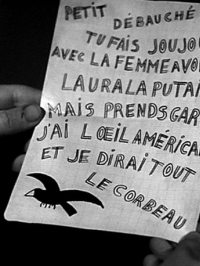
1943 – “Le Corbeau” (Henri-Georges Clouzot)
I’m not sure why some foreign titles retain their original title in popular conversation and some don’t, but the American DVD release of this film goes by “Le Corbeau” and so shall I. Translated as “The Raven,” it’s an early film made by one of my absolute favorite filmmakers of all time, Henri-Georges Clouzot, who only ever received one nomination for Best Foreign Film in his life.
“Le Corbeau” follows an ordinary doctor in a quaint, French town who begins to receive threatening letters from a mysterious author adopting the titular pen name. Accusing him of adultery, committing abortions and other high sins of the era, the film couldn’t start off on a more promising note for a thriller. What’s most interesting about the film is that Clouzot proves to have little interest in the actual resolving of the mystery or the milking of tension it could provide, and instead focuses on how the town subtly turns against each other in the uproar.
It’s in these dynamics that Clouzot makes a powerful statement against the occupation and the negative influence of suspicion. Hardly anyone in the town escapes the film with a completely positive impression left on the viewer and Clouzot revels in the ambiguity. Financed and commissioned by a German-operated comany, it was intended to be a breezy Hollywood-lite mystery for the masses, but was ultimately banned and Clouzot wouldn’t direct again for four years.
The story is expertly told, with stunning black and white cinematography from Nicolas Hayer playfully illustrating the immorality and duality of the villagers. His work with shadows, along with Clouzot’s leisurely, economic shot selection simultaneously serve to establish the sleepy nature of the town and hint toward its gloomy underbelly. Tony Aubin’s score is also nicely integrated.
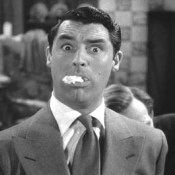 1944 – “Arsenic and Old Lace” (Frank Capra)
Do I still have to write about this movie? If that picture to the left doesn’t make you want to see the movie, nothing will. If that was a picture of Clooney, Pitt, Carrey or anyone in an upcoming summer movie, I would be first in line to see it. Screwball comedy at it’s finest, the Academy saw fit to pass it over despite coming from Hollywood royalty Frank Capra, the Epstein brothers and Cary Grant. That would be like a movie from Ron Howard, Eric Roth and George Clooney getting shut out today.
Of course the Academy has always been averse to slapstick comedy but I actually think it failed to land any mentions because it must have seemed terribly old-fashioned even then. Which is exactly what I love about it. Capra does the absolute bare minimum with his staging to avoid obvious comparisons to the stage play and the Epsteins hardly touched the material in the adaptation. Grant has a gas, as does a scene-stealing Peter Lorre, with everyone ratcheting up every line delivery and reaction shot up to silent film proportions. Capra encouraged it, referring to the set as a “mugger’s ball.”
The back story goes that Capra knew he was going to head off to the War and wanted to make a quick buck to tide his family over while he was gone. He assembled the cast and crew in a flash and was shooting within months. Unfortunately, Warner Bros. was contractually unable to release the film until it closed on Broadway, which caused it to sit on the shelf for two full years (another possible reason for the Oscar snub). When it finally did open, it was a predictable smash.
As shameless as all that sounds, the product certainly is better for the manner in which it was made. Seemingly relieved of any pressure to be anything but enjoyable, and made by a troupe of artists at the absolute top of their games, the movie breezes along on a wave of likability that can maybe never be matched. Compare it to the labored ambition of Judd Apatow’s “Funny People” and you can get a sense of what I’m talking about.
There you have it. What else should be in the discussion?
Comments
13 responses to “LIFE WITHOUT OSCAR: 1943 and 1944”
1943: If it’s fair to pick “Le corbeau,” which was not released in the US until 1948, then I’ll go with Dreyer’s “Day of Wrath,” another 1943 film that was not released in the US until 1948. Powell & Pressburger’s “The Life and Death of Colonel Blimp” would also be an excellent choice.
1944: Continuing the trend, I would pick Powell & Pressburger’s 1944 “A Canterbury Tale,” which was not released in the US until 1949.
Both a very solid picks, very good films – I’ll throw in Michael Curtiz’s “Passage to Marseille” (1944) as a runner-up.
I know people like to rag on it because of the endless flashbacks and the fact that it’s a shameless attempt by Warner Bros. to cash in on the success of “Casablanca,” but I’ve always felt it was criminally underrated.
It has great performances, great action scenes and it fits nicely into Curtiz’s wartime portraits of unwavering patriotism that began with “Captain Blood.”
I was all set to plug The Woman in the Window until I saw that the Academy at least had the intelligence to nominate its score. (Scarcely an honor when the category had a whopping 21 nominees, however.)
Anyway, more impeccable picks, though I could easily have gone with Murder, My Sweet, I Walked With a Zombie (come on, at least an adaptation nom for its Jane Eyre riff), To Have and Have Not (nothing for Lauren Bacall = insanity) or (again, bending the year-of-release rules) Ossessione.
This series keeps getting better. Terrific read.
Just remembered that To Have and Have Not wasn’t Oscar-eligible until 1945. Don’t mind me.
I’m just going by year of first release on IMDb. Seems easiest and doesn’t change the fact that the Academy blew it whatever the year.
I’m actually a fan of Going My Way. Perhaps it hasn’t aged well, but the 1940s were full of great films- many of which have grown in stature over the years, so maybe it gets overshadowed. My own thoughts on 1944 are that Meet Me in St. Louis was the best film of the year and that Laura was a close second. Nonetheless, other entries:
1943:
A Guy Named Joe (Tracy)
I Walked with a Zombie (Lewton)
Shadow of a Doubt (Cotten, Wright)
1944:
Ministry of Fear
The Miracle of Morgan’s Creek
The Phantom Lady
Murder, My Sweet
The Seventh Cross (Tracy)
Woman in the Window (Robinson)
Laura
To Have and Have Not (Bogart, Bacall)
***My own thoughts on 1944 are that Meet Me in St. Louis was the best film of the year and that Laura was a close second.***
“Double Indemnity???”
Count me among those that think Double Indemnity is not as good as its rep
Double Indemnity is a great film, but I’m with Chad, maybe not as good as its rep.
All I know is, Meet Me in St. Louis and Laura are on my Top 100 list, Double Indemnity is not.
Doesn’t make DI any less of a great film, just means I’m not as high on it.
I can watch “Lifeboat” over and over again and each time I see something new in the characters. And Tallulah not getting nominated was criminal.
For me, 1943 is all about:
The Magnificent Ambersons
Shadow of a Doubt
The More The Merrier
Day of Wrath
Hangmen Also Die
Casablanca
I Walked with a Zombie
The Ox-Bow Incident
The Human Comedy
For 1944:
Meet Me In St. Louis
Lifeboat
Double Indemnity
Laura
Arsenic and Old Lace
The Miracle of Morgan’s Creek
Since You Went Away
The Sullivans
Wilson
Murder My Sweet
Hail The Conquering Hero
A Guy Named Joe
@ Dean:
Love Ambersons, but its from 1942.
Woops…a bad mistake. SHADOW OF A DOUBT it is, then.