 Catch up with the idea behind this series here.
A thousand apologies to everyone for the lack of a Sunday Cents column. With a respected actor/director duo putting in numbers as disappointing as “Green Zone,” there was definitely a lot to talk about but I just didn’t have the time or the access to my computer that I needed here at South by Southwest. I have managed to sneak a way for a few precious moments to finalize and post this article, which I’m very happy to see got a good response last week. So here we go again.
1929 – “The Love Trap” (William Wyler)
If there was one film that best represented the awkward transition from silents to talkies, then William Wyler’s early screwball comedy is it for me. The story is typical American silent melodrama, with a down-on-her-luck chorus line girl falling in love with a wealthy gentleman and facing the wrath of his disapproving family, but the kicker comes in the last reel when the previously silent film starts talking. It’s a jarring moment and Wyler uses the transition during an important story beat, similar to Dorothy opening that door to a wildly colorful Oz. While many films from this era featured sporadic dialogue, none felt as carefully manipulated as this instance. Wyler was only 26 when the film was released but his unobtrusive, economic style was already firmly in place. He would, of course, go on to become one of the most successful men ever with the Oscars, earning three Best Director trophies and guiding more actors to Oscar nominated performances than anyone else in history.
Believe it or not, I was actually on a game show a few years back called “Ultimate Film Fanatic” and one of the rounds required two contestants to debate the greatest director of all time. My opponent said Alfred Hitchcock and I said William Wyler. The crux of my argument was that Wyler’s style was so fundamental to movies in such a broad sense, that he was able to hop from genre to genre and tell stories effortlessly. The other guy said Hitchcock revolutionized the way movies are made from the editing of “Psycho” to the score of “The Birds.” I lost the debate. But what I should have said is that Hithcock could only revolutionize the conventions of cinema because Wyler had invented them and made them standard. (Video evidence of this game show here!)
That’s not to say that he doesn’t have moments of great innovation either. Take note of the shot of our happy couple in the back of a cab while an entire comedic sequence takes place behind them, out of focus, through a window. It’s daring stuff and perfectly executed. As for the acting, “The Love Trap” features a fantastically charming lead performance from Laura La Plante and her comedic timing is something to behold, particularly in the silent sequences. Some of the actors are a bit awkward once required to deliver lines, but the overall novelty factor, mixed with some genuinely brilliant moments and camera work make this my pick for 1929.
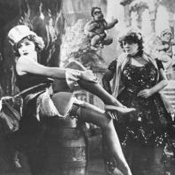 1930 – “The Blue Angel” (Josef von Sternberg)
Von Sternberg and Marlene Dietrich were an early acting/directing powerhouse that actually did receive some Academy attention this year, but for “Morocco” and not this. Emil Jannings turns in a ferocious performance as a professor who gets caught up in the seedy underworld of Berlin’s speakeasys and cabaret joints. Dietrich, of course, plays a dancer and it would be this performance that launched her career as an international superstar.
First and foremost, if you are going to check this movie out, make sure you watch the German version and not the English. Again, still navigating the tricky transition from silents to talkies, the production decided to film every shot twice in both languages so that it could play in both parts of the world. However, the performances in English suffer a bit from the fact that it’s most of the actors’ second language and their accents are so thick. Most DVD’s should have both available to choose from on the same disc.
With that out of the way, you can sit back and enjoy a surprisingly dark and honest portrait of a man spiraling towards self-destruction due to obsession and desperation. If you had any doubt that the melodramatic overacting of the silent age was an art form of its own, then Jannings and his flailing yet devastatingly powerful performance should settle it. His last few, pathetic moments on screen are ironic in that they feature imagery you’d expect from the happy-go-lucky silent age placed within a grim context that wasn’t yet in vogue among an industry dominated by comedies and musicals or redemption dramas. That being said, there are some light moments and a few dynamite musical numbers for Dietrich to chew on so it’s not a wall-to-wall downer.
What do you guys think? Got any recommendations of your own?
Comments
20 responses to “LIFE WITHOUT OSCAR: 1929 and 1930”
For someone who hasn’t been exposed before to the director and films mentioned this is an AMAZING read!!!! Thank you!!!!
I got to say, I would go with George Melies for greatest director of all time.
Good article. I also think Hithcock is the best but there are many directors I’m not very familiar with their work. Wyler is one of them.
You really should have had more time. This ended up not being about knowledge and critical thinking but time management skills. I have to say, I’m impressed by the fact that you didn’t say you won the show. I wish I were that modest.
I haven’t seen (nor heard) of Wyler’s “The Love Trap,” but “Blue Angel” is a very good choice.
As an alternate, may I suggest Frank Capra’s “Ladies of Leisure” (1930), which unfortunately dissolves into a creaky melodrama in the end, but provides us with Barbara Stanwyck’s first great performance. There’s a breakfast scene with her and the comparatively dull Ralph Graves that is stunning.
Chad, were those your “lucky pants”? ;-)
For 1929, I’d pick the infamous mess Queen Kelly; for 1930, the even more notorious L’Âge d’Or.
I can’t say I’m really into the early surrealist cinema. L’age d’or and Blood of a Poet are cool to see once but ultimately not my bag.
Chad, you should’ve won that game show, hands down. I agree with both directors, but I think your argument about Wyler is so much stronger. He has been much more influential across cinema as a whole than Hitchcock.
I enjoyed The Love Trap quite a bit, although I tend to prefer most of Wyler’s other films that I’ve seen.
I must say, Chad, it warmed my heart to read such a favourable approximation of Wyler, who is one of my favourite filmmakers, and, I would argue, the greatest of all time. The man just doesn’t get enough love in this day and age. In an ideal world, you would be able to mention his name and get the same response that you would for Hitchcock or Scorsese or whoever.
Skip’s a Basterd. :D.
What a random game show. Congrats on winning Chad! I think I’m going to go check out The Love Trap based on your argument.
It’s funny how people just let go with someone like Hitch. Good, influential director sure… BUT the best ever?
Not even close. Not by consistency, not by range not even by visuals or performances. Sorry guys. Hitch is simply a very good director and that is it.
Wyler, though is pretty great and, no matter what some idiots may say, a true auteur.
Recalls our poll from two summers back. Hitch, I believe, beat out Kubrick (my personal choice).
I think I fell in love with William Wyler when I saw The Little Foxes. You want innovation? What about Bette Davis sitting on the couch while her husband crawls up the stairs? Thanks for defending him, Chad. It’s amazing that the man who led so many actors to Oscar night and won 3 of his own is so underappreciated.
Here’s a 1931 film FYC: Fritz Lang’s “M”
Ingmar Bergman is the greatest director ever.
I think calling a director the definite “best of all time” is quite ridiculous. You could write down quite a long list of directors of which you can say that they are kind of the highest league. I mean:
“But what I should have said is that Hithcock could only revolutionize the conventions of cinema because Wyler had invented them and made them standard.”
I think this quote perfectly shows that you can’t compare two directors of two different movie eras. When your point is right, Hitchcock didn’t even have the chance to revolutionize cinema the way Wyler did. Because it had already happened.
Anyway, at the end it is a question of taste. Maybe you can say that Tarantino is a better director than Guy Ritchie. Well, I’m even quite sure you can say that. :D. But comparing, for example, D.W. Griffith with Ingmar Bergman – impossible. They both had a great effort for cinema and which one was better or more important…? Your taste tells you.
It’s all about opinon, not about facts. ;)
Oh my god. Never thought that you’re so cute on that video. You look calm and not that cynic as i thought. Maybe i’m wrong. But, i’m in crush now. Lol.
As for best director of all time, Stanley Kubrick. All. The. Way.
There is a big difference between being the best filmmaker and the best director. Isolating that one element is difficult and often biased by an individual’s other contributions to a film. Billy Wilder is by far my favorite filmmaker, but not the best director. Hitchcock is a good choice from my perspective.
Kubrick is more of an all-around filmmaker. Scorsese cannot be underestimated as a director. Even in his weaker films, his directing astonishing. Bergman and Griffith are both excellent as well, but Fellini is better. As for Wyler, Mrs. Miniver is painful to the eyes.
I too enjoy M from 1931.
My favorite movie from 1929 is G.W. Pabst’s silent classic Diary of a Lost Girl. The movie is available on DVD but remains little seen and discussed. It’s one of my favorite films ever.
Pabst released another movie in 1929, Pandora’s Box, which, despite being a better known title I’m sure also got zero Oscar love. It’s also an excellent movie but I prefer Diary of a Lost Girl.
My picks (again for deserved but unlikely Oscar recognition; and I’m also not picking what Chad picked):
1929:
Alfred Hitchcock’s “Blackmail”
Dziga Vertov’s “The Man with the Movie Camera” (it’s remarkable but the Academy would never have gone anywhere near it)
Georg Wilhelm Pabst’s “Pandora’s Box”
1930:
Luis Bunuel’s “The Age of Gold”
Aleksandr Dovzhenko’s “Earth”
Relatively weak years for this kind of thing, but there we are…