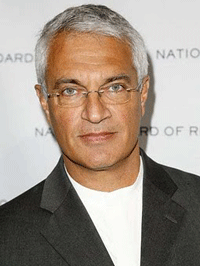
 Louie Psihoyos is a vegetarian. Go figure. On the sunny afternoon of the Critics’ Choice Movie Awards, we meet at a West Hollywood vegetarian cafe to discuss “The Cove,” the former National Geographic photographer’s first foray into the world of feature filmmaking, and a stand-out piece of activism that seems to galvanize most anyone who’s seen it.
“A year ago this week we were just hoping people would like it in Sundance,” he says. “We had eight public screenings there and eight standing ovations. I certainly wanted the movie to create a wave of activism, because to me, film is the most powerful weapon by far. You make a bomb, you kill people, you make a movie, you get allies, and that’s what I wanted to do.”
The film, if you haven’t heard by now, exposes the brutal annual slaughter of dolphins in the small harbor village of Taiji, Japan. Local fisherman claim it is a tradition when it doesn’t even date back a century, which really gets under Psihoyos’s skin.
“They’ve been doing it with drive boats since 1933,” Psihoyos says. “My mother was born in 1925. She’s older than their ‘tradition.’ Besides, when you know that your tradition is poisoning people — and they were force-feeding poisoned meat to school children — your tradition argument, I’m sorry, it falls apart.”
Meanwhile, dolphin meat from the slaughter (from those dolphins not whisked away to a life in dolphinarium captivity) is sold as whale meat, given to schools to feed children. Oh yeah, and the meat is toxic, containing high levels of mercury that could instigate a pandemic of deformity and neurological disorder akin to the Mimamata “disease” of a half-century ago.
It goes without saying, the film stretches out of the realm of animal rights and into the realm of human rights.
“You can look at this film any way you want,” Psihoyos says. “You can look at it as trying to save dolphins or you can look at it as trying to save us. These animals are the only wild animals throughout history that have saved the life of human beings. That’s a form of communication. This happens routinely. We’ve lost a lot of perspective, I think.”
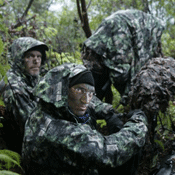
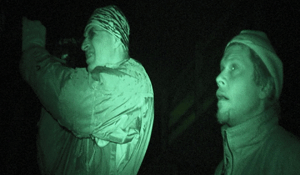
The film was structured as a sort of espionage yarn, a covert “making of” as Psihoyos and his crew set about infiltrating the cove and planting cameras to capture what exactly goes on (since fisherman are aggressive about keeping on-lookers, and certainly journalists, away from the area). Psihoyos enlisted the help of Industrial Light and Magic in creating rock-like casings for the cameras and assembled a group of professionals with different but applicable skill sets, all in the service of outing the truth.
 Psihoyos says he carried a “relentless pursuit of perfection” over from his days as a still photographer into his work on a debut feature film. “I know how to dig into huge subjects relatively quickly,” he says. “I did that while working with National Geographic. The best way to do a story is go find the world’s experts on it. Read all you can find, but when you sit at the foot of a master, that’s when the real research begins.
Enter Ric O’Barry, infamous for his activism in the area, who met Psihoyos at an event from which he was pulled from the ticket by the sponsor, Sea World. O’Barry serves as a hero figure in the film, a wonderful touchstone for the audience with a fiery, infectious spirit, while talking head interviews with others, including Psihoyos, are scattered throughout.
But, as Psihoyos says later at the Santa Barbara Film Festival, he was “dragged kicking and screaming” into this structure. He didn’t want to be a subject in his film. But ultimately it became obvious that it was the best way into the story and would make the most captivating case as a piece of visual storytelling.
The patron saint of “The Cove” was entrepreneur Jim Clark, who put up much of the money for the production and has loomed as a big figure in Psihoyos’s life, the filmmaker says. He’s a man Psihoyos clearly admires and, of course, considers a friend, as they both share an awe and fondness for the ocean (a fondness that would one day lead Psihoyos to help found the Oceanic Preservation Society).
“When I was in college I took a diving course and that got me interested in underwater,” Psihoyos says. “You can go into the water and it’s a whole new universe. I got really addicted to the oceans. And then I met Jim Clark. When he was in college, he built the computer systems that sent man to the moon. He did that when he was like 26 years old. And then he started Silicon Graphics which was featured in a lot of movies, like ‘Jurassic Park.’ Then he started what became WebMD, and that’s the third billion dollar company. He said he did it just to prove the first two weren’t a fluke!
Psihoyos says he used WebMD, in fact, to save his mother’s life when he found out that doctors were “over-medicating” her. When he shot Clark for Fortune magazine, the two became dive buddies. “He took me to some of the best places int he world,” Psihoyos says.
 But one film isn’t enough for Psihoyos to fit his activist spirit into. At the Santa Barbara fest, he says his next film will be an exploration of extinction cycles and that we are in the middle of a new one right now. It recalls an aside he shared over lunch back in West Hollywood.
“Mercury happens naturally in the environment,” he says. “About half of it was already there, but the escalation has gone up five times since the industrial age due to the burning of fossil fuels like coal. Over half of our energy comes form coal. I thought the worst thing you can do for the environment is make a movie about it, so we changed the way we got our energy back in Colorado where we did post-production not he film. I installed 120 solar panels on our roof. We’re in Boulder, on the eastern slope of the Rockies where there’s kind of a rain shadow. So now we generate 140% of our electric use, so that means the electric company gives me a check every month.”
Back in Santa Barbara he notes that some might complain about the expense of such a set-up, but after getting a bit excited and showing some real fire in his proclamations concerning the real cost of what’s happening, he says, “My solar panels look pretty God damn cheap.”
Psihoyos says he’s enjoyed the season, though he had no clue there were so many awards shows. He says he and his co-nominees are in the “save the world business. We’re competitors, yeah, but we’re collaborators.”
To that end, the Oscar nomination — which had not come yet when we spoke — is important for one major reason.
“It’s the most watched show on Japanese television,” he says. “They don’t watch the Super bowl. That, to me, would be, like, game over. I think when the Japanese see this, talk about breaking through. That would be such a huge bump. I always told the crew that we’re trying to start a movement more than make a movie. And awards are collateral on the way to solving the issue. I think most people who make documentaries are trying to change the world a little bit and that’s why I got into it.”
Comments
One response to “INTERVIEW: Louie Psihoyos”
I love this doc. I love this man. And I love him even more because he’s a Vegetarian. He puts his money where his mouth is or I guess I should say he puts his mouth where his heart is. Protecting our world’s oceans and the creatures that live in them. that compassion clearly extends to all for him. he’s an inspiration. great interview.