In Contention

Tag: Warner Bros. Pictures

  • Time Warner weeds out indie filmmaking

    The news that Time Warner is phasing out Picturehouse Entertainment and Warner Independent Pictures was a bit upsetting this morning, I have to say.

    WIP may not have hit any major strides (though a Best Picture nominee one year after it became a brand wasn’t too shabby), but I believe Bob Berney had built something special at Picturehouse, a company that was beginning to look like a real home for filmmakers and visions you can’t put into little boxes.

    Of course, the “dependent” circuit, as it were, has claimed this sort of artists’ haven thing for some time. But long ago many of them began to succumb to the same inflated budgets and profit-obsessed mentalities as their parent companies. I never got that vibe from Picturehouse.

    Just look at some of the product: “Fur,” “A Prairie Home Companion,” “Pan’s Labyrinth,” “Tristam Shandy,” “Mongol” and “La Vie en Rose,” featuring a lead performance whose ultimate Oscar victory caught more than a few people off guard.

    Forgive me, but the notion that the now in-house New Line Cinema is somehow going to reach the niches that Berney and WIP did is a stretch. The potential seems all too clear for the brand to go back to the genre-soaked days of old, Dimension Films to Warners’ Miramax. But I’m happy to be proven wrong.

    But for me, it’s a sad moment. I liked what Berney had cooking and on the occassions that I spoke to him about this project or that, I thought he had a pretty hip (and, thankfully, realistic) vision of what he could do at the company.

    But what do I know?

  • That leaked Two Face photo…

    Jeff Wells is running it over at his site. So is AICN. Since I saw at least two take-down orders out there on the net, I refrained from running the pic. But Jeff says he ran it by publicists at Warner Bros. and no one got back to him, so taht was reason enough for him.

    Anyway — while it’s there — what do you think? Personally, if it’s indeed real, I think it’s perfect. Especially knowing what it might look like on film with Wally Pfister playing with the shadows. And it’s downright terrifying.

  • Harvey Dent’s coming out party in NYC

    It looks like Warner Bros. unveiled the new trailer for “The Dark Knight” at the New York Comic-Con over the weekend (I still feel burned they never turned anything up in San Diego last summer). As expected, the PR focus has shifted off of the Joker character in the wake of Heath Ledger’s death and over to Aaron Eckhart’s Harvey Dent.

    The new trailer comes amid a flurry of recent viral PR for the film aimed at the district attorney character, both on the net and in the “real world.”

    Did I mention how much my head is about to explode with anticipation over this film? And if it’s nearly three hours long — God help me, I’ll be in batty heaven.

    But back to Dent, I think this series has the makings of putting Eckhart in a very exciting position in 2011, much like the anticipation over Ledger’s Joker portrayal. Eckhart as Two-Face could be just as explosive, just as creepy and, perhaps, twice as ruthless. We have to get there first, and “The Dark Knight” will be our road there…

    …that’s all I’m sayin’.

  • REVIEW: “The Departed” (****)

    Warner Bros. Pictures\' The DepartedOne of the most artistically ruthless films to be produced in decades, “The Departed” is a spike of adrenaline straight to the heart of an audience desperately in need of such rambunctious filmmaking.  A loose but paradoxically loyal remake of the Hong Kong thriller “Infernal Affairs,” the film is doused with a cast of familiar faces, each performer offering portrayals unique to anything in their respective repertoires.

    The script, tuned down to deafening perfection by screenwriter William Monahan, is as frenetic as director Martin Scorsese’s visual vernacular.  And the atmosphere, molded by Scorsese as if he were twenty years younger, is as saturating and penetrating as one could hope for out of a freewheeling, balls-to-the-wall entry in the cops and robbers genre.

    This is truly one of the best films of the year.

    Scorsese fell off his throne in the eyes of many when he began tackling epics like “Gangs of New York” and “The Aviator” in recent years.  Some felt the fixture of 1970s cinema was chasing awards glory in earnest and therefore watering down his artistic capabilities.

    Still, those films have much more to offer than most viewers allow, affording dense portraits of 19th century America and the unraveling world of Howard Hughes respectively.  But it admittedly goes without saying the director hasn’t been near the top of his game in well over a decade, and the worry was he might be slowing down.  With “The Departed,” that line of thinking flies right out the window.

    The story is one of deception and lies, the hardships of undercover life and the effect such particulars have on a human being.  The heights Michael Mann was aiming for in “Miami Vice” in this regard are cleared with considerable comfort by Scorsese’s effort.

    Leonardo DiCaprio stars as William Costigan, a good kid from a working class family who hopes to make a difference in the Massachusetts State Police.  But his superiors, Queenan (Martin Sheen) and Dignam (Mark Wahlberg), see through him immediately as just a kid playing the role of cop more so than living it.

    Undercover work in the Irish mafia, however, might be something up his alley.  After all, deception seems to be one of his outstanding qualities.

    Colin Sullivan (Matt Damon), meanwhile, is a young buck who was introduced to organized crime at an early age.  Presented as a surrogate son to Irish crime lord Frank Costello (Jack Nicholson), Sullivan also rises quickly through the ranks of the Boston Police Academy.  He is soon positioned as Costello’s mole on the inside, greasing the rails for the mob boss to live his evil and criminal life as he sees fit, without recourse or precaution.

    Leonardo DiCaprio in The DepartedAs the film pushes forward at an unforgivable pace, each respective mole becomes cognizant of the other’s existence.  The drama therefore introduces itself in the form of a race against odds (and in the most hair-raising of environments) for each to discover the other before their rapidly evaporating time expires.

    These are roles most actors spend a lifetime hoping to nail, but in “The Departed,” even the supporting elements are tough enough to chew and find significant flavor.

    Alec Baldwin, for instance, continues to tap into a post-Kim Basinger era of confident, sleazy, yet somehow appealing portrayals as Ellerby, an officer in charge of the building case against Costello.  Martin Sheen commands a father figure for DiCaprio’s Costigan with relative ease, while Mark Wahlberg sparks a curious foil to Sheen’s Queenan as a sharp-tongued Sergeant overseeing undercover operatives.

    Vera Farmiga adds another delicate and layered performance this year (along with work in Anthony Minghella’s “Breaking and Entering”) as Madolyn, a department psychiatrist who becomes involved with both Costigan and Sullivan.  And Ray Winstone fits comfortably into the mold as Costello’s right-hand man Mr. French.

    But DiCaprio and Damon’s front-and-center portrayals are what the film hinges on.

    Damon’s is a specific and moderately callous turn, one less merely villainous than it is antagonistic by necessity.  DiCaprio’s performance as Costigan, meanwhile, might be his most accomplished to date, or at least closely rivaling his work in “The Aviator” two years ago.

    An actor consistently relegated to the “pretty boy” column, DiCaprio proves time and again that he is a performer capable of reaching certain emotional depths that others in his generation can’t quite claim for themselves.  And though both of these performances are showcases for each actor, it’s still not enough to steal the show.

    If there is one thing audiences will be talking about regarding “The Departed” for years to come, it will be Jack Nicholson’s flagrant bloodlust and vicious insanity as Frank Costello.

    Costello is the vilest of human occurrences, a truly despicable creature whose sole purpose in the world is to rail against the status quo and push his own boundaries as far as he can to get the maximum stretch out of life.  As the character admits later on, “I haven’t needed the money since I took Archie’s milk money in the third grade.  I haven’t needed p***y either, but I like it.”

    Jack Nicholson in The DepartedIndeed, Costello is one of the true villains of the modern cinema, as morally filthy as he is fascinating.  And Nicholson wallows in the role like he was born to wear it, savoring every feral gaze and relishing every blood-splattered grin.  It might be his best work since “The Shining” 26 years ago, and a performance Academy voters are likely to eat right up like Ben Kingsely’s Don Logan in 2001’s “Sexy Beast.”

    William Monahan’s erratic screenplay is enough to give anyone an anxiety attack, but Scorsese plays the thing like a fiddle.  Utilizing a crew of usual suspects, the filmmaker finds the pulse of the tale in a hurry and never relents.

    Thelma Schoonmaker deserves awards consideration for piecing together parallel narratives while still implementing the greatest of techniques scene after scene.  Michael Ballhaus’s camera glides through each sequence and constructs time and space in a manner reminiscent of his work on “Goodfellas,” and most recently, Janusz Kaminski’s underappreciated efforts on Steven Spielberg’s “Munich.”

    And I can only hope theaters across the globe crank the volume up to the level it was at in the screening room on the Warner Bros. lot, because the soundscape of the film is as much a character in the tale as Costigan, Sullivan or Costello.

    But the real story of “The Departed” has to be Scorsese’s reclamation of his former relentless ways.  This is an effort that fills out a trilogy of sorts with “Mean Streets” and “Goodfellas,” further securing the director’s status as the greatest of urban film artists.

    What makes the accomplishment all the more appealing is the sense that Scorsese is a beast awakened, done with a slumber that appealed to some and still puzzled others.  “The Departed” is crafted like he just recently discovered the medium of cinema and all its wondrous possibilities, fresh out of film school and desperate to express himself.

    It’s energizing just thinking about it.

    And, like the best of Scorsese cinema, I expect “The Departed” could be largely ignored by the awards season outside of performance respect and potential craft consideration.  But it really doesn’t matter what happens to the film in the approaching Oscar derby, does it?

    This is as hard boiled as filmmaking can get, and it proves a talented director still has more finesse and spirited determination than half the industry around him.  So take note.  An old dog can teach as many new tricks as he can learn.

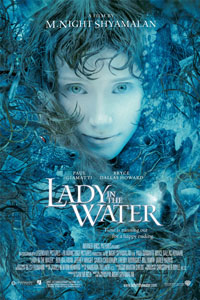
  • REVIEW: “Lady in the Water” (**1/2)

    Warner Bros. Pictures\' Lady in the WaterM. Night Shyamalan is an artist like any other.  There are a lot of potent ideas and whims of fancy bouncing around inside his inarguably creative mind.  He is, in all likelihood, just as his representation in the American Express commercial, discovering vibrant new details worthy of expansion at every step of the way.

    However, as a filmmaker, Shyamalan has never found the appropriate balance for fully realizing his themes and notions.  For all of the discussions he wishes to have with his audience, for all his attempts to represent each of them completely, the insularity of his concepts gets the better of him every time out.  Such is the case with “Lady in the Water,” a film far less deserving of the inevitable wave of detest coming its way, whatever level of failure it may exist upon.

    In the film, Paul Giamatti plays Cleveland Heep, a man lost in his own sorrows and retreating to the far reaches of an anonymous apartment complex in Philadelphia.  As superintendent, Cleveland has carved out a position of semi-importance and purpose, but one easily filled by anyone, as he well knows.

    That would be, in Cleveland’s mind, the point –- the more invisible his existence the better.  Why that is, we are left only to imagine for a while, but we discover the tangibility of Cleveland’s discontent in due time.

    The complex itself is filled with an assortment of colorful characters, from the raucous and inebriated band, to the unnecessarily unique father specializing in crossword puzzles, to the former author and current animal-loving old lady, to the Asian mother and her wacky/sexy daughter.  Then there is the scientifically driven young man committed to working out only the right side of his body, the Latin family fit with five daughters…oh, and let us not forget the disenchanted and wonderfully cynical film critic, truly obvious in its purpose as a character.

    The writer/director himself, of course, turns up in the film, in a much more layered role than he has filled in the past, proving that sometimes he just might be a better actor than he is a writer.

    Late one night, Cleveland discovers a girl swimming past curfew in the swimming pool of the complex.  After a routine slip-and-fall on the deck, Cleveland is rescued, as it would seem, by the mysterious girl.  He is then left to wonder who this odd, comfortably naked and somewhat aloof individual is.  We learn this information through the (at first glance) woefully expository story from the Asian firecracker, a story held amusingly out of context for much of the film.
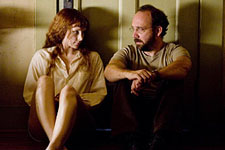
    Bryce Dallas Howard and Paul Giamatti in Lady in the WaterHowever, critiquing the story of “Lady in the Water” from this point forward in any traditional sense would be a drastic mistake.  It is at this moment – discovering the girl is a sea nymph named Story hailing from The Blue World – that you truly have to let yourself be taken with the fantasy of it all if you are to derive any enjoyment in the matter.

    And that statement reads much more typically than it should.

    The point is there are elements at work here that command a literal release of the plot.  You really and truly must reduce yourself to childhood.  No one would look for sensible justification in a big, bad wolf dressing in a grandmother’s night gown, but there are lessons there to be learned all the same.

    Fortunately, the above-mentioned humor is a tool Shyamalan uses quite well to keep the balance on the ludicrous nature of this yarn.  It isn’t lost on him that his story is terribly contrived, even for a “bedtime story.”  But it isn’t the plot he is interested in here, so much as the characters.  In this fashion, “Lady in the Water” is perhaps the first true character study of Shyamalan’s career.

    The film is not merely about finding one’s place in the world.  It is about having the courage to face that place, and assuredly, much as with “Signs,” the filmmaker uses this opportunity to speak to fate and faith throughout.  Cleveland is a man with a painful past, one that he believes will abandon him if he abandons it.  But such considerations are inherently foolish.  We are not only sculpted by our past, we are owned by it.  We are owned by it until we sum up the fortitude to accept it, and through a fantastical, absolutely incoherent fable, Shyamalan makes this point clearly.

    What will certainly be lost in the shuffle of criticism of is the conviction and passion that is more apparent here than in past efforts from the director, efforts that were drastically obvious attempts at capitalizing on that fated moniker “The Next Spielberg.”  It will be more fun in our typically lazy analytical film community to draw blood.  Ironically enough, most points of negative concern will be viable.  But they will be defeatist all the same.

    Paul Giamatti truly is a saving grace here in many respects.  As a stuttering, introverted and simple man, Cleveland is a curious anchor for such a story.  However, dazzling as always, Giamatti sells his side of things like a champ.  Conversely, the rest of the cast is filled out on the page in an extremely flat manner, all of them serving a pre-ordained purpose in the story.  But Cleveland is a complex and interesting character whose ins and outs deserved the right attention.

    Bryce Dallas Howard in Lady in the WaterAs the mysterious Story, Bryce Dallas Howard is appropriately creepy, and, I guess, appropriately detached.  However, I don’t know how one would begin to critique a performance like this.  When you get right down to it, it’s all external – every bit of it.

    Jeffrey Wright, Bob Balaban, Bill Irwin, Freddy Rodriguez and Sarita Choudhury fill out the rest of the principle supporting cast, elementarily conceived characters on the whole, but organic to the tale all the same.  And, in most cases, the actors do a fine job of elevating their roles ever-so-slightly.

    The problem with “Lady in the Water” is a rather significant one, though.  Tonally, it is even.  Thematically, it could use some work, but the elements are there and coherent.  Performances are as good as they were going to get.  The filmmaking is, as always with Shyamalan, top notch.  He remains visually dynamic as a director.

    No, the problem with Shyamalan and his latest effort is the same issue he has had for six years.  He cannot seem to understand that the role of the artist is not infinitely solitary.  That, my friend, would be a real “bedtime story.”  If you roll with something as risky as this on your own, you are bound to trip and stumble, and who will be there to catch your fall?  Better yet, who should be?

    Maybe that is the sort of risk Shyamalan is attracted to taking, but you can only fall so many times before you can’t help yourself up anymore.  Shyamalan is getting to that point.

    Ultimately, this is a filmmaker with a choice to make.  With “Lady in the Water,” he has concocted, again, a string of interesting ideas that he cannot fully develop.  His central theme rings true.  However, there are so many particulars that threaten depth and yet remain on the periphery, it becomes apparent that Shyamalan is a director, however talented, lacking the maturity to understand that art is not a singular achievement – and a film is anything but.

    It is the mark of professionalism to trim the fat.  This seems to be lost on Shyamalan.  Furthermore, the lessons he learned (or perhaps did not learn) on “The Village” were taken personally and manifest themselves in aspects of “Lady in the Water” in very petty ways.  The lessons he has been avoiding on his latest effort already show the signs of potential insularity once again, taking to chastising a studio that had every right not to believe in a project that, however booming in potential, just wasn’t there yet.

    The golden child simply hasn’t allowed the industry to break him, and his humility is nowhere to be found.  That vicious cycle has produced terrible filmmaking since the dawn of cinema, and Mr. Shyamalan is dangerously close to the same precipice.  Perhaps it is time for him to stop listening to the voices inside his head, and start lending credence to the voices outside.