
In Contention

Tag: Uli Edel

  • Poor UK reviews for ‘Baader Meinhof’

    With a higher international profile than most of the other submissions in the category, Germany’s controversial “The Baader Meinhof Complex” would appear to be headed for a Best Foreign Language Film nomination — and there is talk that film has screened well for Academy members.

    However, with nominees in this category generally receiving so much less public attention than in others, critical reception can be an important factor in the voting — and it’s in that department that things aren’t quite going to plan for Uli Edel’s film. Trade paper reviews have been lukewarm, with Variety deeming it “long and humdrum,” and Screen International declaring that it “emotionally flatlines, even as it fascinates.” (For my part, I thought it engrossing enough but dramatically opaque.)

    Now, on the eve of the film’s UK release, it has been even more harshly dismissed by critics here. In a severe one-star review, The Independent’s Anthony Quinn writes:

    How far was Germany’s recent Nazi past to blame for the rise of the Red Army Faction? How did a small group of radical left-wing students of the 1960s turn into one of the most feared terrorist units of the 1970s? What was the nature of the disputes that eventually split apart the RAF, and what resonance does their legacy have today? Any one of these questions might have been a useful co-ordinate by which to plot a narrative … But it turns out he hasn’t answered any of them. His approach has simply been to cram everything he knows about the Baader Meinhof years into a running time of two and a half hours. It is really the most unhelpful and unenlightening film on the subject you could possibly imagine.
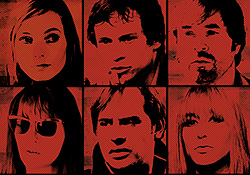
    (more…)

  • SHORT TAKE: “The Baader Meinhof Complex” (***)

    The Baader Meinhof ComplexGermany has hit something of a sweet spot with the Academy of late, having won Best Foreign Language Film twice in seven years, and scoring two additional nominations — all with somber, rock-solid takes on aspects of the country’s fascinating 20th-century history. (Last year’s winner, “The Counterfeiters,” may have been from Germany’s neighbor Austria, but it was a clear continuation of the trend.)

    So I’m not at all surprised to hear whispers that this year’s German entry, “The Baader Meinhof Complex,” is going down well at Academy screenings. A weighty, expansive and absorbing study of the war of terror waged against the state by the radical Red Army Faction in 1970s Germany, as well as the personal conflicts raging between its three leaders, it ticks any number of Academy boxes: it feels ‘important’ yet accessible, exotic in subject but familiar in form. Intelligently structured and immaculately crafted, its initially daunting 150-minute running time fairly zips by.

    Yet it isn’t quite a great film. Where Florian Henckel von Donnersmarcks’s stunning “The Lives of Others” managed to filter volumes of political context through a finely wrought personal narrative, “The Baader Meinhof Complex” — admittedly working within the bounds of non-fiction — occasionally struggles to locate the human complexity within the history.

    The three protagonists speechify to rousing effect, but their psychological motivations and vulnerabilities remain frustratingly opaque to the end. Fine actors like Martina Gedeck and Moritz Bleibtreu consequently can’t find enough notes to play in the portrayals of the title characters; more compelling is Johanna Wokalek, who, as Baader’s wife Gudrun, colors her political passions with a fierce sexuality.

    Uli Edel directs with a sure, selfless hand, placing story before style, which makes sense with story material this rich. While his approach borders on the prosaic at points (I could do without such literal music cues as “Blowin’ in the Wind”), this is still robust meat-and-potatoes filmmaking: not as innovative or as challenging as other fare on offer, but nutritious nonetheless. The density of incident and detail crammed into the film’s frame is impressive, but it’s hard not to come away wishing one knew the people at its centre a little better.

  • Sweden and Germany loom large in Oscar race

    As anyone who follows the arcane workings of the Best Foreign Language Film award knows, there is no such thing as a sure thing in the category. However, it’s fair to say that Sweden and Germany have emerged as strong contenders in the race after both countries selected high-profile films as their official entries.

    Unsurprisingly, Sweden has chosen “Everlasting Moments,” a highly personal biopic from veteran filmmaker Jan Troell — a Best Director nominee back in 1973 for “The Emigrants.” The film is a portrait of Maria Larsson, Sweden’s first female photographer, who also happens to be the grandmother of Troell’s wife (and co-scripter) Agnes. The film bowed at Toronto last week to warm reviews, including this rave from Screen International:

    Discreet, old fashioned, traditional and altogether admirable, this is Jan Troell in what he does best … Paying minute attention to the smallest details, taking its time but never appearing to drag its feet, immensely sympathetic to its heroes and villains alike, this is an intimate family portrait and at the same time a rich canvas of working class life … This picture has quality stamped all over it, awards are likely to come its way whether for direction, photography or the performances of Maria Heiskanen and Mikael Persbrandt.

    By all accounts, it’s a stately, beautifully crafted period piece with a degree of social gravitas — difficult to see the Academy resisting that one.

    On a very different note, Germany has gone with Uli Edel’s terrorism thriller “The Baader Meinhof Complex” as its entry. The film, a chronicle of the infamous left-wing Red Army Faction group that terrorised the country through the late 60s and early 70s, has yet to open in its home country, but advance word is promising. (Jeff Wells gives some useful insight here.)

    (more…)