 Romance seems to be the theme that sparks the most diverse reaction from the artistic community, filmmakers in particular. There are various methods and structures utilized to tell tales of the elusiveness of love, and new, fresh takes on this binding structure of human interaction come into the cinematic arena every year.
Some audiences prefer the restraint but equal probing of, say, “The Remains of the Day.” Others might yearn for the creative ferocity of “Eternal Sunshine of the Spotless Mind.”
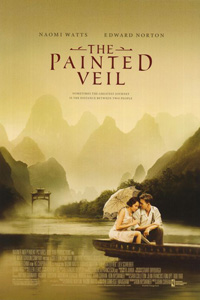
John Curran’s “The Painted Veil” might not be as calm as the former, and certainly not as unique as the latter, but it is nonetheless a story fabulously woven and penetrating in its exhibition of a new kind of love story. It is one of the year’s finest films.
Based on the M. Somerset Maugham novel of the same name, “The Painted Veil” is a tale of forgiveness above all else. It is a deconstruction of our surface frailties and a call to understanding the virtues that lie beneath, and certainly, the lessons that might be learned all too succinctly with the experience of poor decision.
Conveyed through a creative structure and filmed with long, deep breaths of beauty and compassion, John Curran’s effort propels him from an independent background and into a stoic place of assured filmmaking competence.
He might be a director to keep an eye on in the future.
Naomi Watts stars in the film as Kitty, a spoiled and monetarily nurtured sort who longs to break away from her meddlesome mother and tiresome life in London. She meets Dr. Walter Fane (Edward Norton) at a family gathering one night and the good doctor falls for her immediately.
Inevitable courtship commences, though Kitty doesn’t seem to take a specific interest over the course of two years (which fly by in the tight structure of the first act) until Walter asks for her hand in marriage.
Kitty agrees, if only to break free of the ties of London, and the doctor whisks her away to Shanghai, where he will be working and studying.
All of this is told betwixt scenes depicting a very different Mr. and Mrs. Fane making an overland voyage to a Chinese village, a couple uncomfortable with one another and uninterested.
This cross-editing comments directly upon the present in a structure recently apparent in Christopher Nolan’s “Batman Begins.”
As the past blends with the here and now, the first act comes to a head with Walter’s discovery of Kitty’s affair with Charles Townsend (Live Schreiber), a popular diplomat in Shanghai who is also married. Under the threat of divorce (and therefore scandal), Walter forces Kitty to accompany him to the faraway village where he will study and help treat a cholera epidemic, and in so doing, perhaps glean some sort of pleasure from Kitty’s distress at the expedition.
 Tensions, meanwhile, are running high between nationalist Chinese and the westerners they feel are invasive to their way of life. Held somewhat emotionally captive in this unfamiliar environment, Kitty spends her days and nights wasting away and feeling useless.
Walter avoids her, quite clearly considering her with disgust and disdain. But the man Kitty married, she never bothered understanding or even knowing, and so a trying excursion to the Far East, it seems, might reveal the good man she was too selfish to discover, and the life she has wasted on herself for far too long.
“The Painted Veil” is a complicated but delicate film. It really is a lasting sort of story, however, and credit seems to be best served to writer Ron Nyswaner.
I personally have never read Maugham’s novel, so if the first act structure of the film is apparent therein, forgive my ignorance. But my assumption is that is not so and it was the clever creation of Nyswaner to comment directly on the Fanes through a simple but purposeful structure from the first frame of the film.
Whoever is responsible, the device is a brilliant one because it works on so many levels. Nyswaner (who was nominated for an Oscar in 1993 for his original screenplay “Philadelphia”) also takes a certain care to pace the story with a sense of measure, but never at the expense of interest. A film that might seem boring to some is in fact quite engaging throughout.
Edward Norton and Naomi Watts have a specific chemistry that is extremely organic to the piece. Norton in particular (who also served as one of the film’s producers) provides perhaps his best performance since “American History X,” and certainly his best since “25th Hour.”
He trumps the quality he tends to have difficulty shaking, that tendency to be Edward Norton first, the character second. Here, he is fully believable and lived-in as Walter.
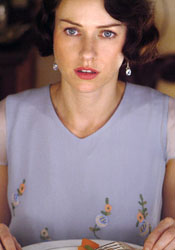 Naomi Watts shines and has the clear character arc of a woman who grieves for her past mistakes. Kitty is extremely child-like at the film’s start. By the end, she is a woman with a life of experience and a future that would have been uncertain otherwise.
It is a slow revelation for the character, which in some ways makes it more poignant. To paraphrase, a convent nun puts it to her late in the film, “When duty and love are one, then you are truly full of grace.”
And that is the lesson Kitty learns a thousand miles from familiarity.
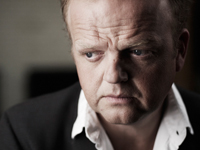
Another performance worth commenting upon is Toby Jones’s portrayal of Mr. Waddington, a liaison for the Fanes who is quite the warm friend of the family, so to speak. It’s the kind of small but meaningful turn that Harvey Weinstein would have ushered to a supporting actor nomination in the 90s, one that typically slips under the radar in today’s movie-going environment.
The technical elements of the film are quite lovely, hinting at the works of James Ivory or Anthony Minghella in some instances. Stuart Dryburgh’s cinematography thankfully avoids the temptation of drowning the scenery out in golden hues and tonal recreations, rather depending on putting forth beautiful imagery to tell the story first.
The work of editor Alexandre de Franceschi is some of the most understated but clearly exemplary efforts at the AVID this year, and Alexandre Desplat’s majestic score is his finest work to date, fit with soaring themes and delicate subtlety.
“The Painted Veil” is the crowning jewel of producer Bob Yari’s output this year. It is also a fantastic get for Warner Independent Pictures, who might try harder with the film than a larger distributor would (though that is yet to be seen).
It is a comforting reminder of the filmmaking medium, that stories can be told with beauty and simplicity and still evoke effective emotional impact. A fantastic effort.
 2005 was the year of Heath Ledger’s beautiful, moving performance in “Brokeback Mountain,” which I saw for the first time in Toronto. It instantly became the talk of the festival, and the film became the one to beat for the Academy Award.
 Sorry for following up on this so long after Kris’ teaser… what can I say? It’s Christmas party central round these parts.