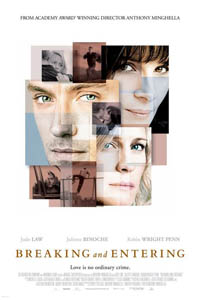
 Anthony Minghella’s “Breaking and Entering” is one of the most sincerely penetrating films of the year. It’s most unique quality is the sense of legroom it provides, a healthy stretch of a film with deep breaths and drawn out considerations, as opposed to the typical anxiety of temperamental manipulation (which all film tends to be by nature).
The film cannot be approached by the director’s past offerings, most of them over-reaching in their intentions and ultimately short of greatness as a result. “Breaking and Entering” is not a masterpiece, but it certainly treads such waters as an honest and tangible portrayal of mid-life confusion and crisis.
In the film, Jude Law stars as Will, a London architect and head of a somewhat unorthodox household. He lives with his girlfriend of ten years, Liv (Robin Wright Penn), yet they remain unmarried. The two are at that point in a relationship when the boredom of familiarity have finally given way to something else, something utterly lacking and altogether confusing.
Together, Will and Liv have raised Liv’s daughter, Beatrice (Poppy Rogers), a behaviorally dysfunctional teenager very representative of the trauma Will and Liv’s emotional schism has imposed on the family.
Will’s company has recently set up new office space in a seedy district of London. After receiving a large shipment of computer components, the office is burglarized one night by a team of acrobatic youngsters. One such child is Miro (Rafi Gavron), a Bosnian refugee living with his mother, Amira (Juliette Binoche).
Miro lost his father before fleeing his homeland, and his own story is not an unfamiliar one, one of longing and despair manifested in his getting himself into frequent trouble with the authorities. He now thieves for his dead father’s brother, perhaps to keep some sort of touch with his former, all but forgotten life.
Amira, meanwhile, is as sick with worry as one can imagine. Making ends meet as a seamstress, she frequently expresses disgust with Miro’s extracurricular choices, but overshadowing that disappointment is an unwavering love for her child.
Binoche’s more playful scenes with Gavron are the emotional center of the film, representative of a spirited devotion and affection that seems missing from Will’s life, and a sham if ever apparent therein.
 After a series of such robberies, Will begins staking out the building with partner Sandy (Martin Freeman) and an inquisitive prostitute, Oana (a humorous and insightful Vera Farmiga). He finally catches Miro in the act one night, and in chasing him he follows the boy to his home. There Will encounters, from a distance, Amira and her concern for her son.
The moment is the beginning of an emotional whirlwind that will become increasingly confusing before clarity will be restored. Will ultimately engages in an affair with Amira, perhaps searching for love as he later will claim to Liv, but more likely discovering a void to fill, one he cannot seem to fill at home.
“Breaking and Entering” is an awakening experience. At its core, the film is about honesty. It is about being truthful to yourself, your needs, your desires, your love, your family and your impulses.
Will is a man turned around and without direction. His confusion is not his fault, nor is it his family’s. It is our very nature to search out our boundaries and our limitations. It is also our very nature to seek assurance in where we find ourselves.
In that light, “Breaking and Entering” has much in common with Todd Field’s “Little Children.” Both films speak to mid-life indecision and discomfort, and both films weave tales of lost souls finding their way back to their life roles.
Jude Law’s performance as Will might be the greatest performance of the year. It is a textured and nuanced turn that has a blistering emotional veracity.
I would perhaps go so far as to call it his best work to date, but his is still a resume bursting with diverse portrayals throughout. In “Breaking and Entering,” however, Law has tapped into the leading man potential he has only threatened in efforts such as “Cold Mountain” and the phenomenal “Closer.”
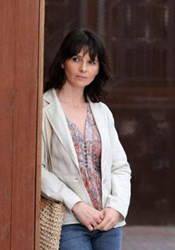 Juliette Binoche is appropriately self-aware and headstrong in her performance as Amira. Driven yet still full of the youth she had ripped from her through tragedy, Amira is an extremely interesting creation and a vibrantly unique character.
No one has carried across beautiful and tired so capably since Meryl Streep in “The Bridges of Madison County.” She also works quite beautifully off of the balanced anxiety and mother-love of Rafi Gavron’s performance.
Elsewhere, Ray Winstone turns in a cheeky performance as investigating CID officer Bruno, while Martin Freeman’s brief stint as Sandy is further proof he deserves more roles with meat on them. Poppy Rogers has some integral scenes as Beatrice, but if there is a weak link in the cast, it pains me to say it might be Robin Wright Penn.
Some may find her emotional recoil fitting and appropriate, but something about the performance feels as though the actress doesn’t fully understand her character. The work recalls Patrick Wilson’s ambivalence in “Little Children.”
The technical aspects of the film deserve accreditation of the highest order, most especially Gabriel Yared’s piano-infused original score and Benoît Delhomme’s subdued cinematography. Each element goes toward making the piece a truly unique experience, and certainly a unique Minghella experience.
“Breaking and Entering” really feels like Anthony Minghella’s most personal and convincingly sincere film yet. It boasts a lived-in quality making it feel like a story the writer/director has been playing over and over again in his head, perfecting every glance and sigh, tuning every emotional pitch to tonal superiority.
From an opening shot bleeding subtext and sporting an initial narration more enlightening than most, it is a film and, more importantly, a screenplay, that commands respect and appreciation. In a year exploding with accomplished filmmaking, “Breaking and Entering” fits right in.
 It’s been a while since I’ve committed to a long-form review, and for that, I have to apologize. Short Takes here and there don’t exactly cut it, but we’ve certainly stayed afloat in this light with Guy’s wonderful work across the pond. I don’t get a chance to sit down and hammer out some thoughts very often, and I’m hoping that will change in the coming weeks.
 Had anyone said to me in the 1970s that Clint Eastwood would in time become one of the finest and most important American directors in modern cinema, I would have laughed — quite loudly — in their collective faces.