In Contention

Tag: Rodrigo Prieto

  • TECH SUPPORT: Best Cinematography — Volume I

    Of the so-called “tech” categories, Best Cinematography is one of the most popular, certainly for me. The invention of the camera took us beyond radio and literature and set modern art on a path aimed toward the moving picture, and this field recognizes those behind the lens.

    Cinematography obviously has a massive impact on a film, everything unfolding within a frame and any nuance specific to the tone, atmosphere and theme of the piece.  It is unimaginable to think of a good movie not having a good Director of Photography (DP).

    “Pretty” films with beautiful landscapes and memorable, postcard-like shots shots are a regularity (and tend to win).  But war films also show up regularly.  And being a Best Picture contender never hurts. Innovative lighting that creates unique mood is frequently rewarded, at least with nominations, as well.

    While this branch does at times play favorites (Robert Richardson and Roger Deakins being the most notable), it always tends to find room for one, two or three first-time nominees every year. From this vantage point, I’m curious who they will be because, the way I see it, most of the obvious contenders have been nominated before.

    (more…)

  • SHORT TAKE: “Biutiful” (**1/2)

    Cannes Film Festival

    “How much does life weigh?” asked Alejandro González Iñárritu’s sophomore feature “21 Grams” – and while the literal answer was there in the title, it’s been clear from the rich buffet of human suffering in his films thus far that he believes it weighs rather a lot indeed.

    Brace yourselves, then, for “Biutiful,” an effortfully solemn amalgamation of personal crises and social concerns from the director’s previous films that might consider going by the tagline: “Life’s about to get heavier.”

    If that’s an overly glib response to an evidently considered and compassionate personal statement on González Iñárritu’s part – it’s his first feature to spring from his own (co-written) screenplay, after all – I apologize. There’s nothing like bleary-eyed festival fatigue to shorten one’s patience with films that fall a little short of either potential or expectation.

    But it takes more than undisputed sincerity to make a film that resonates, and “Biutiful” paints from too limited an emotional palette for its high-stakes story of parental duty, in the face of hovering mortality, to hit home the way it should.

    (more…)

  • REVIEW: “Broken Embraces” (***)

    Broken EmbracesMateo Blanco, the fictitious, sightless filmmaker who is both the ostensible hero of Pedro Almodóvar’s 17th feature film, “Broken Embraces,” and a highly refracted alter ego of Almodóvar himself, runs his career by one golden principle: “no sequels, remakes or biopics.”
    This statement, hammered home to Blanco (Lluis Homar) by his long-serving agent Judit (Blanca Portillo), could be read as a cheeky allusion to Almodóvar’s own directorial philosophy. Arguably the most defiantly trademarked of all contemporary arthouse auteurs – even the casual cinephile can identify un film de Almodóvar by its palette alone – he is nonetheless surprisingly resistant to repetition.

    As tempting as it may be for some to color his oeuvre with the same brush, there’s less common aesthetic ground between the jagged raunch of a “Kika,” the elegant humanism of a “Talk to Her,” or the icy genre play of a “Live Flesh,” than meets the eye, skewed black humor and extravagant visuals notwithstanding.

    It’s not a case of phasal development either: the remarkable creative hot streak of his last five films saw him trying on a range of tonal and structural guises, unexpectedly becoming this generation’s crossover arthouse teddy-bear in the process.

    (more…)

  • TECH SUPPORT: Best Cinematography – Volume I

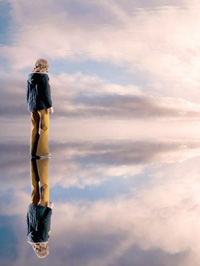
    Saoirse Ronan in The Lovely BonesLIGHTS…CAMERA…you were probably waiting for the word “action,” no? Action is, after all, what many individuals go to a film to see. But the “lights” and the “camera” in this classic phrase bring a film beyond a book or a radio show…and capture the “action.”

    The individuals who paint the images of cinema with light and composition are rewarded in the Oscar category of Best Cinematography. Cinematographers are pivotal in the making of any film and it is thus unsurprising that directors often continuously work with the similar camera heads.

    Like many cinephiles, I must say this is my favorite of the so-called “technical” categories and I eagerly anticipate the race every year.  This year is no exception.

    Australian D.P. Dion Beebe might seem to be leading this year’s lenser race with his third collaboration with Rob Marshall, the musical adaptation “Nine.” Despite not being cited by the Academy for some of his more innovative work (see Michael Mann’s “Collateral”), Beebe has been previously nominated for 2002’s “Chicago” and won the Oscar in 2005 for “Memoirs of a Geisha.” “Nine” will give him the opportunity to pay homage to Federico Fellini while also capturing sprawling musical numbers, a feat this category tends to reward.

    (more…)

  • Stunning new ‘Broken Embraces’ trailer

    The Guardian has exclusively debuted the brand new trailer for Pedro Almodovar’s “Broken Embraces,” and it’s a thing of considerable beauty.

    Mixed reviews be damned — the oil-painting saturated color of Rodrigo Prieto’s lensing (which weirdly reminds me of Vittorio Storaro’s work on Bertolucci’s “The Spider’s Stratagem”), the cannily cool choice of Cat Power on the soundtrack, not to mention the stylistics of Penelope Cruz’s headlong dive into fetishized femme fatale territory, all have my mouth positively watering. I’ll be seeing the film later this month, and that day can’t come too soon.

    The Guardian selfishly won’t let us embed the trailer, so watch it here. Now. We’ll post it here as soon as it becomes available.

  • ‘A rollicking struggle, a joy to watch’

    Breathe, my fellow Almodovar devotees — the first reviews for “Broken Embraces” are in. While they’re not unqualified raves, it would appear that the master has pushed himself into new and challenging tonal and thematic territory, and the critics are duly appreciative.

    Screen International’s Barry Byrne suggests that it will delight fans and befuddle others, but isn’t that usually the case with auteur works as singular and stylised as Almodovar’s? Extracts from Byrne’s measured take on the film (beware of spoilers, however):

    The film is awash with references to the noir genre, Italian neo-realism and even to Almodóvar’s own quirky oeuvre. Stylistic nods to films including Nicholas Ray’s In a Lonely Place and Vincente Minnelli’s The Bad and the Beautiful form part of Almodovar’s valentine to cinema.

    Fans of Almodovar will get plenty of what they expect here – rich saturated colours, hyper plotting, stylistic pyrotechnics and off-centre comedy. But there are carefully nuanced male characters too and the bleak, distant tone coupled with the unassuaged pain of the leads is a new departure for the director.

    In the more successful first half of the film he elegantly pulls it off … (but) With the action moving ponderously towards a baffling denouement, we enter the terrain of high melodrama.

    (more…)

  • Película negra

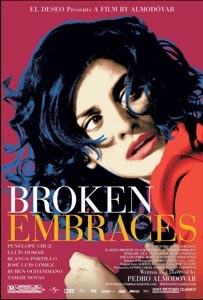
    I’m sure many of you by now have seen the gorgeous European poster artwork for Pedro Almodóvar’s upcoming “Broken Embraces,” in all its lurid Warholian variations. (If you haven’t, Nat Rogers has the lot here.)

    Now, even more enticingly, we have the first full-length Spanish trailer for the film, an expansion of sorts of the enigmatic teaser that was revealed a few weeks ago. Obviously, it comes without English subtitles, and I’m afraid my college-boy Spanish is not what it was a few years ago, so I still have only a vague grasp of what it’s all about. Fine by me … when I’m looking forward to a film as much as this one, I prefer to remain as unspoiled as possible.

    Regardless, the trailer appears to confirm suspicions that this is a return for the master to the cruel, contemporary noir territory of “Live Flesh” and “Bad Education” — which might come as a relief to those, like me, who found “Volver,” for all its candy-coloured beauty, a little fey for its own good. As it stands, the pristine femme fatale styling of Penelope Cruz, and the popping hues of Rodrigo Prieto’s apparently luscious lensing, immediately call to mind John M. Stahl’s dayglo melodrama/noir/kitsch hybrid “Leave Her to Heaven.”

    Which is fine by me. But that’s just going on appearances. The Spanish, of course, get to find out on March 18. The rest of us have rather longer to wait.