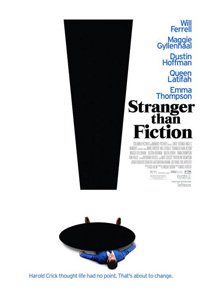
 Marc Forster’s “Stranger Than Fiction” really ought to be referred to as Zach Helm’s “Stranger Than Fiction.” While the “Finding Neverland” helmer does a sensational job conveying the brilliant and elaborate story to the screen, it is evident throughout that the writer’s intentions are being taken care of.
And thank God for that, because Helm’s creation is ultimately one of the most potent, meaningful and literarily astute pieces of screenwriting in the medium.
It might seem obvious that comparisons to Charlie Kaufman are in store for Helm and the resulting film. It is true that the screenwriter reaches for certain human and social truths via his creatively unorthodox approach, much like Kaufman has done in his most recognizable work.
But Helm also tackles his themes in a paradoxically accessible manner that can speak to larger numbers and to even larger truths. With this debut feature, Helm has truly hit a grand slam.
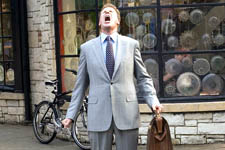
In the film, Harold Crick (Will Ferrell) is an unspectacular IRS agent who lives each and every day by the book. He isn’t the sort to color outside the lines, if you follow. The world makes sense to him broken into a strict regimen inside his mind, a regimen that is so second nature it is almost appealing. He counts steps, brushes his teeth with a consistent amount of strokes each morning and keeps track of every second to spare via his handy wristwatch alarm.
These peculiarities are hammered home through the educated, cheeky narration of some omniscient presence, and it seems like another simple tale of a man and his wholesome life. That is, until Harold becomes cognizant of the narration.
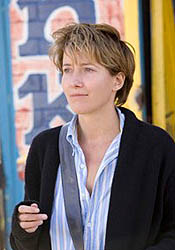
As it turns out, Harold is the main character in the latest novel from author Kay Eiffel (Emma Thompson), whose voice provides the narration he hears day in and day out. Harold isn’t aware of this, of course. He just thinks he is losing his mind.
The effect is merely annoying and diversionary for him to start, but Harold really begins to get nervous when the voice makes a passing comment on the foreshadowing of his “imminent death.”
In disarray, Harold seeks out the advice of a literary scholar, Dr. Jules Hibert (Dustin Hoffman). Dr. Hibert takes up the task of distinguishing what sort of story Harold is experiencing. Is it a comedy or is it a tragedy? Is he a specific figment of literary history or someone else? Is there a specific author behind the tale? Is Harold merely crazy?
 Meanwhile, Harold has been given the task of auditing a feisty bohemian baker, Ana (Maggie Gyllenhaal). Discontent with “the man” and certainly not afraid to speak her mind, Ana is, if anything, Harold’s polar opposite: hip, tattooed, free-spirited and boisterous.
He is, of course, immediately taken by her. And maybe he could do something about it if that pesky voice would just leave him alone. Or maybe hearing his seemingly aimless existence play out through mundane narration is the swift kick in the rear he needed to start living his life the way he wants to.
For much of the narrative, “Stranger Than Fiction” is about just that. It is about coloring OUTSIDE the lines and living life as you – not your schedule – see fit.
When Harold meets Ana, he begins to find this perspective. And when he finally decides to do all the things he wanted to do in his life, “I want you” is all he can say to her that conveys what he really feels. It is a brief and ironic moment that cleverly speaks to the sexes’ tendency to play games through courtship.
Who has time for such things – especially when your “imminent death” is upon you?
All of this is told parallel to Eiffel’s story. Suffering a terrible case of writer’s block and having been assigned an assistant, Penny (Queen Latifah), by her publisher, Eiffel can’t seem to figure out the best way to kill Harold Crick.
She spends her days imagining automobile accidents and visiting hospital emergency wards, desperate for that spark of creativity that will ignite her novel’s conclusion.
Eiffel is famous for killing people in her books, you see. More specifically, she is famous for killing people she has created as noble, admirable individuals you’d hate to see go. But perhaps the time has come for her to start doing things out of her typical order as well.
And that’s when “Stranger Than Fiction” treads breathtaking territory. What Helm’s screenplay does that takes it up a level in brilliance is present a third act that makes the film about something else entirely – something that almost flies in the face of the first two thirds of the story.
 It took two viewings to really grasp the importance of that shift in theme, and when it landed, it certainly had an impact. In that final act, the film becomes a story about living for others as much as for yourself.
Modest Christian symbolism, intended or otherwise, may or may not click with viewers (Eiffel sticks out as a deity capable of bestowing mercy on those who live unselfish lives), but regardless, Helm pieces together a story much denser than it would appear at an initial glance. Such is the mark of artistry that is welcome and rare.
The performances across the board are outstanding. Will Ferrell presents Harold Crick as his finest portrayal to date, as fittingly awkward as he can be moving. Maggie Gyllenhaal exudes a sexiness and charisma that plays fantastically off of Ferrell’s quirky charms.
Dustin Hoffman seems born for the role of the dry-witted Dr. Hibert, and Emma Thompson’s hermitic author is at once peculiar and inspiring. Queen Latifah, though in something of a throwaway role, somehow still feels like the perfect choice for Penny.
Marc Forster, meanwhile, deserves a lot of credit for diversifying his directorial choices. He seems to be gravitating toward stories that have a certain warm center, which can be appealing or annoying (depending on the viewer).
Helm’s screenplay is the most accomplished the director has worked with thus far, and he does a flawless job of putting the script on the screen without fuss and without unnecessary trademark.
“Stranger Than Fiction” will be about a number of different things for a number of different people. For some it will be about living life to the fullest. For others it will be about trusting your instincts and going after what you desire.
For me, it is about recognizing the importance of the little things we encounter, day in and day out, that go toward creating the huge puzzle we spend most of our days trying to decipher. Life really is what happens when you’re making other plans.
 In the final analysis, there isn’t much to say other than: What a captivating way to put a bow on the worst and, ultimately, most boring Oscar season of all time. The 81st annual Academy Awards swiftly went down earlier this evening with few surprise winners and a classy new sheen. It was captivating and, at times, inspiring. Here are my thoughts on Hollywood’s biggest night:
 This, I can’t go along with. I’ve been one of the biggest supporters of whatever Bill Condon and Laurence Mark can cook up, but crooning during a segment like this? And Queen Latifah of all people (who I love, mind you)? I don’t like it. Maybe it’ll work but I’m skeptical.