In Contention

Tag: Maria Bello

  • ‘Beautiful Boy’ trailer

    I’ve spaced it a bit on Shawn Ku’s “Beautiful Boy,” which is set to play the Toronto film festival next month.  There’s something a bit opportunistic and obvious to me about making a movie concerning the impact of a school shooting on the shooter’s parents, but nevertheless, Michael Sheen and Maria Bello appear to be bringing their “A” game here.  If a buyer looking for an acting awards run bites, that could change the course of the season somewhat.  We’ll know in a few weeks.  Check out the trailer after the jump.

    (more…)

  • The Great Performances: 2005

    Heath Ledger in Brokeback Mountain2005 was the year of Heath Ledger’s beautiful, moving performance in “Brokeback Mountain,” which I saw for the first time in Toronto.  It instantly became the talk of the festival, and the film became the one to beat for the Academy Award.

    Ledger was astonishing as the taciturn cowboy who is more surprised than anybody when his soulmate turns out to be another cowboy, portrayed superbly by Jake Gyllenhall. If there is a more deeply felt moment in film history than Ledger gently adjusting Gyllenhall’s shirt at the end of the film, his eyes filled with tears, I don’t know what it is. That’s loss, that is absolute heartbreak, that is one of the greatest acting performances of the decade.

    Phillip Seymour Hoffman would win the Oscar for his transformation into “Capote” and he’s very good, but just not in the same league as Ledger. I wondered from time to time if “Infamous” had been released earlier if Toby Jones might have won the Oscar instead of Hoffman. Each becomes Capote in a very different manner, and side by side it is difficult to choose the stronger portrayal. Certainly I prefer Hoffman’s as it is darker, and for me more realistic, but there can be no denying Jones.

    (more…)

  • Don’t give up on Maria Bello

    It is a well-known fact (okay, okay, this writer’s opinion) that Maria Bello was robbed of a 2005 Oscar nomination for Best Supporting Actress for her taut, unnerving performance in Cronenberg’s “A History of Violence,” despite a gong from the New York critics and a (lead) nomination at the Globes. (She wasn’t far off for “The Cooler” a year previously, either.)

    Now you may recall (though I wouldn’t blame you if you’d already forgotten) that the winner of Best Supporting Actress that year was Rachel Weisz for her agreeable and, in my opinion, wholly unremarkable work in “The Constant Gardener.” It’s a win I’ve never really understood.

    Now, in a depressing twist of fate, Bello finds herself taking over Weisz’s role in the godawful “Mummy” franchise, the latest installment of which Kris seems less than keen on. If you ever needed a textbook demonstration of the difference an Oscar (or at least a nomination) can make to an actor’s career, there you have it.

    However, in an interesting Guardian interview with the excellent film writer Ryan Gilbey, Bello appears to be making the best of a bad situation. The usually more indie-minded actress tells Gilbey that she’s always hankered after just such a part:

    I’ve been telling my agent for years that I wanted an action movie, but no one saw me like that. Two weeks before my 40th birthday, I guess I’d given up. I mean, how many action roles are there for women over 40? Soon after that, I got a call to say they were considering me for the part.

    (more…)

  • REVIEW: “World Trade Center” (***1/2)

    Paramount Pictures\' World Trade Center“World Trade Center” is a nearly flawless account of something so personal, yet so universal, that it leaves the instigating events of September 11, 2001 almost as an afterthought – lipstick on the rim of a wineglass long emptied.

    he triumph of commanding such humanity in the face of a story that could have easily been played up as the rah-rah “9/11 MOVIE” some might have expected belongs in large part to screenwriter Andrea Berloff, who pitched a striking and rich tale to producers Michael Shamberg and Stacy Sher before burying herself into the lives of Will Jimeno and John McLoughlin (the two Port Authority survivors upon which the film is based).  A huge chunk of that glory, however, deserves to be placed into the hands of Oliver Stone, a filmmaker who shows in this latest effort (in a career speckled with films that were his own, if nothing else) that he retains the professionalism to tell a story free of artistic whimsy or personal commentary.

    The film tells Jimeno (Michael Peña) and McLoughlin’s (Nicolas Cage) story in a straightforward manner free of any fuss, unnecessarily schmaltzy or otherwise.  The drama of this story is not manufactured and is very much real.  Of the 20 individuals successfully retrieved from the rubble of the World Trade Center, Jimeno and McLoughlin were numbers 18 and 19.

    Part of a confused and unprepared Port Authority team hastily assembled (as most efforts inevitably were that day), the two officers were in the lobby of Tower One when its fatal collapse ensued.  Along with three other officers, the two men successfully retreated into an elevator shaft as the concrete jungle descended upon them.  They had no idea what was happening, and indeed would not be aware that the World Trade Center had been obliterated until they were pulled from the rubble an ungodly number of hours later.

    I read Berloff’s screenplay a few months ago and I found the material somewhat insipid upon an initial assessment.  However, I must say I was more than pleasantly surprised to see the tale ultimately lifted so vibrantly off the page by Stone and the actors involved, finding the true pulse of the screenwriter’s work.

    Berloff chooses to reveal Jimeno and McLoughlin’s story in the manner I reported on at that time, something of an “Apollo 13” template, cutting from the men in peril, to their wives, Allison (Maggie Gyllenhaal) and Donna (Maria Bello) respectively.  Trapped, in their own way – on the outside, Allison and Donna waited in vain for word of their husbands’ survival, their demise, anything beyond the insistence of their simply being “missing.”

    Nicolas Cage in World Trade CenterMeanwhile, the longer Jimeno and McLoughlin remained submerged, the stronger their hope became in the face of losing the lives they loved, the lives in which they belonged more so than any other place on Earth.  As their bodies physically gave way to the unforgiving pressure and internal bleeding, their spirits remained as solid as ever.

    Nicolas Cage portrays McLoughlin with the steely sense of awareness and second-nature knowledge that seems about right.  McLoughlin has seen much in his many years at the Port Authority, and if any man was the one to look to in such a crisis, he was the guy.  He drafted the emergency scenarios relevant to another Word Trade Center attack following the 1993 bombing, but no one saw this event coming.

    There simply was no plan.  But McLoughlin dove in as if he just did not know what to do otherwise, and it takes a certain acceptance of whatever might come one’s way to be that headstrong and that assured without the slightest trace of self-awareness.  Cage portrays as much with a delicate ease that is at once arresting and relaxing.

    Jimeno, the rookie of the crew, was out to prove himself like any other new kid on the block.  He wanted the acceptance of his comrades but he also knew where the boundaries of his job were drawn.  The respect he unabashedly held for authority is present in Peña’s portrayal, as well as a certain, at times infectious, positivity that shines through the thickest of rock and dust debris covering the actor’s face.

    Gyllenhaal and Bello portray two women cosmically intertwined who would not meet one another, nor know of their fated connection until the whole ordeal was resolved.  As the pregnant and sometimes hysterical Allison, Gyllenhaal steps her game up a notch (and will do so further later this year in Marc Forster’s “Stranger Than Fiction”), while Bello (donning eerie yet somehow strangely appealing blue contacts) portrays the rock of a mother of four you’d expect Donna McLoughlin to be; she certainly seems like the sort of woman the thought of whom would keep a man alive.

    The rest of the cast most notably includes an unrecognizable Stephen Dorff as the officer in charge of Jimeno’s and McLoughlin’s extraction once they were discovered, as well as a nice cameo from Stone staple Frank Whaley as a helpful paramedic who seemed to have a story worth telling of his own.  Michael Shannon also co-stars as Dave Karnes, a former marine who, desperate to help the situation, drove from Connecticut to New York and made his way to ground zero.  Had he not taken that moment to rediscover his passion for serving his country, Jimeno and McLoughlin might never have been found alive.

    I have to mention clearly that, while such thematics as “serving one’s country” or “the brotherhood of many to save a few,” or what have you, might seem potentially over-bearing, they are not as much in this film.  These strands and basic facts come together on screen in “World Trade Center” less as manipulation than they do as insistent historic rhetoric.  And the old-fashioned relating of the story from the hands of director Oliver Stone is at times stunning.

    Michael Pena in World Trade CenterHumility is the most endangered trait amongst the filmmaking community today, and perhaps since the dawn of the medium.  That Stone could so humbly remove himself and his ego from the spotlight in order to convey Jimeno’s and McLoughlin’s story is striking, not only due to the fact that this is Oliver Stone we are talking about, but I venture to say because few, if any other filmmaker, would have been so selfless about such a film.  This will widely be reported as the most un-Oliver Stone film of the director’s career, and while that statement is true, it should not be seen as a slight, as if to say he finally came around or some such nonsense.

    Stone is one of the most artistically gifted filmmakers of his generation, responsible for some arousing innovations in visually storytelling.  But he is also capable of the basest aspects of the field, and “World Trade Center” is his charcoal sketch; it is his watercolor with primaries.  He left the fancy toolkit at home this time around, and he may have found something invigorating lurking in his long-abandoned primitive brushstrokes.

    Before closing here I think it is worth pointing out that, all due respect to the cinematography of Seamus McGarvey or the score from Craig Armstrong, Jan Roelfs’s painstaking recreation of ground zero is worth a specific mention above all else.  The work put into the rubble trapping Jimeno and McLoughlin, not to mention the practical usage of set materials during the collapse of the first tower, are design elements of the highest order, and should “World Trade Center” become an awards giant this Oscar season, I should certainly hope Roelfs and his team will be remembered.

    Ultimately I must say I am very proud of the Hollywood establishment for handling 9/11 in the successful manner we’ve seen this year.  Universal’s “United 93” and Paramount’s “World Trade Center” are two drastically different films with drastically different themes.  One is about dread, the other about hope.  However, just as those two feelings can go hand in hand, so do these two films, serving as serendipitous compliments to one another.

    “That day” was very much about dread and hope, and now that those two surface level, primal aspects of the event have been handled so capably, the filmmaking community is free to express itself through 9/11 in much more visceral, peripheral ways.  Mike Binder’s upcoming “Reign Over Me” might just be that first step.  In the meantime, “World Trade Center” is a beautiful, engaging and affecting experience, one of the very best films of the year.

  • Best in show 2005: the year in superlatives

    It’s time to really round out the year and offer up my picks for awards in 2005.

    In addition to the typical categories – which finally see their winners announced today – you’ll find some other fun arenas for awards citation. Call it a mish-mash of MTV-Awards-type kudos and other frequently heralded categories we find time to time in various critics’ awards and precursor ceremonies.

    No one is better at this sort of thing than Nat Rogers over at The Film Experience, so I recommend you all take a look at his Film Bitch awards when he dishes them out in the coming weeks.

    These will likely be my last extensive thoughts on the awards season this year, barring any brief comments I may or may not make here and/or there. There will, of course, be one final predictions update before the end of the year.

    It feels good to wrap everything up before Christmas vacation, I have to tell you. But the Oscar season is by no means over, so I’ll be diving right back in once 2006 finally rolls around.

    (more…)

  • INTERVIEW: Maria Bello

    Actress Maria Bello tells it how it is.
    She seemingly refuses to censor herself, and in an interview setting she is perfectly comfortable allowing her thought process to be put on display. She’s headstrong, contemplative and overwhelmingly sensitive to the natural process of learning, be it through life, through career, through love or through family. She’s one of the few who seems to approach acting from within rather than from without, and as such, she was the perfect candidate for the demanding and crucial role of Edie Stall in David Cronenberg’s A History of Violence.

    An actress with roots in television, including a modest stint on NBC’s “ER”, Bello has made rather defining marks in her cinematic output thus far. She typically finds herself portraying ladies mesmerized by their leading men.

    In Permanent Midnight, she played the whimsical groupie (of sorts) to Ben Stiller’s former junkie screenwriter. In Auto Focus she found face-time opposite Greg Kinnear’s sex-addicted Bob Crane. In The Cooler she bounced off of the passive and reactive William H. Macy as a call girl searching for a pulse in lighted but lifeless Las Vegas. And this year, she offers her best work to date, opposite Viggo Mortensen, portraying equal parts of fear, loathing and intrigue as the wife of a man caught between a clouded past and a hopeful future.

    (more…)

  • REVIEW: “A History of Violence” (***1/2)

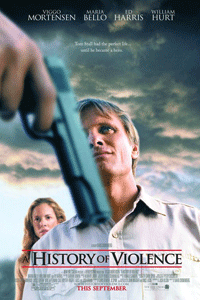
    A History of Violence“A History of Violence” is going to be David Cronenberg’s crowning glory. It’s the film that has something to say about every cinematic endeavor in his lengthy portfolio. It’s the film that time will remember him by.
    Based on a gritty graphic novel by John Wagner, the film is a commentary on the nature of violence, the mechanics of its simplicity and the mechanics of its complicity. It’s an account of the effect violence has on a household, on a town, on many different psyches. It’s one of the smartest subtextual films of the year, yet the subtext seems obvious. But it’s not.

    “A History of Violence” is a very intricate film.

    The fascination is that to be so meticulous in its thematics, the story is relayed in a very elementary fashion. No fancy tricks, no overwrought hand-to-mouth relay – just basic, almost painfully simple storytelling. I would say that not only is it Cronenberg’s most accessible film, but it is potentially his most disturbing. And, obviously, that is saying a LOT.

    The events take place in Millbrook, a picturesque small-town setting that stands almost archetypal in the midst of an upcoming storm. The storm comes in the form of two mass murderers waltzing into Tom Stall’s (Viggo Mortensen) downtown diner with evil intentions. After handily disposing of the would-be murderer/rapists, Stall is catapulted into the limelight as an unassuming hero. He soon finds himself at the whims of Philadelphia mobster Carl Fogaty (Ed Harris) and his band of cronies, expressing a vested interest in this small town savior.

    The violence in the film is extensive and at times outrageous, though it retains a level of creativity and relevance that keeps it from becoming gratuitous – shockingly. The gore is stomach-turning, to be sure, but vital to the components of the story Cronenberg is telling. Ultimately, it’s all seemingly a justification for the career he has made in the splatter business, as if it’s all been a long, slow ride to this moment, this declaration, this brand of insightful commentary.

    Furthermore, the film boasts one of the most organic ensemble performances of the year.

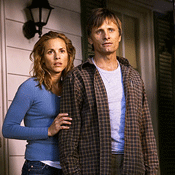
    (from left) Maria Bello and Viggo Mortensen in A History of ViolenceMortensen portrays Stall with a particular ease. Rather he inhabits him, giving the kind of performance that true acting is all about. At the same time, it’s the sort of work that gets ignored during awards season in favor of showier turns.

    Ed Harris springs onto the screen as the creepy Fogaty, and I have to say he sculpts the character off the page better than any other actor could have managed. On paper, Fogaty is assuredly a device if anything. Harris breathes him in and out and terrifies accordingly, though I must admit it’s missing a certain something to be considered formidable in the Oscar ring.

    William Hurt’s five minute cameo is one of the best pieces of work this year, a barrel of laughs and yet a swift study in acting perfection. Yes, perfection.

    But the real stand-out is Maria Bello. Bello was passed over by the Academy for a notice in 2003 for her multi-lauded performance in The Cooler, but I don’t expect that to be the case this year. If “A History of Violence” has any real shot at Oscar recognition, it is for her explosive performance. This is fire-breathing, gut-wrenching, head-spinning work. The layers that would be considered missing in a film like this, one that could easily be labeled “surface,” she adds them…in spades.

    A final note, “A History of Violence” also has something to say about passion. I’m not afraid to say that I haven’t quite put my finger on it yet, but it has something to do with two raunchy sex scenes that manage to remain out of the realm of gratuitous – much like the violence – as well as the motivations behind the character of Stall and why he is where he is at the film’s open. There is most definitely a point being made about desire, vehemence and conviction. It’s lurking – much like the film.

    I can’t wait to see this again.