In Contention

Tag: Marc Forster

  • EW’s Heath Ledger appreciation

    Cover of Entertainment WeeklyEntertainment Weekly’s current cover story is a somewhat engaging retrospective on the career of Heath Ledger through the words of his friends and collaborators.  The first story of its kind to date, the piece is a nice idea given that Jan. 22 is both the anniversary of Ledger’s unfortunate death and the day he will likely nab a posthumous Oscar nomination for his work in “The Dark Knight.”

    My only beef with the story is the insistence on either writers Josh Rottenberg and Cristine Spines, or their editor (can’t be sure which), to fish out the most US Weekly-brand quotes from some of these people, splashing suspicion on the drug use about (though director Terry Gilliam refutes that at one point), leaning heavily on talk about Ledger’s insomnia and basically painting a much more morose portrait than was really necessary.  It’s a tough, sad read as a result.  But it’s solid and, like I said, unique.  Here are some highlights:

    “The Patriot” co-star Mel Gibson:

    His audition for The Patriot was rough. But he got the gig because of some kind of honest thing that was intrinsic to him. He was just authentic and sincere. I don’t think he knew the power he had already. So he’d work himself up into an angst situation, trying to get at things that were already there. You almost wanted to say, ”Dude, just calm down and be yourself. It’s good.”

    “Monster’s Ball” director Marc Forster:

    When he read the script, Heath said, ”Look, I get this character. I totally understand him. I’ll come down there and breathe in that world.” He wanted to try something different, something where the movie wasn’t resting on his shoulders. The one thing he said was, ”I’m not going to participate in the promotion of the movie. I’m just going to come in and focus on the acting.”

    “Four Feathers” co-star and friend Wes Bentley:

    Heath didn’t give himself enough credit for his talent as an actor. He didn’t know what he had so he decided to enjoy what was being offered to him. I wanted to explain to him, ”Please wake up to how great you are.” He didn’t have any classical training. He didn’t have anyone making him feel like he had credibility. The only voice he listened to was his own self critic, because it was the loudest.

    And finally, this sobering remark from Gilliam:

    I was in Vancouver, and there was a computer with a BBC website and it says, ”Heath Ledger found dead.” My immediate response was, ”It’s a f—ing Warner Bros. publicity stunt for the Joker!” We kept looking at the computer thinking it was going to change. But it wouldn’t go away…We’re cutting Parnassus now, so it’s like I work with Heath every day. He’s in fine shape, at least in the world I’m inhabiting at the moment. It just doesn’t make sense. Every day goes by and I think, He’ll be back in a second.

    Read the rest of the piece here.

  • 11/3 Oscarweb Round-up

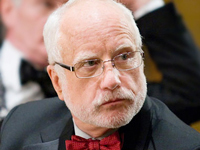
    Richard Dreyfus• Probably running out of things to talk about, Peter Bart reviews the New York Times’ Holiday Movies section. [Peter Bart]

    • Monika Bartyzel aggregates reactions to Richard Dreyfus’s poo-pooing of “W.” on “The View.”  Damn it must be cool to do and say whatever the fuck you want to. [Cinematical]

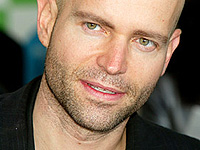
    • Jason Solomons talks to “Quantum of Solace” director Marc Forster. [The Guardian]

    • Boyd van Hoeij files from the last gasps of the Rome fest. [indieWIRE]

    • John Horn goes deep on “Frost/Nixon.” [Los Angeles Times]

    • Jeremy McCarter goes first person with Charlie Kaufman. [Newsweek]

  • 10/13 Oscarweb Round-up

    Marc Forster• Robert Abele gets Josh Brolin to reveal his inner ‘W.’ [The Envelope]

    • Tom O’Neil gnaws on the Oscar potential of Anne Hathaway in “Rachel Getting Married.” [Gold Derby]

    • Peter bart makes a lot of presumptions and assumptions about the craven mentality of duel performers in a given Oscar season. [Peter Bart]

    • Vulture kicks off this year’s Oscar Futures with pro on “Milk,” con on “W.” [Vulture]

    • Alonso Duralde studies the work of Leonardo DiCaprio as “Body of Lies” releases into cinemas. [MSNBC]

    • Brad Brevet does the same, but draws the conclusion that DiCaprio has never quite hit it out of the park. [Rope of Silicon]

    • Scott Bowles, meanwhile, draws up an obit on the box office performance of “Body of Lies.” [USA Today]

    • Jeff Dawson goes in depth with “Quantum of Solace” helmer Marc Forster. [The Times]

    • Lauren Schuker digs into the global investments on Oliver Stone’s “W.” [Wall Street Journal]

    • Larry Charles chooses his 28 most subversive comedians. [Entertainment Weekly]

  • POLL: How do you feel about Bond’s missing catch phrases in ‘Quantum of Solace?’

    In this morning’s Oscarweb round-up, we linked to a story in London’s Independent newspaper about the upcoming 22nd installment of the James Bond franchise, “Quantum of Solace.”  It appears director Marc Forster and company have opted to exclude the infamous catch phrase, “Bond. James Bond.” from the film’s script.  Also getting the cut is the “shaken, not stirred” aside that we all know and love.  It’s an unexpected departure that could have a few fans up-in-arms…or not.

    So in this week’s poll, I thought I’d ask the readership: is this a travesty or no big deal at all?  Tell us in the sidebar poll!

  • 9/22 Oscarweb Round-up

    Quantum of Solace• “Real” men of the screen are a dying breed, according to Peter Bart. [Peter Bart]

    • Journos keep beating a dead horse about the new “At the Movies” failure. [eFilmCritic]

    • And again. [The Hot Blog]

    • Anne Thompson salutes Telluride and New York for steering clear of high profile American cinema, but as she notes, was there really a choice this year? [Thompson on Hollywood]

    • Erik Davis talks Bond with Daniel Craig and Marc Forster. [Cinematical]

    • Speaking of Bond, apparently the character won’t be uttering a few of his infamous lines in the latest installment. [The Independent]

    • John Horn sits down with Diablo Cody on the set of “Jennifer’s Body.” [Los Angeles Times]

    • Dennis Lim, meanwhile, chats it up with “Class” director Laurent Canet in the wake of his film landing the official French foreign film selection for this year’s Academy Awards. [New York Times]

    • Giles Hattersly gets some quality time with “I’ve Loved You So Long” star Kristin Scott Thomas. [The Times]

    • Kevin Kelly talks to “Zack and Miri Make a Porno” director Kevin Smith at Fantastic Fest. [Spout Blog]

  • Forster on Bond: It’s about character

    Odd to be linking to Time Out twice in one day, but I couldn’t let this interview with Marc Forster, director of the keenly awaited “Quantum of Solace,” go by. The interview finds Forster in London, scrabbling to complete the first edit of the latest 007 outing in a fortnight’s time.

    Many eyebrows were raised when it was revealed that the low-key director of “Monster’s Ball,” “Finding Neverland,” and “The Kite Runner” was taking on this most commercial of franchises – I always thought it rather a nice fit. For me, Forster never injected much individual flair or perspective into his otherwise workmanlike ‘serious’ pictures; I have a feeling more of his creative personality might emerge when working against the grain of his interests. Certainly, Forster doesn’t seem to be radically modifying his storytelling approach – he believes he was hired because the producers wanted a more “emotional component” to the film:

    Several times (Forster) mentions what he believes will be at the heart of the new film: character. ‘The great thing is that Daniel and I had an intense relationship, so between us we could always go back to the character … There’s this conflict going on: he’s an assassin, but he’s also lost someone he loves. We’re asking: where’s the psychological conflict in that?

    Sounds good to me. Other promising tidbits include Forster citing genius production designer Ken Adam, who worked on the first Bond films, as an influence on his creative vision, and a sneak peek at what promises to be the most exciting foe in some time for 007:

    We see a flash, too, of the new Bond villain, French actor Mathieu Amalric, who plays a character with the decidedly unvillainous name of Dominic Greene. ‘In the old Bond films, it was clear who were the good guys and who were the bad guys. Today, it’s not so clear. I feel like Mathieu looks so sympathetic and normal, the type you can’t see right away is the villain.’

    (more…)

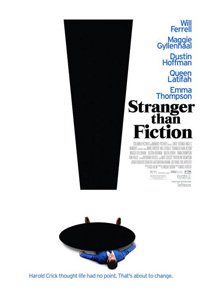
  • REVIEW: “Stranger Than Fiction” (****)

    Columbia Pictures\' Stranger Than FictionMarc Forster’s “Stranger Than Fiction” really ought to be referred to as Zach Helm’s “Stranger Than Fiction.”  While the “Finding Neverland” helmer does a sensational job conveying the brilliant and elaborate story to the screen, it is evident throughout that the writer’s intentions are being taken care of.

    And thank God for that, because Helm’s creation is ultimately one of the most potent, meaningful and literarily astute pieces of screenwriting in the medium.

    It might seem obvious that comparisons to Charlie Kaufman are in store for Helm and the resulting film.  It is true that the screenwriter reaches for certain human and social truths via his creatively unorthodox approach, much like Kaufman has done in his most recognizable work.

    But Helm also tackles his themes in a paradoxically accessible manner that can speak to larger numbers and to even larger truths.  With this debut feature, Helm has truly hit a grand slam.

    In the film, Harold Crick (Will Ferrell) is an unspectacular IRS agent who lives each and every day by the book.  He isn’t the sort to color outside the lines, if you follow.  The world makes sense to him broken into a strict regimen inside his mind, a regimen that is so second nature it is almost appealing.  He counts steps, brushes his teeth with a consistent amount of strokes each morning and keeps track of every second to spare via his handy wristwatch alarm.

    These peculiarities are hammered home through the educated, cheeky narration of some omniscient presence, and it seems like another simple tale of a man and his wholesome life.  That is, until Harold becomes cognizant of the narration.

    As it turns out, Harold is the main character in the latest novel from author Kay Eiffel (Emma Thompson), whose voice provides the narration he hears day in and day out.  Harold isn’t aware of this, of course.  He just thinks he is losing his mind.

    The effect is merely annoying and diversionary for him to start, but Harold really begins to get nervous when the voice makes a passing comment on the foreshadowing of his “imminent death.”

    In disarray, Harold seeks out the advice of a literary scholar, Dr. Jules Hibert (Dustin Hoffman).  Dr. Hibert takes up the task of distinguishing what sort of story Harold is experiencing.  Is it a comedy or is it a tragedy?  Is he a specific figment of literary history or someone else?  Is there a specific author behind the tale?  Is Harold merely crazy?
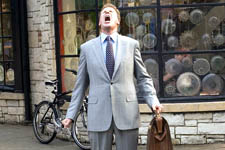
    Will Ferrell in Stranger Than FictionMeanwhile, Harold has been given the task of auditing a feisty bohemian baker, Ana (Maggie Gyllenhaal).  Discontent with “the man” and certainly not afraid to speak her mind, Ana is, if anything, Harold’s polar opposite: hip, tattooed, free-spirited and boisterous.

    He is, of course, immediately taken by her.  And maybe he could do something about it if that pesky voice would just leave him alone.  Or maybe hearing his seemingly aimless existence play out through mundane narration is the swift kick in the rear he needed to start living his life the way he wants to.

    For much of the narrative, “Stranger Than Fiction” is about just that.  It is about coloring OUTSIDE the lines and living life as you – not your schedule – see fit.

    When Harold meets Ana, he begins to find this perspective.  And when he finally decides to do all the things he wanted to do in his life, “I want you” is all he can say to her that conveys what he really feels.  It is a brief and ironic moment that cleverly speaks to the sexes’ tendency to play games through courtship.

    Who has time for such things – especially when your “imminent death” is upon you?

    All of this is told parallel to Eiffel’s story.  Suffering a terrible case of writer’s block and having been assigned an assistant, Penny (Queen Latifah), by her publisher, Eiffel can’t seem to figure out the best way to kill Harold Crick.

    She spends her days imagining automobile accidents and visiting hospital emergency wards, desperate for that spark of creativity that will ignite her novel’s conclusion.

    Eiffel is famous for killing people in her books, you see.  More specifically, she is famous for killing people she has created as noble, admirable individuals you’d hate to see go.  But perhaps the time has come for her to start doing things out of her typical order as well.

    And that’s when “Stranger Than Fiction” treads breathtaking territory.  What Helm’s screenplay does that takes it up a level in brilliance is present a third act that makes the film about something else entirely – something that almost flies in the face of the first two thirds of the story.
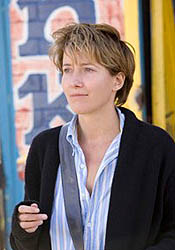
    Emma Thompson in Stranger Than FictionIt took two viewings to really grasp the importance of that shift in theme, and when it landed, it certainly had an impact.  In that final act, the film becomes a story about living for others as much as for yourself.

    Modest Christian symbolism, intended or otherwise, may or may not click with viewers (Eiffel sticks out as a deity capable of bestowing mercy on those who live unselfish lives), but regardless, Helm pieces together a story much denser than it would appear at an initial glance.  Such is the mark of artistry that is welcome and rare.

    The performances across the board are outstanding.  Will Ferrell presents Harold Crick as his finest portrayal to date, as fittingly awkward as he can be moving.  Maggie Gyllenhaal exudes a sexiness and charisma that plays fantastically off of Ferrell’s quirky charms.

    Dustin Hoffman seems born for the role of the dry-witted Dr. Hibert, and Emma Thompson’s hermitic author is at once peculiar and inspiring.  Queen Latifah, though in something of a throwaway role, somehow still feels like the perfect choice for Penny.

    Marc Forster, meanwhile, deserves a lot of credit for diversifying his directorial choices.  He seems to be gravitating toward stories that have a certain warm center, which can be appealing or annoying (depending on the viewer).

    Helm’s screenplay is the most accomplished the director has worked with thus far, and he does a flawless job of putting the script on the screen without fuss and without unnecessary trademark.

    “Stranger Than Fiction” will be about a number of different things for a number of different people.  For some it will be about living life to the fullest.  For others it will be about trusting your instincts and going after what you desire.

    For me, it is about recognizing the importance of the little things we encounter, day in and day out, that go toward creating the huge puzzle we spend most of our days trying to decipher.  Life really is what happens when you’re making other plans.

  • REVIEW: “World Trade Center” (***1/2)

    Paramount Pictures\' World Trade Center“World Trade Center” is a nearly flawless account of something so personal, yet so universal, that it leaves the instigating events of September 11, 2001 almost as an afterthought – lipstick on the rim of a wineglass long emptied.

    he triumph of commanding such humanity in the face of a story that could have easily been played up as the rah-rah “9/11 MOVIE” some might have expected belongs in large part to screenwriter Andrea Berloff, who pitched a striking and rich tale to producers Michael Shamberg and Stacy Sher before burying herself into the lives of Will Jimeno and John McLoughlin (the two Port Authority survivors upon which the film is based).  A huge chunk of that glory, however, deserves to be placed into the hands of Oliver Stone, a filmmaker who shows in this latest effort (in a career speckled with films that were his own, if nothing else) that he retains the professionalism to tell a story free of artistic whimsy or personal commentary.

    The film tells Jimeno (Michael Peña) and McLoughlin’s (Nicolas Cage) story in a straightforward manner free of any fuss, unnecessarily schmaltzy or otherwise.  The drama of this story is not manufactured and is very much real.  Of the 20 individuals successfully retrieved from the rubble of the World Trade Center, Jimeno and McLoughlin were numbers 18 and 19.

    Part of a confused and unprepared Port Authority team hastily assembled (as most efforts inevitably were that day), the two officers were in the lobby of Tower One when its fatal collapse ensued.  Along with three other officers, the two men successfully retreated into an elevator shaft as the concrete jungle descended upon them.  They had no idea what was happening, and indeed would not be aware that the World Trade Center had been obliterated until they were pulled from the rubble an ungodly number of hours later.

    I read Berloff’s screenplay a few months ago and I found the material somewhat insipid upon an initial assessment.  However, I must say I was more than pleasantly surprised to see the tale ultimately lifted so vibrantly off the page by Stone and the actors involved, finding the true pulse of the screenwriter’s work.

    Berloff chooses to reveal Jimeno and McLoughlin’s story in the manner I reported on at that time, something of an “Apollo 13” template, cutting from the men in peril, to their wives, Allison (Maggie Gyllenhaal) and Donna (Maria Bello) respectively.  Trapped, in their own way – on the outside, Allison and Donna waited in vain for word of their husbands’ survival, their demise, anything beyond the insistence of their simply being “missing.”

    Nicolas Cage in World Trade CenterMeanwhile, the longer Jimeno and McLoughlin remained submerged, the stronger their hope became in the face of losing the lives they loved, the lives in which they belonged more so than any other place on Earth.  As their bodies physically gave way to the unforgiving pressure and internal bleeding, their spirits remained as solid as ever.

    Nicolas Cage portrays McLoughlin with the steely sense of awareness and second-nature knowledge that seems about right.  McLoughlin has seen much in his many years at the Port Authority, and if any man was the one to look to in such a crisis, he was the guy.  He drafted the emergency scenarios relevant to another Word Trade Center attack following the 1993 bombing, but no one saw this event coming.

    There simply was no plan.  But McLoughlin dove in as if he just did not know what to do otherwise, and it takes a certain acceptance of whatever might come one’s way to be that headstrong and that assured without the slightest trace of self-awareness.  Cage portrays as much with a delicate ease that is at once arresting and relaxing.

    Jimeno, the rookie of the crew, was out to prove himself like any other new kid on the block.  He wanted the acceptance of his comrades but he also knew where the boundaries of his job were drawn.  The respect he unabashedly held for authority is present in Peña’s portrayal, as well as a certain, at times infectious, positivity that shines through the thickest of rock and dust debris covering the actor’s face.

    Gyllenhaal and Bello portray two women cosmically intertwined who would not meet one another, nor know of their fated connection until the whole ordeal was resolved.  As the pregnant and sometimes hysterical Allison, Gyllenhaal steps her game up a notch (and will do so further later this year in Marc Forster’s “Stranger Than Fiction”), while Bello (donning eerie yet somehow strangely appealing blue contacts) portrays the rock of a mother of four you’d expect Donna McLoughlin to be; she certainly seems like the sort of woman the thought of whom would keep a man alive.

    The rest of the cast most notably includes an unrecognizable Stephen Dorff as the officer in charge of Jimeno’s and McLoughlin’s extraction once they were discovered, as well as a nice cameo from Stone staple Frank Whaley as a helpful paramedic who seemed to have a story worth telling of his own.  Michael Shannon also co-stars as Dave Karnes, a former marine who, desperate to help the situation, drove from Connecticut to New York and made his way to ground zero.  Had he not taken that moment to rediscover his passion for serving his country, Jimeno and McLoughlin might never have been found alive.

    I have to mention clearly that, while such thematics as “serving one’s country” or “the brotherhood of many to save a few,” or what have you, might seem potentially over-bearing, they are not as much in this film.  These strands and basic facts come together on screen in “World Trade Center” less as manipulation than they do as insistent historic rhetoric.  And the old-fashioned relating of the story from the hands of director Oliver Stone is at times stunning.

    Michael Pena in World Trade CenterHumility is the most endangered trait amongst the filmmaking community today, and perhaps since the dawn of the medium.  That Stone could so humbly remove himself and his ego from the spotlight in order to convey Jimeno’s and McLoughlin’s story is striking, not only due to the fact that this is Oliver Stone we are talking about, but I venture to say because few, if any other filmmaker, would have been so selfless about such a film.  This will widely be reported as the most un-Oliver Stone film of the director’s career, and while that statement is true, it should not be seen as a slight, as if to say he finally came around or some such nonsense.

    Stone is one of the most artistically gifted filmmakers of his generation, responsible for some arousing innovations in visually storytelling.  But he is also capable of the basest aspects of the field, and “World Trade Center” is his charcoal sketch; it is his watercolor with primaries.  He left the fancy toolkit at home this time around, and he may have found something invigorating lurking in his long-abandoned primitive brushstrokes.

    Before closing here I think it is worth pointing out that, all due respect to the cinematography of Seamus McGarvey or the score from Craig Armstrong, Jan Roelfs’s painstaking recreation of ground zero is worth a specific mention above all else.  The work put into the rubble trapping Jimeno and McLoughlin, not to mention the practical usage of set materials during the collapse of the first tower, are design elements of the highest order, and should “World Trade Center” become an awards giant this Oscar season, I should certainly hope Roelfs and his team will be remembered.

    Ultimately I must say I am very proud of the Hollywood establishment for handling 9/11 in the successful manner we’ve seen this year.  Universal’s “United 93” and Paramount’s “World Trade Center” are two drastically different films with drastically different themes.  One is about dread, the other about hope.  However, just as those two feelings can go hand in hand, so do these two films, serving as serendipitous compliments to one another.

    “That day” was very much about dread and hope, and now that those two surface level, primal aspects of the event have been handled so capably, the filmmaking community is free to express itself through 9/11 in much more visceral, peripheral ways.  Mike Binder’s upcoming “Reign Over Me” might just be that first step.  In the meantime, “World Trade Center” is a beautiful, engaging and affecting experience, one of the very best films of the year.