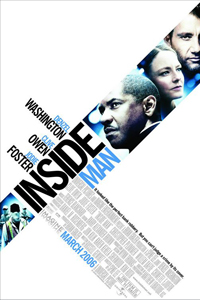
 Spike Lee’s “Inside Man” is an embarrassment of devices from start to painstakingly anti-climactic finish. As a run-of-the-mill heist romp, it still falls prey to a dedicated intention to distinguish itself, both thematically and stylistically.
Thinking it over, I’ve come to the conclusion that it is rather impossible to write a negative review of “Inside Man” without spilling the beans here and there, so I’ll leave it to you to decide whether to venture into the spoiler territory below. If you’re ducking out now, suffice it to say, Spike Lee picked a rather sluggish screenplay to be his first foray into mainstream genre fare, and leaves a bloated two plus hours on the screen that could have been much more effective at a slim, tight 90-100.
So, you’ve been warned…
SPOILERS BELOW
What writer Russell Gewirtz is asking of his audience in his terribly contrived (though I can forgive contrivances alone) screenplay is to shift their sense of antagonism from the right place to the wrong place for the sheer reason that it makes for an intriguing turn of events in the third act.
Christopher Plummer co-stars in the film as a philanthropist and owner/board director of the bank being robbed by Dalton Russell (Clive Owen) and his team of trim-the-fat operatives. We come to discover that one of his deep, dark secrets lies hidden in safe deposit box #392, and that it is enough of a concern for him to call upon the services of Madeline (Jodie Foster), a friends-in-high-places “glorious cunt,” as our screen mayor describes her, to assure its safe keeping.
This “secret,” mind you, amounts to something major enough, but is still physically little more than documents in an envelope that, as Russell candidly observes, probably should have been burned. Let’s set aside the “probably.” A secret like this – you don’t leave it lying around in a safe deposit box. Why the hell would you? There is certainly no upside to such a thing, and while, as I said, contrivances and plot devices can be forgiven, in my book of brainless spring screen entertainment, they ought to be more cleverly thought through than this.
Not to mention, Madeline’s efforts come up short to the point that her character could have easily been written out of the script and the dough tossed Foster’s way could have been spent on a few re-writes.
 On top of it all –- and you’ll make your mind up for yourself on this one -– the secret, which Gewirtz feels is strong enough in and of itself to make the viewer root for Russell’s thief, doesn’t exactly do that job in full. I was left siding with Plummer’s philanthropist in some small way in the matter. Gewirtz gives us every reason to forgive him, to be honest, as he paints the character in a manner that is becoming of someone who has atoned. The sheer fact that he would expect me to turn an about face is somewhat insulting. The world isn’t black and white. But, again, you’ll make your mind up on this one.
END SPOILERS
But let’s get into what really makes “Inside Man” an empty romp as opposed to a satisfying one. If I had to really put a point on it, before the lapses in reason, before the unbearable pacing concerns, before the insulting expectations of the screenwriter, it would have to be the overall bland nature of the characterizations, from tone, to performance, to direction.
Denzel Washington is one of the most charismatic actors of his generation. He has carved a niche of fandom for his stellar, rounded portrayals. Whether it is above-average work in “Malcolm X” or “Philadelphia” or by-the-numbers turns in “Crimson Tide” and “Out of Time,” Washington typically adds dimension to what’s on the page. The majority of his work lies in a middle ground between good and really good (saving the great stuff for here and there), an arena I would venture to say even includes his Oscar winning performance in “Training Day.” But he is regardless an actor who can find the intriguing emotional crevices of the most mundane of characters.
Now in “Inside Man,” teaming with Lee (a director who has brought out the actor’s best) for the fourth time, Washington (as Detective Keith Frazier) seems to have hit the snooze button and lazily translated an already innocuous character to the screen in a sluggish fashion. His performance slips and slides from controlled and cocky to wounded and concerned, smart and assured to confused and lost, and not at all in the good, dramatic way. It’s evident that neither Lee nor Washington really have a hold on who Keith Frazier is, and the anchoring of the film suffers because of it.
This brings me to the biggest waste of the film, and yet still, the best performance of the lot. Clive Owen is cold as ice, determined and unwavering. He’s everything you want out of a bank robber who is on top from start to finish. But why the hell is he doing this???
 This is not nearly the sort of ambiguity and anonymity of intentions that speaks truths to the human condition or anything of that nature. This is a character, intriguing in his actions and objectives as it is, painfully lacking back story and motivation. There is no question that molding the character out somewhat in this regard would have done wonders for the overall thrust of the plot, but this is screenwriting 101 if you ask me.
And don’t blink or you’ll miss Willem Dafoe picking up a paycheck as a uniform cop with little to offer other than the film’s funniest punch line.
I have to say that, while Lee time and time again proves that he is quite uneven as a filmmaker, his work putting “Inside Man” together visually is absolutely commendable. I’m confident in saying he’d rival the greats of heist cinema (Lumet, Mamet, Mann) were he to springboard from a good screenplay. “Inside Man” pops and cracks and we can see he is confident in his direction, staying ahead of the game and not letting the audience catch on too easily. Outside of one terrible choice, the camerawork in the film accelerates from the first frame. With some of the more unnecessary fat cut from the gut of this bloated tale, at about 20-30 minutes shorter, it might have gone down a little easier.
Lee uses Terence Blanchard again for scoring duties. As he did on 2002’s “25th Hour,” the composer lends a majesty and exuberance to Lee’s film that unquestionably makes it more operatic and fuller on the whole. Without it, the film would undoubtedly have been a lesser one.
All things considered, “Inside Man” is going to do exactly what it is meant to do, and what Universal and Brian Grazer expect of it. It’s going to pull down a decent box office take and line the producers’ pockets nicely, as you can’t go wrong marketing something like this. It’s just foothills enough to satisfy the average moviegoer, even if it doesn’t do much in the way of a true cineaste’s desire for the towering peaks of the Rockies.
 After three consecutive duds (in my book, anyway), Clint Eastwood will have to work hard to earn my anticipation again — harder, certainly, than dipping into the biopic well once more — but he sure gets full marks for persistence. Undeterred by his recent strike-outs with the Academy, he continues to assemble the most on-paper baity projects around — this time, a J. Edgar Hoover biopic written by Oscar-winning “Milk” scribe Dustin Lance Black and starring the Oscar-primed Leonardo DiCaprio. The only way this can miss is if it’s even half as dull as, well, “Invictus.”
 I stumbled onto this item over at
 I’m not going to review “Angels & Demons.” Sometimes the idea of tearing a film apart just doesn’t quite appeal to me, believe it or not. But watching the expected unfold on the Sony lot last night, it suddenly occurred to me that Dan Brown’s bloated if intriguingly researched fiction has no place on the big screen. It might, in fact, be better suited to television.
 I don’t know why exactly, but the “roundtable” format of interviews that crops up a lot during awards season often strikes me as rather less fascinating than it’s meant to be. Unless the panel is very smartly chosen, I find the discussion tends to veer towards back-patting and faintly smug in-jokery, rather than stimulating argument between widely differing creative forces.