In Contention

Tag: Bob Hoskins

  • 12/2 OSCARWEB ROUND-UP: Hickenlooper’s photo diary, the race’s generation gap and the ‘My Dog Tulip’ Oscar campaign

    • Anne Thompson has George Hickenlooper’s “Casino Jack” photo diary. [Thompson on Hollywood]

    • Patrick Goldstein writes up the “My Dog Tulip” Oscar campaign. [The Big Picture]

    • Vincent Cassel on “Black Swan,” movie overkill and the politics of selling out. [Movieline]

    (more…)

  • Getting to know Bob Hoskins

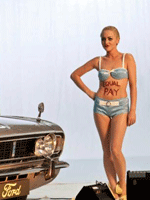
    In Nigel Cole’s crowd-pleasing “Made in Dagenham,” we already know Sally Hawkins is a solid contender in a dense lead actress field for her work as Rita O’Grady, a composite character representing a number of ladies who stood up for equal pay in late-1960s England.  But one of the fringe possibilities for a Best Supporting Actor nomination is Bob Hoskins as Albert Passingham, a supportive union representative.

    Hoskins is well used but sparingly so, and in fact his character’s sudden exit from the narrative (nothing drastic happens to him, he just kind of goes away) kind of makes you wish he was still around when he’s not.  But I wonder if it’s enough to really push through here.

    Regardless, Hoskins is an actor worth championing and he’ll surely have some kind of presence in the awards season.  Recently the UK’s Guardian caught up with him in a “getting to know you” sort of session, and the actor had some insightful commentary on feminism and its place in his preparation.

    (more…)

  • Underdog ‘Dagenham’ may have the AMPAS touch

    In Friday’s Oscar Talk, Anne and I pondered the Oscar potential of Sony Pictures Classics’ typically robust stable of contenders.  So far the best bet to have already hit theaters is Aaron Schneider’s “Get Low,” which could be a below-the-line play as well as a Best Actor possibility for Robert Duvall.

    Films from Rodrigo Garcia, Atom Egoyan and Jean-Pierre Jeunet all came and went, while Woody Allen’s didn’t inspire much at Cannes.  And that’s fine, by the way.  The business isn’t all about awards, obviously, and Sony Classics knows how to make money.  (There’s a reason the dependent is still standing tall.)

    If we properly assume “The Illusionist” will have its day in the animated feature category, while “Inside Job” will be relegated to the documentary field, that leaves three possibilities for Oscar success: Mike Leigh’s “Another Year,” the recently acquired “Barney’s Version” and Nigel Cole’s “Made in Dagenham.” The latter is perhaps the one to watch out for.

    This isn’t a revelation, of course.  Guy’s first stab at predicting this year’s Oscar set noted that “the Academy frequently likes its Britpics chirpy and digestible” and that Cole’s film was “getting ‘next Full Monty’ buzz on its way to a prominent launch at Toronto.”  Having seen the film last week, I have to say, I see his point.

    (more…)

  • The Great Performances: 2005

    Heath Ledger in Brokeback Mountain2005 was the year of Heath Ledger’s beautiful, moving performance in “Brokeback Mountain,” which I saw for the first time in Toronto.  It instantly became the talk of the festival, and the film became the one to beat for the Academy Award.

    Ledger was astonishing as the taciturn cowboy who is more surprised than anybody when his soulmate turns out to be another cowboy, portrayed superbly by Jake Gyllenhall. If there is a more deeply felt moment in film history than Ledger gently adjusting Gyllenhall’s shirt at the end of the film, his eyes filled with tears, I don’t know what it is. That’s loss, that is absolute heartbreak, that is one of the greatest acting performances of the decade.

    Phillip Seymour Hoffman would win the Oscar for his transformation into “Capote” and he’s very good, but just not in the same league as Ledger. I wondered from time to time if “Infamous” had been released earlier if Toby Jones might have won the Oscar instead of Hoffman. Each becomes Capote in a very different manner, and side by side it is difficult to choose the stronger portrayal. Certainly I prefer Hoffman’s as it is darker, and for me more realistic, but there can be no denying Jones.

    (more…)

  • ‘Batman 3’ (and beyond) casting call

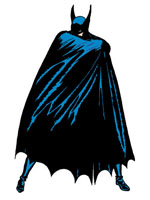
    BatmanOnce again…allow me to geek out for a bit…

    (SPOILERS FOR “THE DARK KNIGHT” IN THE BODY OF THIS POST — NO WORRIES AFTER THE JUMP.)

    Now that the record-breaking hysteria has (somewhat) subsided regarding “The Dark Knight,” I thought I’d take a moment to forecast the third installment (and perhaps future installments) of Christopher Nolan’s franchise.

    First thing’s first. What to call the next film? Ideas bounced around by fans have included tips of the hat to other aspects of the universe (“Batman Beyond,” “The Dark Knight Returns,” etc.). My personal hope was always that the Dark Knight moniker would somehow be a part of the franchise, and thankfully, they went there with the second installment.

    I kind of think taking Frank Miller’s title for part three would be brilliant (especially considering the nature of the final moments of “The Dark Knight”). But the answer here would, of course, have everything to do with the content of the film.

    At this point, we don’t have a clear idea of what to expect from the next film. “Batman Begins” scribe David Goyer (who shares a story credit on “Knight”) formulated the blueprints for a trilogy with Nolan at the outset, and we’re pretty sure Two-Face was supposed to play a considerable role in the next phase. Despite all the chatter that would have you believe Harvey Dent is dead at the end of “Knight,” that early talk of Aaron Eckhart’s contract being for two films couldn’t have been coming from thin air.

    Beyond that, the wonderful thing about the Batman mythos is that there is an array — a “rogues gallery” — of villains to choose from. And certainly, there are seven decades of story development to glean for a solid denouement to the trilogy.

    The Riddler is staring everyone in the face as the most likely possibility. And I really like the idea of handing it over to the character of Coleman Reese (as mentioned by one of our readers last week). Christopher Nolan is supposedly not a fan of the Penguin, and we all want Catwoman to pop up somehow. But that’s a whole other can of worms.

    If I had my druthers, I’d introduce the Riddler and the Penguin (as a mafia figure…nothing major), with Two-Face running rampant as the most dangerous aspect of the trio. But as I said (and we all know), any combination is possible.

    So with that, below you’ll find my personal casting call for the potential rogues we could see in a third film or even future installments of a franchise that could go from here to eternity. Of course, we won’t be seeing all of these cats pop up, but the sky is the limit with this universe.

    Here’s my perspective…

    (more…)

  • REVIEW: “Hollywoodland” (***)

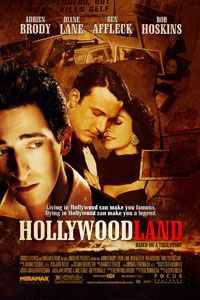
    Focus Features\' HollywoodlandThe death of George Reeves, television’s original Superman, in 1959 defined the loss of innocence for a generation.  There are many who remember where they were the moment they discovered Reeves’s body had been found, the victim of an apparent suicide.

    The lore surrounding the event has even wound itself into incorrect information that perpetuates itself mythically, forever living on as one of Hollywood’s greatest mysteries –- or is there a mystery at all?

    “Hollywoodland” is a project that has seen a long road to the screen, bouncing from one studio to another and back again, enduring rigorous casting scrutiny and a number of raised eyebrows regarding the direction a screenplay based on these questionable events would take.

    Now the feature film debut of television veteran Allen Coulter, “Hollywoodland” is a vivid and self-propelling experience that lingers much longer than you would expect it to.

    In the film, Adrien Brody portrays the fictional private investigator Louis Simo, who makes his way from buck to buck stringing along suspicious husbands and picking at closed LAPD cases like a scavenger of public enforcement.  When he is tipped off to the notion that, following a quick investigation deeming Reeves’s death a suicide, Reeves’s mother believes her son was murdered, Simo embarks on a journey that will become much more personal than he would have ever intended.

    The Reeves story is told through flashback, with Ben Affleck (in his career best work) taking on the role of the tragically typecast actor who rose to stardom as television’s Superman.  Parallel to Simo’s investigation, we’re made witness to the long, inevitable and sad road Reeves travels, at once a handsome lady-killer and a depressed dreamer.

    You see, Reeves was cut from the classic movie star mold.  Cary Grant, Clark Gable and Spencer Tracy would have been fitting company for the talented thespian.  However, such stardom always seemed just out of Reeves’s grasp, and after ambivalently taking the role of the Man of Steel merely to make ends meet, he would endure the sort of fame that would forever seem cheap and lacking artistic context.
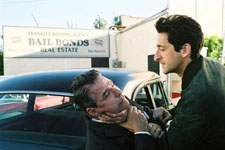
    Adrien Bridy in HollywoodlandWhen audiences were distracted by the actor’s iconic image during his scenes in Fred Zinnemann’s “From Here to Eternity,” the director inevitably had the work Reeves had put into the picture removed.  Suicide, it seemed, made complete sense to the community at large.

    The film takes time to properly examine three popular theories about how Reeves actually met his end.  The perspectives stem from a raucous girlfriend (Robin Tunney) peeved at the actor’s refusal to marry her being responsible, to former mistress Toni Mannix (Diane Lane) becoming so grief-stricken over his leaving her that her husband, MGM general manager Eddie Mannix (Bob Hoskins), had Reeves murdered – not the most implausible act in the eyes of many Angelenos.

    And, of course, the script – written by Paul Bernbaum – takes a thorough look at the classically accepted suicide theory, which certainly carries more legitimate pathos than any other.

    Brody’s work in the film takes a moment to really fit the character, but once he gets into the groove of a divorced father struggling to make his own ends meet, he taps into the personal ferocity that really begins to drive Simo after a tragedy late in the second act propels him to reassess his own perspective.  This is his first true starring role since his Oscar winning performance in “The Pianist,” and he reminds us exactly why he is worthy of the distinction.

    The supporting cast fills out in typical fashion, with Bob Hoskins and Diane Lane seemingly phoning their work in.  Though Robin Tunney really stands out as Reeves’s fiancé, Lenore Lemmon.  The real story, however, is certainly Ben Affleck, in a role that could easily be seen as too demanding given the work we’ve seen out of the actor in recent years.
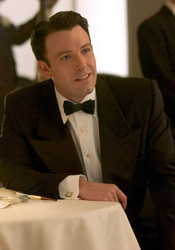
    Ben Affleck in HollywoodlandNo, in “Hollywoodland,” Ben Affleck shows us what he can do when he really wants it.  The actor took a sizeable upfront pay cut on the film (as did pretty much everyone), and while at first glance it may seem that his beefcake persona would laughably overpower the mythos of George Reeves, we soon discover just how tailor-made his screen presence is for the role.

    He captures the man in spirit, voice and mannerism like I certainly wouldn’t have expected, and perhaps many other filmgoers, casual and otherwise, will see the same awards-caliber work.

    When the film opens on September 8th, the Best Supporting Actor race may have truly commenced — or maybe the film will just stay low on everyone’s radar altogether.  But this is a savory, layered performance that does its job in context and is commanding as a supporting turn, giving us a character on which to base the events of the present – a character to care about, to root for and, all at once, to mourn.

    All things considered, Allen Coulter’s work on his first feature is capable and smooth-sailing, if unremarkable by virtue of necessity.  He never gets overly fancy, even with the unique structure, and he guides the film with the anonymous sort of hand that is certainly a positive thing.  This may well be the only cinematic testament to the legacy of George Reeves, and it is as thorough a testament as one could have asked for, despite dramatic twists and turns that might have been more suitably trimmed for a tighter overall experience.

    In the end, however, a focused performance in the film’s background works off of a truly driven performance in the foreground to give an appropriately rounded take on what has to be considered one of the most devastating events in television history.