In Contention

Tag: Anne Reid

  • Queen’s Honors for Harwood, Zeta-Jones, Okonedo

    Capping what was a pretty decent day for South Africa yesterday, one of the country’s most notable cinematic sons, Ronald Harwood, was accorded a knighthood in yesterday’s Queen Birthday Honors list. The Oscar-winning playwright and screenwriter (“The Pianist,” “The Diving Bell and the Butterfly,” “The Dresser”) is the only film figure granted that top honor in this year’s list. He offers this quote in response:

    “I was truly surprised and greatly delighted to learn that I was to receive this honour. I arrived in England in 1951, at the age of 17, from South Africa where I was born in the hope of making my way in the great world. So it has been a long, fruitful and immensely enjoyable journey, crowned by this splendid reward for which I am deeply grateful.”

    Lower down on the list is a trio of British actresses; most elevated among these is a second 2002 Oscar champ, Catherine Zeta-Jones, who was named a Commander of the British Empire for her film and charity work. (Okay, a CBE, but I like the mental image of the “Chicago” star commandeering an entire empire. You know she would.)

    (more…)

  • The Great Performances: 2004

    Paul Giamatti in SidewaysIn Alexander Payne’s “Sideways,” Paul Giamatti gave the best performance by an actor in 2004, so said the New York Film Critics Circle, and how right they were.  So why, why, why was the actor denied an Oscar nomination?  Granted, it was a strong year, but his work was at the top of that heap and that snub was one of the biggest shocks of the year.

    Here was a man giving perhaps the finest performance in a comedic film since Dustin Hoffman in “Tootsie.” His co-stars go were recognized, save for the equally deserving Sandra Oh, but the leading man, around whose performance the film stands, is snubbed.  All I can remember saying is: “Wow.”

    Certainly Jamie Foxx deserved the attention he received for “Ray” and Leonardo DiCaprio was astonishing in “The Aviator,” even though he drew some criticism for before too youthful in the role. Rubbish, I thought.  He was superb, inhabiting Howard Hughes as he must have been in those days, brash, cocky, wealthy and willing to do anything that interested him.

    Clint Eastwood was terrific in “Million Dollar Baby,” while Jim Carrey gave a wonderful performance in “Eternal Sunshine of the Spotless Mind” — a marvelous piece of acting, in fact.  Equally fine, and dark, was Kevin Bacon as a pedophile struggling to start anew in “The Woodsman,” which was one of the most daring American films in a long time.

    (more…)

  • Cougar in a corset

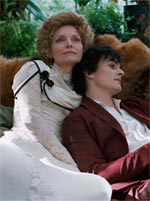
    Michelle Pfeiffer and Rupert Friend in CheriJane Shilling has a piece at the Telegraph about the gender politics of “Chéri” — specifically, the social disruption engendered by a romantic relationship between a middle-aged woman and a young man.

    Describing “Chéri” author Colette, and by extrapolation the character of Léa (played by Michelle Pfeiffer in the film), as “the original cougar,” Shilling suggests that the story of her love for a man half her age is more provocative to a contemporary audience than the first readers of the 1920 source novel:

    A couple of weeks ago in Grazia magazine an article appeared about a fascinating modern phenomenon. “Until recently,” wrote the author, Rita Sangha, “a woman dating a much younger man was likely to be ridiculed. But things have changed. Thanks to stars like Madonna, a ‘cougar’ – an older woman dating a younger man – isn’t seen as desperate: she’s glamorous and in charge of her own destiny.”

    Perhaps, she would have been amused – though not surprised – to discover that the seductive alchemy of a love affair between a middle-aged woman and a boy young enough to be her son would seem even more scandalous in 2009 than it did when she sat down to write it, 90 years ago.

    Shilling’s rather sketchy argument fails to bridge these two contradictory points — how is the so-called “cougar” phenomenon both laudable and scandalous? — though that perhaps accidentally echoes Colette’s own ambiguity on the matter. As I discussed in my Page to Screen article on the novel, Colette both defends Léa and Chéri’s generation-crossing relationship, but condemns a similar dalliance by of one of Léa’s peers as grotesque; the principal difference, it seems, lying in the two women’s levels of physical attractiveness.

    (more…)