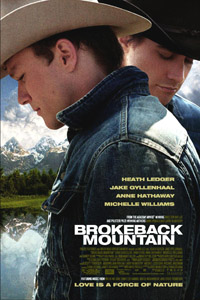
 It is the true mark of artistry that guides a hand away from the simplistic and into the complex.
“Brokeback Mountain” is and has been poised to merely be considered “the gay cowboy movie,” a label I’ve defended it against ever since I first read E. Annie Proulx’s short story (which originally appeared in The New Yorker).
In the final analysis, however, director Ang Lee strikes so many right chords in the film, which took eight years to find its way to the screen, that one comes to forgive moments of melodrama that creep into an otherwise emotionally raw narrative.
The story revolves around two ranch hands, Ennis Del Mar (Heath Ledger) and Jack Twist (Jake Gyllenhaal), who come to form a close bond while sheepherding for extra income over the summer of 1963.
A chance moment of absolute comfort overtakes the two men one night, and that bond becomes a sexual one, but more appropriately, a sensual one. Their lives soon part ways, and years go by before they reunite for the first of a number of getaways to the mountains of Wyoming, both with wife and child at their respective homesteads.
The story would be a tightrope walk for any seasoned filmmaker. Indeed, as Del Mar notes of the forbidden passion he and Twist share, “there ain’t no reins on this one.” It is an applicable statement to the tale itself, and like Twist’s rodeo cowboy, Lee takes the thunderous implications and bucking ferocity of the story in stride, riding the beast the full eight seconds. In so doing he elevates the chronicle above the physicality which can unfairly precede it.
What struck this viewer most is that Lee reveals the thin line between love and hate with absolute expertise. Pain is a natural byproduct of intense passion. When Ennis punches the wooden walls of a façade –- after what he presumes to be the last time he’ll ever see Jack –- the reaction is both to the pain of loss and the anger he feels toward something clutching his heart so authoritatively. Let alone any thoughts that he may feel disgust for the act he has committed, surely the last thing he’d expect to have happened. This is quite apparently the first time Ennis Del Mar has ever fallen in love.
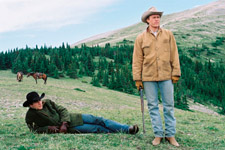 The performances largely represent the correct emotional cachet across the board. Ledger’s seedy, love-struck cowboy is the standout. He lurks between his own surface, a character inside an entirely different persona. At once guarded and intense, this has to be seen as the actor’s finest work to date.
The moment he claims “I’m nothing, I’m nowhere,” it becomes one of the truest depictions of the trappings of desire and ardency we’ve seen on screen.
Much credit is due to a well-assembled and emotionally investigated screenplay from Diana Ossana and Larry McMurtry, but Ledger’s task was a challenging one regardless of the words provided.
Suitably boring is Ennis’ wife Alma, played rather succinctly by Ledger’s real-life sweetheart Michelle Williams. The performance gives us another level of understanding when Ennis flees away to the mountains with Jack, as his “real” life becomes a slow, uneventful process lacking any real passion or excitement. Alma’s distress and shock at the knowledge of her predicament plays well through pained eyes. The difficulty, however, lies on the other side of things.
Jake Gyllenhaal slips over the top a bit too often as Jack Twist, both in times of joviality and in times of sincerity. He really hits his stride, however, once the character begins to age over the course of the narrative’s 15 or 20 years, as we see the toll longing and idolatry have taken on him.
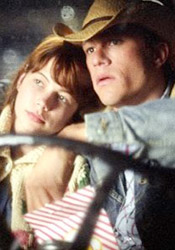 It has to at least be said that Gyllenhaal has come into his own this year, both through this performance as well as through his controlled portrayal of an equally emotionally secluded young man in the underwhelming “Jarhead.”
Anne Hathaway has a presence as Twist’s wife, Lureen, which overrides the function of the character. Her face is so bold and her performance so over-baked that it really clashes with the intent of the role.
The relationship between Jack and Lureen just isn’t as thematically potent as the relationship between Ennis and Alma, due largely to this, and if there is a weak link in the case, I’d consider Hathaway as such.
Regardless of imperfection, what we have in Brokeback Mountain is a brutal account of tragic love. It’s one of the oldest stories in the book, but Lee’s conviction and dedication to the core of Proulx’s wonderful story, in every waking aspect of the film’s creation, is what assists it in vaulting quite capably beyond simple-minded nonsense.
Such a perception could easily have been detrimental to understanding the affecting symphony being composed here.
 What can be said of the fearless Edward Norton, who recently became an on-screen comic book hero? I never understood his choice to take on the role of Bruce Banner, a.k.a. The Incredible Hulk. And now, post-release, I’m still puzzled.
 When Ang Lee set out to direct the first feature film adaptation of Marvel’s Incredible Hulk property five years ago, some things were…different.