 M. Night Shyamalan is an artist like any other. There are a lot of potent ideas and whims of fancy bouncing around inside his inarguably creative mind. He is, in all likelihood, just as his representation in the American Express commercial, discovering vibrant new details worthy of expansion at every step of the way.
However, as a filmmaker, Shyamalan has never found the appropriate balance for fully realizing his themes and notions. For all of the discussions he wishes to have with his audience, for all his attempts to represent each of them completely, the insularity of his concepts gets the better of him every time out. Such is the case with “Lady in the Water,” a film far less deserving of the inevitable wave of detest coming its way, whatever level of failure it may exist upon.
In the film, Paul Giamatti plays Cleveland Heep, a man lost in his own sorrows and retreating to the far reaches of an anonymous apartment complex in Philadelphia. As superintendent, Cleveland has carved out a position of semi-importance and purpose, but one easily filled by anyone, as he well knows.
That would be, in Cleveland’s mind, the point –- the more invisible his existence the better. Why that is, we are left only to imagine for a while, but we discover the tangibility of Cleveland’s discontent in due time.
The complex itself is filled with an assortment of colorful characters, from the raucous and inebriated band, to the unnecessarily unique father specializing in crossword puzzles, to the former author and current animal-loving old lady, to the Asian mother and her wacky/sexy daughter. Then there is the scientifically driven young man committed to working out only the right side of his body, the Latin family fit with five daughters…oh, and let us not forget the disenchanted and wonderfully cynical film critic, truly obvious in its purpose as a character.
The writer/director himself, of course, turns up in the film, in a much more layered role than he has filled in the past, proving that sometimes he just might be a better actor than he is a writer.
Late one night, Cleveland discovers a girl swimming past curfew in the swimming pool of the complex. After a routine slip-and-fall on the deck, Cleveland is rescued, as it would seem, by the mysterious girl. He is then left to wonder who this odd, comfortably naked and somewhat aloof individual is. We learn this information through the (at first glance) woefully expository story from the Asian firecracker, a story held amusingly out of context for much of the film.
 However, critiquing the story of “Lady in the Water” from this point forward in any traditional sense would be a drastic mistake. It is at this moment – discovering the girl is a sea nymph named Story hailing from The Blue World – that you truly have to let yourself be taken with the fantasy of it all if you are to derive any enjoyment in the matter.
And that statement reads much more typically than it should.
The point is there are elements at work here that command a literal release of the plot. You really and truly must reduce yourself to childhood. No one would look for sensible justification in a big, bad wolf dressing in a grandmother’s night gown, but there are lessons there to be learned all the same.
Fortunately, the above-mentioned humor is a tool Shyamalan uses quite well to keep the balance on the ludicrous nature of this yarn. It isn’t lost on him that his story is terribly contrived, even for a “bedtime story.” But it isn’t the plot he is interested in here, so much as the characters. In this fashion, “Lady in the Water” is perhaps the first true character study of Shyamalan’s career.
The film is not merely about finding one’s place in the world. It is about having the courage to face that place, and assuredly, much as with “Signs,” the filmmaker uses this opportunity to speak to fate and faith throughout. Cleveland is a man with a painful past, one that he believes will abandon him if he abandons it. But such considerations are inherently foolish. We are not only sculpted by our past, we are owned by it. We are owned by it until we sum up the fortitude to accept it, and through a fantastical, absolutely incoherent fable, Shyamalan makes this point clearly.
What will certainly be lost in the shuffle of criticism of is the conviction and passion that is more apparent here than in past efforts from the director, efforts that were drastically obvious attempts at capitalizing on that fated moniker “The Next Spielberg.” It will be more fun in our typically lazy analytical film community to draw blood. Ironically enough, most points of negative concern will be viable. But they will be defeatist all the same.
Paul Giamatti truly is a saving grace here in many respects. As a stuttering, introverted and simple man, Cleveland is a curious anchor for such a story. However, dazzling as always, Giamatti sells his side of things like a champ. Conversely, the rest of the cast is filled out on the page in an extremely flat manner, all of them serving a pre-ordained purpose in the story. But Cleveland is a complex and interesting character whose ins and outs deserved the right attention.
 As the mysterious Story, Bryce Dallas Howard is appropriately creepy, and, I guess, appropriately detached. However, I don’t know how one would begin to critique a performance like this. When you get right down to it, it’s all external – every bit of it.
Jeffrey Wright, Bob Balaban, Bill Irwin, Freddy Rodriguez and Sarita Choudhury fill out the rest of the principle supporting cast, elementarily conceived characters on the whole, but organic to the tale all the same. And, in most cases, the actors do a fine job of elevating their roles ever-so-slightly.
The problem with “Lady in the Water” is a rather significant one, though. Tonally, it is even. Thematically, it could use some work, but the elements are there and coherent. Performances are as good as they were going to get. The filmmaking is, as always with Shyamalan, top notch. He remains visually dynamic as a director.
No, the problem with Shyamalan and his latest effort is the same issue he has had for six years. He cannot seem to understand that the role of the artist is not infinitely solitary. That, my friend, would be a real “bedtime story.” If you roll with something as risky as this on your own, you are bound to trip and stumble, and who will be there to catch your fall? Better yet, who should be?
Maybe that is the sort of risk Shyamalan is attracted to taking, but you can only fall so many times before you can’t help yourself up anymore. Shyamalan is getting to that point.
Ultimately, this is a filmmaker with a choice to make. With “Lady in the Water,” he has concocted, again, a string of interesting ideas that he cannot fully develop. His central theme rings true. However, there are so many particulars that threaten depth and yet remain on the periphery, it becomes apparent that Shyamalan is a director, however talented, lacking the maturity to understand that art is not a singular achievement – and a film is anything but.
It is the mark of professionalism to trim the fat. This seems to be lost on Shyamalan. Furthermore, the lessons he learned (or perhaps did not learn) on “The Village” were taken personally and manifest themselves in aspects of “Lady in the Water” in very petty ways. The lessons he has been avoiding on his latest effort already show the signs of potential insularity once again, taking to chastising a studio that had every right not to believe in a project that, however booming in potential, just wasn’t there yet.
The golden child simply hasn’t allowed the industry to break him, and his humility is nowhere to be found. That vicious cycle has produced terrible filmmaking since the dawn of cinema, and Mr. Shyamalan is dangerously close to the same precipice. Perhaps it is time for him to stop listening to the voices inside his head, and start lending credence to the voices outside.
 “Babel” is the crowning achievement in the early careers of writer Guillermo Arriaga and director Alejandro González Iñárritu. It will deservedly be seen as that defining moment which took them out of personal thematic expression -– the mark of a true artist -– and into the arena of global and human consciousness through artistic dexterity -– the mark of something much more.
 Vacationing and searching in vain for themselves and their emotional connection once again, Richard and Susan have recently lost one of their children. Neither has recovered, and neither has found the ability to forgive the other.
 The most captivating and award-worthy performances in the film, however, come from Adriana Barraza and, most especially, Rinko Kikuchi. Barraza’s conflict is so frightening, and eventually, so terribly desperate, that it could burden the shoulders of the most gifted of actresses. She commands the role in such a way that we feel for her wholly, in ways both humanitarian and political in nature.
 Michael Mann’s “Miami Vice” is a terribly anxious piece of filmmaking. By its own erratic and rote design, the film marks, at once, a substantial step down for the writer/director, and merely a lateral move in the realm of stylistic representation.
 There is then an assortment of expected character types, from the introverted, consistently pondering drug kingpin (Lois Tosar), to the weasel-ish middle man who smells something fishy (a rather diabolically entertaining John Ortiz), to, of course, the tough-as-nails businesswoman-slash-kingpin girlfriend (Gong Li). This triumvirate of typicality is painfully derivative from the get-go, but we’ve seen Mann take the cliché and turn it into stylistic substance before in “Collateral,” so assuredly one could expect as much once more. Sadly, no such turn of events is in store.
 Li, however, seems forever uncomfortable in a position we are meant to believe is some saving grace for her. She shares the solitude of Crockett, the loneliness. That is their common denominator, and the single thread with which we are to buy this romance. But she does not sell that notion in the slightest. She seems almost lost in her character’s dialogue and motives. Who is this woman? Beyond a random anecdote about her mother – a lone wolf in her own right, it seems – from whence does Isabella come? We do not know.
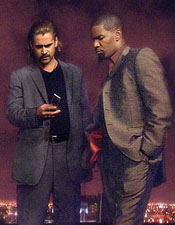 All this talk of the varied cast (however clichéd) has left me little time to fully discuss the technical aspects of the film, all a step down from the vibrant “Collateral,” yet still a move in the right direction for digital cinema.
 Jonathan Dayton’s and Valerie Farris’s “Little Miss Sunshine” is the rare example of the quirky and fringe actually having something to say.
 Richard and Sheryl’s son, Dwayne (Paul Dano), has taken a vow of silence in preparation for his dream of becoming an air force pilot, fit with a “fuck off” attitude and a token bedroom poster depicting the iconic image of Friedrich Nieztche.
 Dano exudes the sarcastic Cobain lyric “teenage angst has paid off well” with every hooded glance or unaffected beat. Most will remember him for his stirring work opposite Brian Cox in 2002’s “L.I.E.,” but his performance here is of a completely different emotive breed.
 When he was appointed to bring one of the most socially complex comic book series to the screen in the form of 2000’s “X-Men,” director Bryan Singer had in front of him the opportunity to usher realism and tangibility into the genre.
 Wasting away in prison, formulating a plot for revenge all along, Luthor has grown to despise the Man of Steel and everything he represents more than ever. And we believe it. Gone is the zaniness of Hackman’s comic relief (mostly, anyway) and in its place we are met with a true testament to the viciousness this character is and has been capable of.
 The rest of the ensemble rounds itself out quite nicely. Frank Langella is a wonderfully hard-nosed Perry White, while James Marsden embodies a man with many of Kal-El’s characteristics –- we can see why Lois would have fallen for him. Sam Huntington puts forth a fun Jimmy Olsen and Eva Marie Saint (though lacking in screen time of consequence) is a warm spot in the film as Martha Kent to say the least.
 I finally got around to seeing the first 9/11 theatrical release earlier this week, Universal’s “United 93,” and the feelings it digs up, the questions it actually asks without hitting us over the head, and the overall commitment to ultra-reality that director Paul Greengrass is proving himself to be the master of, will all make it a unique entry in the coming wave of films rooted in that horrific day.
 Spike Lee’s “Inside Man” is an embarrassment of devices from start to painstakingly anti-climactic finish. As a run-of-the-mill heist romp, it still falls prey to a dedicated intention to distinguish itself, both thematically and stylistically.
 On top of it all –- and you’ll make your mind up for yourself on this one -– the secret, which Gewirtz feels is strong enough in and of itself to make the viewer root for Russell’s thief, doesn’t exactly do that job in full. I was left siding with Plummer’s philanthropist in some small way in the matter. Gewirtz gives us every reason to forgive him, to be honest, as he paints the character in a manner that is becoming of someone who has atoned. The sheer fact that he would expect me to turn an about face is somewhat insulting. The world isn’t black and white. But, again, you’ll make your mind up on this one.
 This is not nearly the sort of ambiguity and anonymity of intentions that speaks truths to the human condition or anything of that nature. This is a character, intriguing in his actions and objectives as it is, painfully lacking back story and motivation. There is no question that molding the character out somewhat in this regard would have done wonders for the overall thrust of the plot, but this is screenwriting 101 if you ask me.
 When hip-hop artist Eminem was nominated in 2002 for the Best Original Song Oscar for his track “Lose Yourself” from Curtis Hanson’s 8 Mile, he did not attend the ceremony and therefore the song was not performed per tradition. Musician and co-nominee Luis Resto was on hand to accept the award.
 This story will break in the trades tomorrow, but here’s the scoop.
 It’s time to really round out the year and offer up my picks for awards in 2005.
 Customarily, here in the midst of our year in review, it is time for me to fill out my ballot.
 Not to start my “Best of the Year” column off on a down note, but from the word go I had the slightest, nagging inclination that 2005 was going to be one of the most disappointing cinematic years we’ve come across. In many ways, my fears were realized – in some cases ten-fold.
 Steven Spielberg’s “Munich,” the big, mysterious player in this year’s Oscar game, has come. And as anyone could have expected, no film could have held up to the expectation.
 I don’t feel like writing passionately about “King Kong” in the slightest. What I can say with utmost conviction is that the film affords too much of EVERYTHING. The story is bloated, with subplots that could have been fleshed out more succinctly by capable hands (I contend that Peter Jackson is not the most gifted director when it comes to combining the dramatic and the spectacle, even if he is quite gifted at relaying them separately).
 Jeff Wells is half right when he says “There’s a new Best Supporting Actress contender in town…10 year-old Georgie Henley, the soul and natural light-beam of ‘The Chronicles of Narnia: The Lion, the Witch and the Wardrobe’…came out of nowhere…but she’s Drew Barrymore in “E.T.” without the cloying I-know-I’m-cute-and-you’re-going- to-adore-me attitude.
 I never saw the stage production of Mel Brooks’s “The Producers.” It was the certifiable “it” item of the 2001 Tony Awards (taking in a record-breaking 12 wins).
 The problem with Woody Allen’s most recent effort, the multi-lauded Cannes favorite “Match Point” is that we’ve seen it all before. The writer/director has approached the exact same territory before albeit on this side of the pond.
 It is the true mark of artistry that guides a hand away from the simplistic and into the complex.
 The performances largely represent the correct emotional cachet across the board. Ledger’s seedy, love-struck cowboy is the standout. He lurks between his own surface, a character inside an entirely different persona. At once guarded and intense, this has to be seen as the actor’s finest work to date.
 It has to at least be said that Gyllenhaal has come into his own this year, both through this performance as well as through his controlled portrayal of an equally emotionally secluded young man in the underwhelming “Jarhead.”