In Contention

Blog

  • Brown-eyed talent

    Thirteen year-old BRANDON WALTERS (Nullah) was discovered by director Baz Luhrmann through a nationwide casting search for a young Aboriginal boy to play the crucial supporting role. After Walters participated in a series of workshops with the director at Fox Studios Australia, Luhrmann traveled to the aspiring young actor’s hometown of Broome, in Western Australia. With the blessing of the boy’s family, Luhrmann offered him the part.

    This is Walters’ film debut.  Walters, who grew up in a remote West Australian town and survived leukaemia at age seven, has already foreshadowed a career in showbiz, saying he was keen to visit the US.  “It’s my dream to go to America. I have to wait and see,” he said.

    From the production notes of Baz Luhrmann’s “Australia.”

  • ‘Soloist’ pushed further back

    After initially being booted out of awards season into the cinematic no man’s land of March 2009, it seems Joe Wright’s “The Soloist” has been rescheduled yet again.

    It’s now apparently slated for release on April 24, which sounds like a beneficial move into early summer-movie territory. Read into that what you will. Perhaps it’s a vote of confidence in the film’s commercial viability, though I suspect this is still no awards contender.

  • The trouble with Oz

    I’ll get into why “Australia” is a problematic film that gets lost in its own ambitions when I review the film in a short while. For now I’ll speak on the positive. We’ve been hearing for some time that young aborigine actor Brandon Walters will turn some heads in the film, and truly, a star is born. A diamond in the rough.

    The rest — not so much. More later.

  • Oprah talks ‘Button’

    So, Oprah tried to work her magic last week on “Australia” — today she’s turning her attention to “The Curious Case of Benjamin Button,” with Brad Pitt and Cate Blanchett both appearing on today’s show.

    I guess you can expect a lot of Brangelina talk if that floats your boat, but hopefully, they’ll find some time to talk about the movie between all that. Tune in if you’re interested.

  • Ebert sidles up to ‘Deep Vote’

    UPDATE: I was in a bit of a rush earlier, but reading it again in more detail, I suspect these are not the thoughts of an AMPAS member, but Ebert’s own predictions in playfully disguised form. Still an interesting read, but several pinches of salt perhaps required.

    EARLIER: Heath Ledger will win the Oscar next February. It’s a done deal. The other four nominees may as well not show up.

    That’s not my opinion there. It’s that (albeit in paraphrased form) of the so-called “Deep Vote,” an Academy insider who recently shared his perspective on the race with Roger Ebert. In an amusing post on his website, Ebert has written up the conversation he had with his mole, and runs through Deep Vote’s other picks — some of which are a little more surprising than the one divulged above.

    I always take such perspectives with a grain of salt — just because someone is a member of the Academy, after all, doesn’t mean they can read the minds of 6,000-odd other voters. But it does provide some interesting insight into which names are in play and generating heat, even if I find it hard to square with certain proclamations.

    For example, I’m sceptical that Jonathan Demme is a “lock” for a Best Director nomination, as is claimed here. It does suggest, however, that there might be more support for him than I expected. I was also interested to see that he has “The Curious Case of Benjamin Button” in his “maybe” pile for a Best Picture nod, behind the likes of “Slumdog Millionaire,” “Frost/Nixon,” “Revolutionary Road,” “Doubt” and “The Reader.” And I liked this tidbit, which suggests he’s a bit more sophisticated than the average AMPAS voter:

    ‘Synecdoche, New York’ is easily good enough, but they’re embarrassed you had to explain it to them.”

    (more…)

  • It’s not just Oprah

    Looking across the early reviews, I think it’s fair to say that “Australia” has cleared the first hurdle. They’re mixed, for sure — hardly new territory for Baz Luhrmann — but there’s a lot of admiration out there, even within the kvetching. There were a number of voices out there anticipating an outright disaster, but so far, it doesn’t sound like one to me.

    The harshest takes so far seem to have been from the Australian press, which isn’t at all surprising. People are more liable to be aggravated by the romanticisation of their own culture than one foreign to them, after all. And “romanticisation” is the operative word here; as with “Moulin Rouge,” one clearly has to buy into Luhrmann’s fanciful stylisation to appreciate the film.

    Screen International obviously did, even if they’re a bit winded by it all:

    Luhrmann has fearlessly gone for the biggest, lushest goal he could imagine — a romantic, old-fashioned epic to stand beside “Gone With the Wind.” Though it fails to reach such Hollywood heyday heights, “Australia”‘s combination of high adventure, awesome landscapes and panting passions is sure to bring out romance starved adult audiences … If the restless richness becomes somewhat indigestible before the film’s considerable length is reached, that’s part of the Luhrmann package. Who else would dare such excess?

    Jackman is the epitome of handsome, untamed individualism: Kidman tempers haughty stridency with a delicate comic playfulness, touching in a scene with young Nullah where she teaches him, with no confidence in her own ability, to sing Over The Rainbow … (Brandon) Walters, aged 12, is perfect as the beautiful, troubled Nullah.

    Technically, this is ravishing, from production and costume designs from Catherine Martin to DoP Mandy Walker’s often-majestic footage. Australia is long on digital effects, mostly to good purpose, though some of the wartime Darwin harbour wide shots are wisely held for the briefest of seconds … The soundtrack is a potpourri of heightened effects and soaring musical themes.

    (more…)

  • 11/19 Oscarweb Round-up

    Kate Beckinsale• David Poland misses the stylistic point of “Revolutionary Road.” [The Hot Blog]

    • Anne Thompson is on the right track, though. [Thompson on Hollywood]

    • Dave Karger digs into the Oscar prospects of the elusive “Seven Pounds.” [Entertainment Weekly]

    • Pete Hammond covers the week in screenings, much of which you’ve already read here.  But he gets more second-hand gossip that Clint Eastwood knocks it out of the park in “Gran Torino.”  Press-at-large screenings start in two weeks. [Notes on a Season]

    • Michael Ordoña talks to Nicole Kidman and Baz Luhrmann (the L.A. Times are getting the royal Fox treatment lately) about “Australia.” [The Envelope]

    • Tom O’Neil talks “Nothing But the Truth” with star Kate Beckinsale. [Gold Derby]

    • Someone call the medic, Grandpa is hearing voices. [Peter Bart]

  • THE LISTS: Top 10 films of the 1970s

    (from left) Dustin Hoffman and Robert Redford in All the President's MenWhen critics and historians of the cinema sit down to discuss uh, cinema, the conversation almost always turns to the great decades in movie history. And n nearly conversation I’ve been a part of, the 1970s reigns supreme as the single decade of brilliance.

    It was a time of enormous artistic growth for film, as up-and-coming directors grabbed Hollywood and ran with it, merging their love for cinema and the works of John Ford, Billy Wilder, and Elia Kazan (among others) with their own fresh ideas. And the releases of “Bonnie and Clyde,” “The Graduate” and “2001: A Space Odyssey” had already announced the arrival of the new American cinema by the end of the 1960s.

    But the next 10 years brought us Francis Ford Coppola, who exploded onto the scene wit four brilliant works and mentored many of the younger directors of the time. Steven Spielberg would earn the name “whiz kid” for his incredible visual storytelling gifts that would eventually make him one of the greats of all time.

    Martin Scorsese was making unsettling character studies that alarmed the studios but thrilled critics and actors, who felt challenged by his work. Woody Allen evolved from comedy writer, to comedic actor-director, to world-class filmmaker by the end of the decade. And Oscar winning film editor Hal Ashby would make a name for himself behind the camera with a swath of works.

    Sidney Lumet, William Friedkin, Peter Bogdonavich, Bob Fosse, Roman Polanski, Bernadro Bertolucci, Alan J. Pakula, Milos Forman, and Michael Cimino would all leave their mark in the 1970s and continue directing to varying degrees of success in the 1980s and beyond.

    Society heavily impacted the work as films about the war in Vietnam dominated much of the 70s’ final years. Watergate raged mid-decade. Stories were plucked from the headlines and committed to celluloid. Movies were exciting, well made, and interesting. Films like John Frankenheimer’s “Black Sunday,” Milos Forman’s “Hair” and Don Siegel’s “The Shootist.”

    Big budget disaster films enlivened the trade, along with movies about divorce, drug addiction, mental illness, organized crime, vigilantes, prostitution, and countless other topical issues that were explored with great courage on screen. I found narrowing it down to a 10 best list to be nearly impossible and enormously frustrating because some the films left off the list should really be here. But that’s just a testament to the era’s resilience.

    (more…)

  • INTERVIEW: Rosemarie DeWitt

    Rosemarie DeWittRosemarie DeWitt is excited.

    It can be difficult to gauge emotion in the formal, slightly removed context of a phone interview, but DeWitt’s warm, clear voice betrays an eagerness right from the get-go, articulating thoughts at a pace that occasionally exceeds my shorthand. Only when addressing the heady buzz of awards season does she finally pause to reach for words.

    “It’s crazy, seriously crazy, but more than anything, it’s just really flattering,” she says.  “This is the best job I’ve ever had, and I’m so, so proud of the film. Anything more than that is just…” A moment passes as she takes a breath, and considers the matter. “Wow,” she concludes simply.

    The film in question, of course, is “Rachel Getting Married,” Jonathan Demme’s barbed family drama that has been widley declared the filmmaker’s return to form after some years in the wilderness. The buzz, meanwhile, is for DeWitt’s subtle, complex turn in the title role, which has garnered considerable plaudits for the hitherto low-profile 34-year-old actor, a frequent stage presence only recently receiving her due on screen, both big and small.

    Best known until now for her tart, sexy portrayal of Midge, Jon Hamm’s bohemian city mistress in TV critics’ darling “Mad Men,” DeWitt is calling from Los Angeles.  She’s just finishing work on another cable series, “The United States of Tara,” a dark, high-concept comedy created by Diablo Cody and starring Toni Collette (an “absolute genius,” DeWitt gushes).

    All of which would be enough to get excited about without Oscar talk being thrown into the mix. But as Rachel, the older sister of Anne Hathaway’s self-destructive addict Kym, DeWitt’s attentive, commendably unflattering performance finds itself right in the thick of the Best Supporting Actress competition. Hers is, for me, the most resonant performance in a film that doesn’t want for thespian fireworks, largely because DeWitt never pushes Rachel into the stock character of the saintly, long-suffering sibling.

    (more…)

  • 11/18 Oscarweb Round-up

    Coraline• Jeffrey Wells responds to the documentary short list. [Hollywood Elsewhere]

    • Dave Karger and Missy Schwartz go back and forth on the Oscar prospects of “Slumdog Millionaire.” [Entertainment Weekly]

    • T.L. Stanley catches up with a report from the “Revolutionary Road” screening this weekend. [Gold Rush]

    • Peter Bart whines about a lack of Oscar ads…again.  And insultingly draws the conclusion that studios are hanging talent out to dry.  Again. [Variety]

    • Patrick Goldstein chastises Bart for the whining (fair enough), but in calling for a moratorium on ad buys, fails to understand that their existence might have something to do with the fact that he hasn’t had to accept a buy-out yet.  Just sayin’. [The Big Picture]

    • Reporting with the Dudes from the “Big Lebowski” festival. [The Guardian]

    • Kathy Marks reports from the ground at the “Australia” premiere in Sydney. [The Independent]

    • Alonso Duralde runs down 10 competitors for Best Picture. [MSNBC]

    • Mickey Mouse turns 80. [CNN]

    • David Frank comes up with 10 reasons not to make a third “Batman” film.  Kris Tapley hunts David Frank down with a pair of garden sheers. [Rope of Silicon]

    • Helen Mirren talks about the joys of being in her birthday suit. [The Times]

    • Susan Wloszczyna talks to Henry Selick about the upcoming “Coraline.” [USA Today]

    • Praising the film for the most part, Glenn Kenny hopes “Revolutionary Road” can find an audience. [Some Came Running]

  • Oops…sorry Kathy

    I just realized that in this morning’s chart update, I forgot to add Kathy Bates to the list for her performance in “Revolutionary Road.”  She is most definitely in the running.  Next week.

  • Is Viola Davis stealing Meryl Streep’s Oscar thunder for ‘Doubt?’

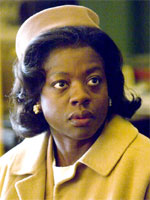
    Amid the conflicting reviews that have emerged so far for John Patrick Shanley’s “Doubt,” the one common denominator between them appears to be unanimous praise for the supporting performance of Viola Davis. You may remember Kris describing her work as “gut-wrenching,” amid an otherwise tepid review.

    Davis’ role may be small — she has a mere two scenes — but as the Academy has demonstrated in rewarding Beatrice Straight in 1976 (or in nominating Ruby Dee earlier this year), brevity is no obstacle when they are sufficiently moved by a performance.

    Knowing the role, I’ve thought for a while that Davis could wind up the film’s strongest contender for gold, despite many supposing the film would be The Meryl Streep Show. Streep, however, has suffered notices as mixed as the film’s, with heady praise balanced out by detractors (including a much-quoted Variety review) who find her performance a tad on the melodramatic side.

    Now Nathaniel Rogers at the Film Experience, whose deeply considered views on the female acting races are always worth reading, has seen the film, and he is also climbing off the Streep bandwagon. Venturing that Streep may have to wait a while longer for that elusive third Oscar, he writes:

    Sister Aloysius is a sticky role but it’s not the slam dunk “erase memories of Cherry Jones’s powerhouse stage creation”‘ it needed to be for Streep to reach Nicholson’s three statue tally. Best Actress fanatics take note: the way is clear for Kate Winslet (Revolutionary Road / The Reader) if she delivers –it’s getting harder and harder to imagine anyone else winning.

    (more…)

  • 15 Oscar docs short-listed

    And here’s the list, from AMPAS:

    “At the Death House Door”
    “The Betrayal (Nerakhoon)”
    “Blessed Is the Match: The Life and Death of Hannah Senesh”
    “Encounters at the End of the World”
    “Fuel”
    “The Garden”
    “Glass: A Portrait of Philip in Twelve Parts”
    “I.O.U.S.A.”
    “In a Dream”
    “Made in America”
    “Man on Wire”
    “Pray the Devil Back to Hell”
    “Standard Operating Procedure”
    “They Killed Sister Dorothy”
    “Trouble the Water”

    The surprising exclusions are “Religulous” (though not really — it isn’t particularly good as a documentary, even if it is amusing and has a soul) and “Bigger, Faster, Stronger.”  The frontrunners, I’d guess, “Encounters at the End of the World,” “Man on Wire,” “Pray the Devil Back to Hell,” “Standard Operating Procedure” and “Trouble the Water.”  But that’s me.

  • Variety weighs in on ‘Revolutionary Road’

    UPDATE: We’re not out of the woods yet. The Hollywood Reporter gives it the thumbs-down, something I didn’t notice earlier, as the review was buried in their impossible website. (Seriously, guys, work on it.) Anyway, Kirk Honeycutt calls it “didactic” and “emotionally overblown,” and has nothing to say about the performances.

    On the other hand, Honeycutt makes no secret of his disdain for the source material (“it fails to escape the novel’s misogyny and contempt for anything suburban”), so make of that what you will.

    EARLIER: And it’s good news, even if they have some reservations. Unlike Kris, I haven’t had the privilege of seeing this yet, but it sure as hell sounds like an across-the-board contender to me:

    “Revolutionary Road” is a very good bigscreen adaptation of an outstanding American novel — faithful, intelligent, admirably acted, superbly shot. It also offers a near-perfect case study of the ways in which film is incapable of capturing certain crucial literary qualities, in this case the very things that elevate the book from being a merely insightful study of a deteriorating marriage into a remarkable one.

    DiCaprio often achieves the kind of double register the film as a whole less consistently captures, as he indicates Frank’s thought process in the split second before he decides what to say. At certain moments, the conjoined cerebral and emotional aspects of his characterization summon the spirit of Jack Nicholson’s breakthrough performances around the time of “Five Easy Pieces.”

    (more…)