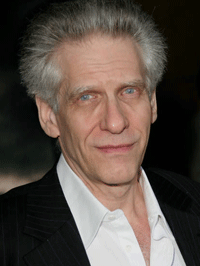
 Filmmaker David Cronenberg has made a career out of disturbing imagery. From James Woods shoving a videotape through his stomach in 1983’s Videodrome to James Spader getting off with a crippled Holly Hunter in 1996’s Crash; Jeff Goldblum spewing acid in 1986’s The Fly to the construction of a weapon made of human bones in eXistenZ, Cronenberg has found a knack for concocting horrifying cinematic incarnations.
His latest film, A History of Violence, opened in limited release last weekend. The film is, by and large, his most subtle effort to date. By that same token, it is also the most disturbing work of his career.
One would never expect such fantastic imaginings to come from the brain of this modest, quiet and unassuming individual. Mr. Cronenberg sits with Zen-like contentment when both surrounded by a roundtable of harping journalists, as well as in private, having just received news of a rave review from The New York Times. He is a man who seems very comfortable in his own skin, peering out at the world he envisions through piercing blue eyes, under furry mantle-like gray eyebrows. He seems quite capable of amusing himself through his work as an artist.
In terms of the media circus surrounding A History of Violence, the seasoned filmmaker is obviously winding down.
“I’m so ready to be silent,” he begins with exhaustion. “But sometimes one comes across interesting things from different angles. There’s a critic I met in Venice who said ‘why do we have to be so analytical about these things? Why can’t we just take it as a kind of wonderful thriller or something?’ I said, ‘well, of course you can.’ And if it doesn’t work on that level – this particular movie – if it doesn’t work on that level, then the other levels aren’t worth discussing because that’s the platform that everything else jumps off.”
A History of Violence stars Viggo Mortensen as Tom Stall, a truly iconic vision of the American way. After defending his small-town diner one night from two would-be murderers with a fell swoop of gory vengeance, Stall is thrown into the limelight and forced to confront an assumed disastrous past in the form of gangster ruffian Carl Fogaty (Ed Harris). What follows is a series of events that reveals layer upon layer of Stall’s character, but most interestingly, provides the basis for a familial breakdown as his wife, Edie (Maria Bello) and children, Sarah and Jack (first-timers Ashton Holmes and Heidi Hayes) are forced to endure the fallout and react in intriguingly different ways.
Josh Olsen’s screenplay is based on the graphic novel of the same name by writer John Wagner, but Cronenberg was not aware the source material existed until well into the process of rewrites – though he still views this as more of an original tale than an adaptation. Olsen’s early drafts had already begun a dissection of the character and situations and were taking the story to a much deeper and resonant place when the director came on board. But as a standalone piece of screenwriting, it doesn’t immediately leap out as a “typical” Cronenberg venture.
“There were a lot of things that interested me about it,” he offers, “but I think the main thing was the iconic Americana element – which is to say, it has elements of an American western, elements of a gangster movie. But I’m not just thinking of movies, because this isn’t really a movie about movies. It has to do with America’s mythology of itself. This small perfect town where everybody’s friendly and happy and what that really entails. So that was the primary thing.”
The next step in Cronenberg’s process of realizing A History of Violence on the screen was casting – something the filmmaker considers a “black art.”
“It’s a subtle, intuitive thing. There’s no rule book to tell you who to cast. So it all starts with the main character. You cast the main character to give you a certain tone. It gets very practical. The character has to be a certain age. He has to feel like he could live in a small American town, and feel like a member of the town – so there were a lot of straight-forward, practical things first.
“You can rule out a lot of actors because they’re too young, too old. But Viggo – I’ve been watching his career for a long time, and he’s the kind of actor I like the most, which is to say he has that charisma and presence on screen of a leading man, but he is not afraid to disappear into the role and to be eccentric and to be subtle like a character actor. So it’s a wonderful combination. That and also the fact that he has that iconic, American – not quite Gary Cooper, but something like that – feel to him.”
And Mortensen inhabits the character of Stall to a degree that his performance sails under the radar like a stealth bomber. The audience isn’t watching Viggo Mortensen on screen. They’re watching Tom Stall, and a level of performance undoubtedly worthy of critical and awards attention.
Alongside Mortensen, Maria Bello ignites the screen with a searing portrayal of a woman torn between the past and the future, struggling to make sense of the present. The chemistry that exists between Edie and Tom in the film sizzles at times, rumbles at others, but always exists in a true and defining form.
Of the casting of Edie Stall, Cronenberg offers more of his “black art” perspective.
“I’m like a marriage councilor,” he begins with a laugh. “I have to find him a wife, and I never get to see them in the same room together. So I meet Viggo. He’s going to do the movie. Now, who’s his wife? So in Toronto I met Maria, because she was shooting some other movie. And I was thinking of her for this movie, but I didn’t tell her. But basically I have to say, like a marriage councilor, yes I think these two people would make a wonderful married couple.”
Much like he has done at various times throughout his career, from Shivers to Dead Ringers to Crash, Cronenberg is very interested in the sexuality of his characters in A History of Violence. To that end, like no other filmmaker, contemporary or prior, he utilizes that basic aspect of the human condition to shed profound light on the subjects of his piece.
“The original script that I read, there were no sex scenes, and I asked the writers to write those. We discussed what the scene was. Because in sex, you’re very vulnerable psychologically and physically and emotionally, and that’s why I wanted those sex scenes because I wanted to know these characters that way. So then the question is: What is being revealed?”
Ever the open-minded craftsman, Cronenberg viewed the process as a collaboration with the cast.
“I let my actors look at [the monitors] whenever they want. A lot of directors don’t like to do that, to let the actors look at the monitors that are on the set, to show playbacks and stuff. I really want them to be involved and feel completely comfortable about what they’re doing, so they can see what they’re doing. There’re no secrets.”
There are a pair of sex scenes in the film, both intriguing and defining on this level or that. One of the scenes travels from brutal to passionate to indicative of the characters’ inner mechanics in one sixty-second series of beats. The nature of the scenes themselves would make one expect a level of reservation on the part of any thespian, but Mortensen and Bello took to it with staunch professionalism and insight.
“They were scared, but actors like to be scared. So do I. You don’t want to just play it safe all the time, you get bored. So, that was a scene that was scary – both of the sex scenes – because they’re people. When you do a sex scene, you bring your own sexuality to the scene, and that’s very revealing. It’s hard to hide who you are when you’re doing a sex scene, and that’s why people are sometimes reluctant to do it, but when you’re an actor, a good actor, that’s a challenge you want.”
The film’s namesake ultimately represents a dual meaning. It indicates a revelation concerning the character of Tom Stall, while at the same time commenting, in some way, small or large, on the very nature of violence as it pertains to all levels of existence – artistic expression, day to day life, inheritance of such virtues, etc. It’s a loaded phrase that ultimately sums up every point or counterpoint the film is attempting to make, and on some level, one could make the point that it provides a nice backing for the notion that the film is in some ways a commentary on David Cronenberg’s penchant for disturbing imagery in his filmmaking.
When approaching the specific scenes that speckle the film with dashes of violent rage and gore, Cronenberg saw it as an opportunity to comment further on characterization.
“I ask ‘where does the violence come from?’ It comes from these characters. ‘What is the violence to them?’ Where did they learn their violence?’ They learned it in the street and it’s business, so that means that it’s fast and it’s efficient and you get it over with and you go on to the next thing.”
Though he’d be quick to disagree with the thought that he is looking back on his career with A History of Violence.
“I wouldn’t say it’s a commentary on my other films. I think it’s dangerous for a filmmaker to get caught up in the mythology of his own movie making and to pay attention to it. I think that’s for critics to do – and for fans, if you’re interested. Not that I don’t take myself seriously, it’s just that I’m looking to the future, to the specifics of the moment. I’m not self-referential.
“There are artists – post-modernists – whose whole theory of art and what they should be doing is self-referential. If they’ve got a body of work, they’re constantly referring to their own stuff. But to me, that’s not something that interests me or excites me. Certainly, people who saw my early horror films and just thought of them as sort of low-budget, tacky horror films see them in a new light when they’ve seen my later films and they think that the later films shine light on them and illuminate them and they start to see things in them that they didn’t see before. And I don’t mind that, it’s just not for me to do that. That’s for somebody else to do.”
Truth be told, when gazing back at the lineage of Cronenberg cinema, self-referential or not, A History of Violence seems to tower above all other accomplishments. But would he also consider it his greatest effort to date?
“The cliché that you get when you ask that question is still accurate,” he begins, “and most people will say it’s like children. You have a whole bunch of children; you don’t really want one to be your favorite. Even if you had one that was your favorite, you’d probably suppress that and hide it from yourself because you have affection for all of them. You have mixed your blood with all of them and they’ve all taken something out of you and they express something of yourself.
“It’s also hard for me to separate what the movie actually is for a neutral viewer from what it is to me in terms of where I was in my life and so on, but that shouldn’t have anything to do with whether the film was your favorite in terms of its quality. It has more to do with where you were in your life and maybe the kind of shoot that you had and who you met on the shoot. This didn’t happen to me, but for example, if you met your wife on that shoot then maybe that particular movie was your favorite because you associate it with this wonderful personal thing that happened to you, but that of course wouldn’t mean anything to a normal viewer. So even at that point, for me to say one is my favorite, I couldn’t do it.
“It’s not like I feel unconnected to them all, but there is a time, like your children, when they go out into the world and they have relations with people you have nothing to do with, and they have their own life. I only watch them when I’m forced to because I’m doing a commentary for the DVD or something, which is a new form of torture. So I look at them because of that, but at the moment I don’t feel the need to.”
All in all, Cronenberg’s latest is his most accessible film to date. With that, and given his posterity in the business, the film is generating the highest level of Oscar buzz a Cronenberg endeavor has experienced thus far. But the director waves off such talk with fleeting humor and candid skepticism.
“I do have a vote. I am a member of the Academy. So I could vote for myself I guess. I remember when I did Dead Ringers, people said ‘Jeremy Irons will definitely win an Oscar nomination for playing these twins in this movie.’ It’s sweet when people talk about Oscars for this movie, because what they really mean is they like the movie a lot, and I appreciate that.”
A History of Violence carries with it a bounty of lessons, morals, indictments, what have you. Any given number of interpretations and levels of insight could be read into the seemingly simplistic journey of the narrative, but even when pressed, the film’s director is not demanding or even hopeful that the audience takes one particular thing away from the experience.
“I’m not specific in the reasons I’m making the movie. If I was making a movie in order to right a social wrong that I saw being done, that would be one thing, and then you might want people to be outraged about this social wrong, but I don’t tend to do that kind of filmmaking – even though sometimes those questions are involved. My movies are structured more like conversations I’m having with myself about something, and then I’m inviting the audience to have that same conversation with themselves – to think about those things and to have some emotional commitment to those questions. But that’s a very vague thing to say – ‘that’s what I want the audience to come away with’ – I can’t even answer that question very specifically. Because it presupposes a kind of movie making that in fact I don’t do.”
It leaves one to wonder, after over 20 years of cinematically representative conversations with himself, does the 52 year-old auteur ever come around to an understanding?
“You come to an understanding, but an understanding is not necessarily a resolution, because the understanding could be that it’s impossible to understand. It’s like life. It’s so rare that you find a moment of complete resolution where everything falls into place and everybody knows everything. There’s always uncertainty. There’s always anxiety. There’s always fear. And there’s a lot of emotion, and this movie leaves it at that.”