In Contention

Tag: David Cronenberg

  • TELLURIDE: Michael Fassbender and a tale of two movies

    Today’s screening of “Shame” was the big note of anticipation for me at this year’s Telluride fest. After bowing in Venice earlier this morning to generally positive praise, my hopes were still high that Steve McQueen made good on the promise of “Hunger” three years ago. And did he ever.

    I’m tired, at the end of a four-film stretch today, so I’ll try not to wander here too much. But the story of the film is Michael Fassbender’s remarkable performance as a sex addict with a dark past that McQueen only vaguely addresses on the page, allowing the actor to indicate with subtlety and precious strokes of nuance what might be eating away at him.

    Once again, McQueen utilizes long takes to allow his actors to explore in the harsh gaze of the camera. But the technique, perhaps more than his previous effort, even, becomes a tool for navigating the viewer. When Fassbender is filmed jogging for a number of minutes, the camera dollying alongside him as he passes intersection after intersection, the effect goes beyond mere observation. McQueen is ushering us, without cheap manipulation, into the character’s mindset.

    (more…)

  • REVIEW: “A Dangerous Method” (**1/2)

    Venice Film Festival

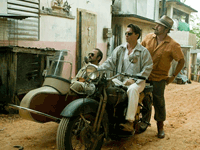
    “Do you think they know we’re on our way, bringing them the plague?” So asks Viggo Mortensen’s Sigmund Freud of his younger colleague Carl Jung (Michael Fassbender), as the two approach New York City to gift the untreated denizens of America with their equally grueling brands of psychoanalysis, in the closing stretch of “A Dangerous Method,” David Cronenberg’s thoughtfully embroidered account of their professional rivalry.

    It’s the sharpest line in corset-prestige specialist Christopher Hampton’s script, adapted none-too-cinematically from his 2002 play “The Talking Cure.” It is also, as most Freudophiles will recognize, one he didn’t write himself — like so many of a writer’s best moments, it was gifted to him by legend. Freud, luckily enough, had a pretty dry line in irony; drier, perhaps, than that of Hampton, who tackles his historical subjects’ rich battle of wills and philosophies with the requisite scholarly enthusiasm, but is oddly cautious,  even a little po-faced, about the way he fashions intellectual debate into drama.

    (more…)

  • 9/2 OSCARWEB ROUND-UP: ‘Diary’ a TFF surprise?, Cronenberg talks ‘Method,’ Cody’s most anticipated

    • Word is one of the big Telluride surprises is the Johnny Depp starrer “The Rum Diary.” [Hollywood Elsewhere]

    • At Venice, is “Contagion” following “The Town”‘s awards playbook? (Uh…yeah.) [24 Frames]

    • Sticking with the Lido, Nick Vivarelli talks to “A Dangerous Method” director David Cronenberg. [Variety]

    (more…)

  • VENICE: Follow the Lido — a festival preview

    “Why Venice and not Toronto?” a colleague asked when I mentioned I was heading to the Lido for the world’s oldest film festival for the third straight year. Given the North American bent of this site, it was a fair question, but also one I found easy to answer — and not just for the dully practical reason of relative airfare expense.

    Toronto may have become the bigger and, depending on your field of interest, more influential festival (certainly so if you’re in the Oscar-watching business). But with its abundance of pre-premiered films and no juried competition, it’ll never have the grandeur or ever-so-slightly scuffed glamor of the Venice event, with its beachside location, soaring marble delegate halls and saturated aroma of overpriced espresso — not to mention the artsier exclusivity of its film programming, a once hit-and-miss virtue that scored a bulls-eye with a 2010 lineup that beat last year’s Cannes for range, relevance and vitality.

    (more…)

  • Venice competition includes Polanski, Cronenberg, Alfredson

    These days, so much media speculation precedes the announcement of any major festival lineup that the eventual unveiling comes almost as an anti-climax — or at least it would do if the long-expected films weren’t so appetizing in the first place. As was the case with the Toronto lineup on Tuesday, the just-revealed programme for this year’s Venice Film Festival is as heavy on highlights as it is light on surprises, and that’s good enough for this Lido-bound journo.

    In recent years, as Berlin has receded, Venice has grown into an increasingly bolshy competitor to Cannes, taking a slightly riskier, younger approach to Competition programming while nabbing enough sexy, big-name auteur titles to draw the headlines. It’s a balance that has paid off handsomely in recent years: “The Hurt Locker,” “Brokeback Mountain,” “Black Swan,” “I Am Love” and “A Single Man” all debuted in Venice before going on to greater success elsewhere.

    This year’s Competition lineup would appear to continue the pattern: for every long-established auteur in line for the Golden Lion, there’s at least one buzzy up-and-comer arriving on the back of a breakthrough hit.

    (more…)

  • ‘A Dangerous Method’ UK trailer

    Yesterday, news dropped of the Venice Film Festival’s opening film; now, with the first look at David Cronenberg’s Lido-bound latest (courtesy of Empire), the autumn festival season is starting to feel alarmingly close. Given the hot cast and the highbrow material, many have been pegging this as a likely Oscar player, despite the fact that Cronenberg (even in period dress) has never caught the Academy’s fancy. My personal hope is that the film is as Oscar-unfriendly as possible — after two accomplished but straightforward genre spins, I’d love to see the director tap into his kinky side again. As is my usual practice these days, I’m not watching the trailer, so I’ll just have to wait and see. You, however, can share your thoughts below. Click the image below to take a look or watch an embed after the jump.

    (more…)

  • AMPAS pays tribute to Jeremy Thomas

    It’s not as formal an honor as one of the Governors’ Awards they dished out last week, but nonetheless, Thursday will find the Academy still in a laudatory mood as they cross the Atlantic to celebrate the career of boundary-busting British producer Jeremy Thomas. AMPAS is holding a Thomas tribute evening in London, with Keira Knightley, Stephen Frears and Cannes festival director Thierry Fremaux among those taking part.

    It’s heartening to see the Academy acknowledge a globally-minded career that has largely been dedicated to shepherding milestone films most of their voters wouldn’t touch with a bargepole: Nicolas Roeg’s “Bad Timing,” David Cronenberg’s “Crash” and “Naked Lunch,” Nagisa Ôshima’s “Merry Christmas, Mr. Lawrence,” Jonathan Glazer’s “Sexy Beast” and so on.

    He’s still busy, to: two of his productions, “Essential Killing” and the superb “13 Assassins,” were in competition at Venice in September, while 2011 will see him renew his partnership with Cronenberg for the eagerly awaited (by me, at least) “A Dangerous Method.”

    (more…)

  • Helmers of the English language, the best and why: part one

    David CronenbergMy recent article on Clint Eastwood drew an excellent response from Nathaniel Rogers (a regular commenter) that led me to this article. In that piece, I make clear my admiration for Eastwood, his artistry and the fact I believe him to be among the three finest directors working in movies. I stand by that, because I do not feel every film a director makes needs to be a masterpiece, as long as they are growing and continually trying to reach for something new.  Even the greatest of artists fail, and in fact they learn more from failure than they ever do success.

    Before the knives are drawn and tossed my way I will remind all that this is my list, just an opinion. I have selected what I believe to be the finest 10 directors working in the English language (five today, five tomorrow). I am positive that there will be disagreement, but that’s what keeps the world turning. Bear in mind that one film does not a genius make, and that a body of work (at least four films) was essential for the list.

    With that, the filmmakers…

    (more…)

  • On the Candian cinema

    With the recent announcement of Paul Gross’s “Passchendaele” as the opening night film at this year’s Toronto International Film Festival (and honor traditionally handed to a Canadian endeavor), I thought I’d dedicate some space to the best of Canadian cinema.  But first, a history of sorts.

    Growing up in Ontario, Canada, I fell in love with cinema at a very young age. I loved watching those old Universal monster movies on Friday nights, or the Sunday afternoon Big Show of the Week, which was usually yet another showing of “Man of a Thousand Faces” or “Red River.” Essentially, I grew up on American films, and I believe American cinema is the most exciting on the globe.

    I say this as a Canadian who loves our national cinema, as a critic who has access to Canadian films that are often never released, and as a huge supporter of the Canadian film industry. As long as the government controls what is happening with the money that makes these films, we will never have as strong an industry as we could, and it will be forever difficult to get a film made in this country.

    Ask Sarah Polley, a national treasure and world-reknowned actress who struggled to get funds to make “Away from Her,” one of the best reviewed films of last year. The reason films get made at all is through government grants and funding. It is a dangerous catch 22.

    The first Canadian that mad an impact on me was “Goin’ Down the Road,” a wonderful picture made in 1970 by director Don Shebib (who attended film school with Francis Coppola). His picture was about Canadians, for Canadians made by Canadians and dealt with plights recognized by Canadians. But of course one did not have to be Canadian to enjoy it. In fact, the film played for more than a year in New York City in 1970 when films lasted longer than two months in theaters. More than the great documentaries from the National Film Board, this film seemed to announce to the world that Canada had a filmmaking community waiting to be unleashed.

    (more…)

  • INTERVIEW: David Cronenberg

    Filmmaker David Cronenberg has made a career out of disturbing imagery. From James Woods shoving a videotape through his stomach in 1983’s Videodrome to James Spader getting off with a crippled Holly Hunter in 1996’s Crash; Jeff Goldblum spewing acid in 1986’s The Fly to the construction of a weapon made of human bones in eXistenZ, Cronenberg has found a knack for concocting horrifying cinematic incarnations.

    His latest film, A History of Violence, opened in limited release last weekend. The film is, by and large, his most subtle effort to date. By that same token, it is also the most disturbing work of his career.

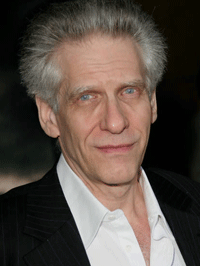
    One would never expect such fantastic imaginings to come from the brain of this modest, quiet and unassuming individual. Mr. Cronenberg sits with Zen-like contentment when both surrounded by a roundtable of harping journalists, as well as in private, having just received news of a rave review from The New York Times. He is a man who seems very comfortable in his own skin, peering out at the world he envisions through piercing blue eyes, under furry mantle-like gray eyebrows. He seems quite capable of amusing himself through his work as an artist.

    (more…)

  • REVIEW: “A History of Violence” (***1/2)

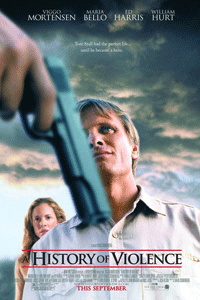
    A History of Violence“A History of Violence” is going to be David Cronenberg’s crowning glory. It’s the film that has something to say about every cinematic endeavor in his lengthy portfolio. It’s the film that time will remember him by.

    Based on a gritty graphic novel by John Wagner, the film is a commentary on the nature of violence, the mechanics of its simplicity and the mechanics of its complicity. It’s an account of the effect violence has on a household, on a town, on many different psyches. It’s one of the smartest subtextual films of the year, yet the subtext seems obvious. But it’s not.

    “A History of Violence” is a very intricate film.

    The fascination is that to be so meticulous in its thematics, the story is relayed in a very elementary fashion. No fancy tricks, no overwrought hand-to-mouth relay – just basic, almost painfully simple storytelling. I would say that not only is it Cronenberg’s most accessible film, but it is potentially his most disturbing. And, obviously, that is saying a LOT.

    The events take place in Millbrook, a picturesque small-town setting that stands almost archetypal in the midst of an upcoming storm. The storm comes in the form of two mass murderers waltzing into Tom Stall’s (Viggo Mortensen) downtown diner with evil intentions. After handily disposing of the would-be murderer/rapists, Stall is catapulted into the limelight as an unassuming hero. He soon finds himself at the whims of Philadelphia mobster Carl Fogaty (Ed Harris) and his band of cronies, expressing a vested interest in this small town savior.

    The violence in the film is extensive and at times outrageous, though it retains a level of creativity and relevance that keeps it from becoming gratuitous – shockingly. The gore is stomach-turning, to be sure, but vital to the components of the story Cronenberg is telling. Ultimately, it’s all seemingly a justification for the career he has made in the splatter business, as if it’s all been a long, slow ride to this moment, this declaration, this brand of insightful commentary.

    Furthermore, the film boasts one of the most organic ensemble performances of the year.
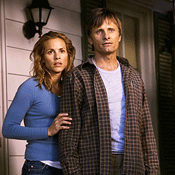
    (from left) Maria Bello and Viggo Mortensen in A History of ViolenceMortensen portrays Stall with a particular ease. Rather he inhabits him, giving the kind of performance that true acting is all about. At the same time, it’s the sort of work that gets ignored during awards season in favor of showier turns.

    Ed Harris springs onto the screen as the creepy Fogaty, and I have to say he sculpts the character off the page better than any other actor could have managed. On paper, Fogaty is assuredly a device if anything. Harris breathes him in and out and terrifies accordingly, though I must admit it’s missing a certain something to be considered formidable in the Oscar ring.

    William Hurt’s five minute cameo is one of the best pieces of work this year, a barrel of laughs and yet a swift study in acting perfection. Yes, perfection.

    But the real stand-out is Maria Bello. Bello was passed over by the Academy for a notice in 2003 for her multi-lauded performance in The Cooler, but I don’t expect that to be the case this year. If “A History of Violence” has any real shot at Oscar recognition, it is for her explosive performance. This is fire-breathing, gut-wrenching, head-spinning work. The layers that would be considered missing in a film like this, one that could easily be labeled “surface,” she adds them…in spades.

    A final note, “A History of Violence” also has something to say about passion. I’m not afraid to say that I haven’t quite put my finger on it yet, but it has something to do with two raunchy sex scenes that manage to remain out of the realm of gratuitous – much like the violence – as well as the motivations behind the character of Stall and why he is where he is at the film’s open. There is most definitely a point being made about desire, vehemence and conviction. It’s lurking – much like the film.

    I can’t wait to see this again.