 Regret to inform that my second day at Cannes was not an especially satisfactory one: three films that all fell short in one way or another and my first shutout (owing to my dingy yellow-card status) from a Competition screening – despite queuing 45 minutes in advance. (That’d be Korean genre piece “The Housemaid,” by the way, which doesn’t appear to have set the Croisette alight, to go from colleagues’ reactions.)
Two upsides exist to this turn of events. First, I’m managing to catch up on plenty of reading while in the screening queue, so can confidently inform you that the latest Kazuo Ishiguro volume is a thorough disappointment, even if I can tell you nothing of “The Housemaid.” Second, it freed up time for a commiserating drinks session with Sasha Stone and Jeffrey Wells, winding up on the beach at an open-air screening of “From Here to Eternity.” At festivals, there’s always a plan B.
“CHONGQING BLUES” (**)
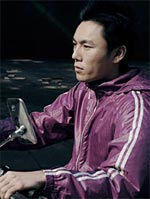
Xiaoshuai Wang’s “Chongqing Blues” came into the Competition with a slight dent in its armor – however good it turned out to be, it would forever (or at least for the duration of the festival) be recognized as the film that wasn’t initially deemed strong enough for the lineup, bumped up from Un Certain Regard only when certain other options didn’t pan out. Having now seen the film, I can promptly withdraw my sympathy: Wang’s film was fortunate to make the UCR cut, much less the big show.
Drab, maudlin and never content to let one scene make a point when three will do, Wang’s film treads well-worn thematic territory as a long-absent father comes to terms with the loss of his breakaway son: unfortunately, advance knowledge of the whys and hows of the latter’s demise rather siphon any tension from the enterprise, rendering the increasingly lengthy explanatory flashbacks little more than filler.
Wang Xueqi turns in a suitably stoic performance as the stricken pater, but he is given little more to do than react mournfully to news proffered by others – with disparate parties conveniently conspiring to parcel out information in the most deliberate way possible. While we wait for Wang’s character to catch up with us, we’re at least entertained with fortune-cookie wisdom from those he meets along the way. “Don’t all rivers flow to the sea?” enquires his limpid ex-wife. The question is asked rhetorically, though you can hardly begrudge her this uncertainty in a film so short on movement itself.
As if to emphasize the apparent randomness of the Competition upgrade for “Chongqing Blues,” it was followed by two Un Certain Regard titles that would have made superior inclusions – even if neither was exactly a home run.
“THE STRANGE CASE OF ANGELICA” (***)
Manoel de Oliveira’s remarkable achievement in being alive, must less an active filmmaker, at the formidable age of 101 does, I fear, lead some critics to condescendingly praise his recent films for their mere existence. Still, 2009’s “Eccentricities of a Blonde Haired Girl” – a crisp, cruel fable as indebted to, say, Ophüls as his own lengthy oeuvre – merited the effusion.
His latest, “The Strange Case of Angelica,” drops that clear-eyed wit for a more contrived sense of quirk, but there are enough teasing digressions and non-sequiturs here to delight and provoke the faithful.
Resuming leading-man duty from “Eccentricities…” (and once more looking unnervingly like a swarthier Mark Wahlberg), Ricardo Trêpa plays Isaac, a young photographer assigned to create a portrait of a the deceased young daughter of a wealthy local family. As you do, he finds himself duly infatuated with the dead woman, dimly straddling the border between the present and the afterlife, with ultimately severe consequences.
On this slender premise, de Oliveira pins a cheeky selection of sight gags, a lot of glorious Chopin concertos and what may or may not be some off-center political commentary, as the Jewish Isaac’s increasingly suspicious neighbors conduct wayward conversations on antimatter and mosquitoes. It goes without saying that de Oliveira’s film is an acquired taste, more wilfully woolly than his recent work, but it may yet reward a repeat viewing.
“TUESDAY, AFTER CHRISTMAS” (**1/2)
I’m not sure whether there’s as much to be gleaned from Radu Muntean’s “Tuesday, After Christmas,” an intelligent, empathetic and extremely well-acted domestic drama that could nonetheless rank as the most polite study of extramarital sex I’ve ever seen. Following the patient, observational mode of his Romanian peers, Muntean constructs his film as a series of leisurely conversational set pieces, demonstrating a keen ear for the rhythms and nuances of everyday exchanges, and executing a deft bit of narrative wrongfooting in his opening act, as roles of wife and lover to Mimi Branescu’s male protagonist are kept pleasingly indistinct.
The film becomes less effective, however, as the triangle reaches its wholly credible but faintly tepid breaking point: Muntean and his ensemble are to be commended for offering a more considered, less shrill take on the tenuousness of contemporary marriage, but he may have ended up skirting the drama along with the histrionics; we may have known many people to endure similarly civilized personal crises, but we wouldn’t necessarily make movies about them either.
Tomorrow: with any luck, “Wall Street 2: Money Never Sleeps” and/or Cristi Puiu’s “Aurora” and Hideo Nakata’s “Chatroom.”
Comments
8 responses to “CANNES: ‘Chongqing Blues,’ ‘The Strange Case of Angelica,’ ‘Tuesday, After Christmas’”
A shame about Tuesday, After Christmas, although it sounds fairly typical of the Romanian New Wave – showing the more uncinematic truth about healthcare, war, law, and so on. This doesn’t sound like one of the more successful ones.
On that note, I’m really pumped to hear what you think of Aurora. The Death of Mr Lazarescu is quite the piece of work.
Nocturnes? I’ve been waiting for my library’s one copy for weeks, what’s wrong with it?
Echoing Daniel’s comment above, while it may not be related to Cannes, I find the latest Kazuo Ishiguro’s short story compilation “Nocturnes” similar to the works of Haruki Murakami: drawing heavily on music as metaphors, harrowing sets and wandering characters. Perhaps Ishiguro is not quite there yet in terms of achieving Murakami’s flawless subdued quality, that’s why not all short stories in “Nocturnes” come up strongly.
Back to Cannes now, I guess. :)
I suppose it’s a a testament to the slow start of the festival that Ishiguro is more interesting than the actual films.
“You be Kerr, I’ll be Lancaster.”
Angelica seems exciting and to be fair it has received very warm praise from the press atleast where I am looking. I still haven’t had opportunity to watch his 2009 film which you also liked.
Blues strikes me as the kind of sentimental film that might please the academy if submitted for foreign language film.
Guy, how does one qualify for a white press pass or do you have to pay extra for it?
White press passes are for the cream — Cannes places a lot of stock in readership/circulation figures, and they’re still quite biased towards print media. As far as I know, it’s not a privilege you pay for.
[…] Guy Lodge calls it “the most polite study of extramarital sex I’ve ever seen.” [In Contention] […]