In Contention

Tag: The Assassination of Jesse James by the Coward Robert Ford

  • Who joins the great Best Picture snubs this year?

    It happens every year, a great film, in some cases destined to be remembered more than the eventual Oscar winner is snubbed for a Best Picture nod, or gets nominated and loses to an inferior film that happened to capture the public’s attention at that particular point in history.

    Some of the greatest films of all time lost the top award, “Citizen Kane” among them, arguably the greatest of all time (though I disagree). “The Treasure of the Sierra Madre”, easily John Huston’s best work, joins the list, as does “The Searchers,” which is in my opinion the finest western ever made and contains the greatest John Wayne performance of all time.

    Remember “Rocky” winning over “All the President’s Men,” “Network” and “Taxi Driver?” Or “Kramer vs. Kramer” over “Apocalypse Now?” In the last twenty years, Oscar has pulled some howlers, some choices that left me nearly putting my foot through the television upon the announcement. The first time I remember being really, truly angry at a lame decision was in 1981 when “Chariots of Fire” bested Warren Beatty’s “Reds,” which I believe to be among the best films of the 80s.

    (more…)

  • Pitt finally going to get some Oscar love?

    Over the course of his impressive career, Brad Pitt has not always been appreciated for the fine actor he is. This is an actor who could easily take the cheap way out and do one goofy romantic comedy or silly film after another, but who instead takes bold risks with his career, always challenging himself, and though sometimes falling flat on his face, growing as an actor.

    Pitt is not the first actor to grow in maturity through the years; look at John Wayne, badly under appreciated for much of his career, though his work in “The Quiet Man”, “Rio Bravo” and especially “The Searchers” was astounding. His last performance, as the gunfighter dying of cancer in “The Shootist,” richly deserved Oscar attention which sadly never came.

    Actors, the great ones, live to challenge themselves, never content to continue doing what they have done before, they need change, they live for challenge.

    (more…)

  • The top 10 shots of 2007: part two

    Today we round out the top 10 shots of the year with the final five.  Check out part one if you missed it.

    Let’s dive in:

    #5

    Michael Clayton

    “MICHAEL CLAYTON”
    Director of Photography: Robert Elswit

    We were completely ripping off New York filmmaking from the 1970s, things like “Klute” and pretty much everything Owen Roizman has ever shot.  But Tony’s sense of these things was not lots of little pieces; he loves making kind of graphic frames that play as long as possible.

    –Robert Elswit

    Robert Elswit had a hell of a year in 2007, finally getting his due from the American Society of Cinematographers who awarded his work in Paul Thomas Anderson’s “There Will Be Blood.”  There was another film featuring Elswit’s unique signature, however, that flew under the radar for its considerable attention to composition and camera movement: Tony Gilroy’s “Michael Clayton.”

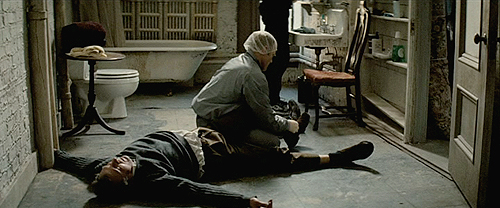
    Much is made of the film’s final sequence, a long shot focused on Clayton as he rides away from the hysteria in his life, desperate for his cab driver to “just drive.”  But a companion shot from earlier in the film was just as arresting, if not more so, as a purposeful point of transition to the second half of the endeavor.  A long tracking shot that never misses a beat, both behind and in front of the camera, the scene detailed is the expert, painfully clinical execution of Arthur Edens, played to an award-worthy T by Oscar nominee Tom Wilkinson.

    The final image is steeped in theme, and an initial tracking sequence under Edens’ opening monologue pulls the viewer into the film’s interior world, but this particular shot is so cold as to be frozen in its depiction of something at once gruesome and strangely beautiful, fluid.  I’m not privy to whether it may have been a directorial decision, though I suspect it may have been, but it is the crown jewel in a film packed with precision from Elswit.
    (more…)

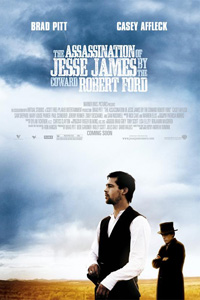
  • REVIEW: “The Assassination of Jesse James by the Coward Robert Ford” (****)

    The Assassination of Jesse James by the Coward Robert FordIn 1983, author Ron Hansen crafted a novel that ought to be considered mandatory reading for anyone fancying himself or herself attracted to the western as a genre and as a conveyor of essential truth. A Shakespearean account of betrayal in the old west, Hansen’s masterful sketches revealed deep and vibrant characters that transcended the nickel-book mythology into which they inevitably found themselves woven.

    Twenty-four years later, filmmaker Andrew Dominik has accomplished a visual telling of that story as close to cinematic perfection as you could hope for. At the risk of sensationalism, I would call “The Assassination of Jesse James by the Coward Robert Ford” the most accomplished work of moving imagery committed to film in nearly a decade. It is a staggering piece of true cinematic art.

    The tale is as simple as it is complex, a trait shared by the greatest of western storytelling. Jesse James (Brad Pitt), the infamous outlaw of old, found himself the subject of obsession, fascination and idolatry by the young and ambitious Robert Ford (Casey Affleck). A yearning to touch greatness, or even reside in similar territory, drove Ford to seek out acceptance amongst James and his gang of outlaws in the waning years of the 19th century. A lethal combination of angst, envy, hubris and government sanctioning brought Ford to a place on April 3, 1882 where firing a bullet into the back of James’ skull seemed the logical course of action. And so it was.

    Dominik and director of photography Roger Deakins have framed the legend of James in some instances by blurring the outer edges of the frame. Perhaps the intention is to convey a legend we know little about, given the cloud of mythology that surrounds actuality. But there are depths of reality here that speak to some fairly grandiose truths, and that, I think, is what Dominik is driving at.

    With all the sensationalized accounts, all of the larger-than-life depiction, there is true poetry in the life and death of the outlaw. And there is true poetry in his assassin’s regret. Myth is born out of realism, and Andrew Dominik, an Australian, seems to understand the American western better than any contemporary, and many who paved the way before him.

    (more…)