In Contention

Tag: Spike Lee

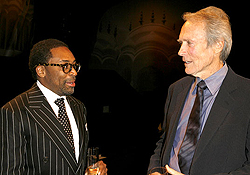
  • Spike Lee = the Jesse Jackson of film?

    Roger Simon seems to think so:

    Why would Lee pick this fight?

    Unfortunately, it couldn’t be more obvious. Like Jesse Jackson and Al Sharpton, time has been passing Spike Lee by. His worldview comes from another era and he has never really sought to revise it, to open his eyes. Proof of that is that for more than a decade Spike has barely made a film any of us can remember. Compare that to Eastwood, who, although some twenty-seven years Lee’s senior, is at the top of his career, having scored big in 2003-2004 with Mystic River and Million Dollar Baby.

    No wonder Spike’s jealous. So what does he do? He reaches back to an era when he was more successful. He plays the old identity/race card. Now we could all laugh and say this is just another case of an (prematurely) aging artist grasping for attention, but these times are more complex than that. We don’t know which way we are going – toward a post-racial future or back to a racist past.

    His argument is interesting because it is equal parts over-simplified and shrewd. The Lee/Eastwood dispute has been talked to death…and again…and again, but the overriding feeling I had following the initial Cannes fracas was sadness — sadness that Lee has shown yet again that he is unable to prove his (at times justified) contradictory opinions without the stench of clichéd rhetoric and steadily outdated reason.

    (more…)

  • Spike vs Clint: Round Three

    Oh dear, this really is getting ugly. As we all knew he would, Spike Lee has responded to Clint Eastwood’s instructions that he “shut his face” about the issue of the supposed sidelining of African-Americans in “Flags of Our Fathers.” And, in an interview with ABC News’ Sheila Marikar, it seems Lee hasn’t picked his words any more tactfully than Eastwood:

    First of all, the man is not my father and we’re not on a plantation either. He’s a great director. He makes his films, I make my films. The thing about it though, I didn’t personally attack him. And a comment like ‘a guy like that should shut his face’ — come on Clint, come on. He sounds like an angry old man right there.

    If he wishes, I could assemble African-American men who fought at Iwo Jima and I’d like him to tell these guys that what they did was insignificant and they did not exist. I’m not making this up. I know history. I’m a student of history. And I know the history of Hollywood and its omission of the one million African-American men and women who contributed to World War II. Not everything was John Wayne, baby.

    Now I’m actually more sympathetic to Lee’s views than some, and I think Eastwood could have phrased his remarks more delicately. But the plantation line takes the argument to a place it really doesn’t need to go, and frankly makes me cringe. These are two of the best, most thoughtful filmmakers in the business, and this is the level of discussion they come up with?

    Lee closes the interview with a peace offering that strikes me a somewhat half-hearted, not least because he can’t resist inserting a political barb there too:

    Even though he’s trying to have a Dirty Harry flashback, I’m going to take the Obama high road and end it right here. Peace and love.

    Not cool. I hope Eastwood has enough smarts to let this go. I suspect he won’t. For my part, I hope “Miracle at St Anna” is a terrific enough film to overshadow this squabble.

  • Eastwood tells Lee to ‘shut his face’

    After a terse response at Cannes to Spike Lee’s accusation that “Flags of Our Fathers” sidelined African-Americans’ contribution to WWII, Clint Eastwood has spoken at greater length about the matter. In a substantial interview in today’s Guardian, he makes his feelings toward Lee quite clear:

    “He was complaining when I did Bird. Why would a white guy be doing that? I was the only guy who made it, that’s why. He could have gone ahead and made it. Instead he was making something else.” As for Flags of Our Fathers, he says, yes, there was a small detachment of black troops on Iwo Jima as a part of a munitions company, “but they didn’t raise the flag. The story is Flags of Our Fathers, the famous flag-raising picture, and they didn’t do that. If I go ahead and put an African-American actor in there, people’d go, ‘This guy’s lost his mind.’ I mean, it’s not accurate.”

    In what appears to be a pre-emptive strike, he defends his new film “Changeling” against similar accusations, noting that it takes place in Los Angeles before it had a significant black population:

    “What are you going to do, you gonna tell a fuckin’ story about that? Make it look like a commercial for an equal opportunity player? I’m not in that game. I’m playing it the way I read it historically, and that’s the way it is. When I do a picture and it’s 90% black, like Bird, I use 90% black people … A guy like him should shut his face.”

    Well, I wouldn’t expect the Clintster to mince his words, but still… wow. It will be interesting to see if Lee has (another) rebuttal prepared. For one thing, one wonders what makes of Eastwood taking on Nelson Mandela in “Human Factor.” (Eastwood has a quip prepared already: “I’m not going to make Nelson Mandela a white guy.”)

    Lots of good stuff in the interview besides, particularly for fans of the Dirty Harry films. Check it out here. 

  • Great Oscarless directors

    Alfred Hitchcock, Charlie Chaplin, Howard Hawks, Stanley Kubrick, Preston Sturges, Ernest Lubitsch, Hal Ashby, Alan J. Pakula, Sidney Lumet, Spike Lee, Paul Thomas Anderson.

    Collectively they represent some of the greatest directors in the history of the cinema, and together they share one rather unbelievable fact…not one of them is a Academy Award winner for Best Director.

    Each has the distinction of nominee, of course.  But to think that filmmakers such as James Cameron (The King of the World, remember?), Richard Attenborough, Ron Howard, Sir Carol Reed (for “Oliver,” man?), John G. Avilden, Michael Cimino, Robert Benton, Robert Redford, Robert Wise (for “The Sound of Music??”) and George Roy Hill, to name a few, have Oscars on their mantles and the giants above do not is simply insane to me.

    (more…)

  • Movies that Oscar missed

    As film junkies, we all know it happens. Usually every single year there are one or more films the Academy passes over for Best Picture consideration, in some cases because there are, after all, just five slots available, but in others because, well — they blew it.

    Like the rest of you, I sit and listen to the nominees announced live every January and have never had a year when I did not roll my head and ask to no one in particular, “Where is such and such or so and so?”

    I mean for me, the great honor is the nomination, because when “Kramer vs. Kramer” defeats “Apocalypse Now” for Best Picture, how can you possibly take the winners seriously? However, a nomination — that is decidedly different.

    Where was the Best Picture nod for John Ford’s masterful “The Searchers,” arguably the greatest American western ever made? And Alfred Hitchcock’s “Psycho,” which redefined the horror genre?

    Since 1980 there have been a number of truly brilliant films passed over, leaving this critic often shaking his head in disgust, though I get over quick enough to watch the damned awards…talk about hooked. But it amazes me how “The Empire Strikes Back” can be a better film than “Star Wars,” yet not be nominated in the big race. Ditto Brian De Palma’s “Blow Out,” possibly the finest film of his career, ignored in every category despite its artistic mastery. The very same year Milos Forman gave us “Ragtime,” a much stronger film than “Chariots of Fire,” which won the Oscar, or even “On Golden Pond,” one of the five nominees!

    (more…)

  • Heavy

    Asked twice by The Times to respond to Lee’s criticism, Eastwood stared out into the audience as the compere refused to accept a question that did not relate to L’Échange.

    LINK

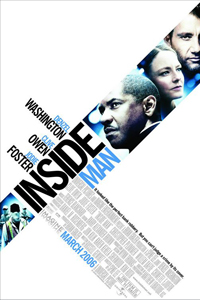
  • REVIEW: “Inside Man” (**)

    Universal Pictures\' Inside ManSpike Lee’s “Inside Man” is an embarrassment of devices from start to painstakingly anti-climactic finish. As a run-of-the-mill heist romp, it still falls prey to a dedicated intention to distinguish itself, both thematically and stylistically.

    Thinking it over, I’ve come to the conclusion that it is rather impossible to write a negative review of “Inside Man” without spilling the beans here and there, so I’ll leave it to you to decide whether to venture into the spoiler territory below. If you’re ducking out now, suffice it to say, Spike Lee picked a rather sluggish screenplay to be his first foray into mainstream genre fare, and leaves a bloated two plus hours on the screen that could have been much more effective at a slim, tight 90-100.

    So, you’ve been warned…

    SPOILERS BELOW

    What writer Russell Gewirtz is asking of his audience in his terribly contrived (though I can forgive contrivances alone) screenplay is to shift their sense of antagonism from the right place to the wrong place for the sheer reason that it makes for an intriguing turn of events in the third act.

    Christopher Plummer co-stars in the film as a philanthropist and owner/board director of the bank being robbed by Dalton Russell (Clive Owen) and his team of trim-the-fat operatives. We come to discover that one of his deep, dark secrets lies hidden in safe deposit box #392, and that it is enough of a concern for him to call upon the services of Madeline (Jodie Foster), a friends-in-high-places “glorious cunt,” as our screen mayor describes her, to assure its safe keeping.

    This “secret,” mind you, amounts to something major enough, but is still physically little more than documents in an envelope that, as Russell candidly observes, probably should have been burned. Let’s set aside the “probably.” A secret like this – you don’t leave it lying around in a safe deposit box. Why the hell would you? There is certainly no upside to such a thing, and while, as I said, contrivances and plot devices can be forgiven, in my book of brainless spring screen entertainment, they ought to be more cleverly thought through than this.

    Not to mention, Madeline’s efforts come up short to the point that her character could have easily been written out of the script and the dough tossed Foster’s way could have been spent on a few re-writes.
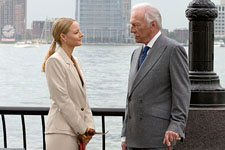
    Jodie Foster and Christopher Plummer in Inside ManOn top of it all –- and you’ll make your mind up for yourself on this one -– the secret, which Gewirtz feels is strong enough in and of itself to make the viewer root for Russell’s thief, doesn’t exactly do that job in full. I was left siding with Plummer’s philanthropist in some small way in the matter. Gewirtz gives us every reason to forgive him, to be honest, as he paints the character in a manner that is becoming of someone who has atoned. The sheer fact that he would expect me to turn an about face is somewhat insulting. The world isn’t black and white. But, again, you’ll make your mind up on this one.

    END SPOILERS

    But let’s get into what really makes “Inside Man” an empty romp as opposed to a satisfying one. If I had to really put a point on it, before the lapses in reason, before the unbearable pacing concerns, before the insulting expectations of the screenwriter, it would have to be the overall bland nature of the characterizations, from tone, to performance, to direction.

    Denzel Washington is one of the most charismatic actors of his generation. He has carved a niche of fandom for his stellar, rounded portrayals. Whether it is above-average work in “Malcolm X” or “Philadelphia” or by-the-numbers turns in “Crimson Tide” and “Out of Time,” Washington typically adds dimension to what’s on the page. The majority of his work lies in a middle ground between good and really good (saving the great stuff for here and there), an arena I would venture to say even includes his Oscar winning performance in “Training Day.” But he is regardless an actor who can find the intriguing emotional crevices of the most mundane of characters.

    Now in “Inside Man,” teaming with Lee (a director who has brought out the actor’s best) for the fourth time, Washington (as Detective Keith Frazier) seems to have hit the snooze button and lazily translated an already innocuous character to the screen in a sluggish fashion. His performance slips and slides from controlled and cocky to wounded and concerned, smart and assured to confused and lost, and not at all in the good, dramatic way. It’s evident that neither Lee nor Washington really have a hold on who Keith Frazier is, and the anchoring of the film suffers because of it.

    This brings me to the biggest waste of the film, and yet still, the best performance of the lot. Clive Owen is cold as ice, determined and unwavering. He’s everything you want out of a bank robber who is on top from start to finish. But why the hell is he doing this???

    Clive Owen in Inside ManThis is not nearly the sort of ambiguity and anonymity of intentions that speaks truths to the human condition or anything of that nature. This is a character, intriguing in his actions and objectives as it is, painfully lacking back story and motivation. There is no question that molding the character out somewhat in this regard would have done wonders for the overall thrust of the plot, but this is screenwriting 101 if you ask me.

    And don’t blink or you’ll miss Willem Dafoe picking up a paycheck as a uniform cop with little to offer other than the film’s funniest punch line.

    I have to say that, while Lee time and time again proves that he is quite uneven as a filmmaker, his work putting “Inside Man” together visually is absolutely commendable. I’m confident in saying he’d rival the greats of heist cinema (Lumet, Mamet, Mann) were he to springboard from a good screenplay. “Inside Man” pops and cracks and we can see he is confident in his direction, staying ahead of the game and not letting the audience catch on too easily. Outside of one terrible choice, the camerawork in the film accelerates from the first frame. With some of the more unnecessary fat cut from the gut of this bloated tale, at about 20-30 minutes shorter, it might have gone down a little easier.

    Lee uses Terence Blanchard again for scoring duties. As he did on 2002’s “25th Hour,” the composer lends a majesty and exuberance to Lee’s film that unquestionably makes it more operatic and fuller on the whole. Without it, the film would undoubtedly have been a lesser one.

    All things considered, “Inside Man” is going to do exactly what it is meant to do, and what Universal and Brian Grazer expect of it. It’s going to pull down a decent box office take and line the producers’ pockets nicely, as you can’t go wrong marketing something like this. It’s just foothills enough to satisfy the average moviegoer, even if it doesn’t do much in the way of a true cineaste’s desire for the towering peaks of the Rockies.