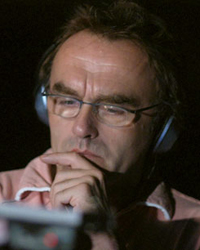
 Roughly halfway through my interview with Danny Boyle, the small, rather alarmingly wallpapered room we’ve been seated in is, by some technical error, suddenly flooded with the opening beats of “Orphans,” the first track off Beck’s “Modern Guilt” album.
Boyle immediately leaps to his feet to report the problem, though he can’t help nodding in
time to the music. “That’s the new Beck, isn’t it,” he notes excitedly. “Fantastic stuff. Now’s not the time, but fantastic stuff.” The music vanishes. Boyle flops back onto the couch, straightening out his rumpled plaid shirt.
It’s a fittingly surreal interlude for an audience with Boyle, demonstrating both his utterly unflappable personality and his keen interest in every sight and sound around him — whether invited or not. It’s a heightened awareness that is apparent in every one of his films; few directors make films as busy as Boyle’s, films as alive to the possibilities of environment, movement and music. His is a sensation-driven cinema that comes into full fruition in his astonishing new film “Slumdog Millionaire,” a breathless rush of visual and narrative energy that marries fanciful storytelling to a rich, perceptive study of a 21st-century nation.
It’s also his first film with an entirely non-Western context, something which seems to have further fired Boyle’s creative impulses. “India is just … everything at once,” he enthuses, gesticulating wildly to convey the scale of it all. “It’s got these amazing extremes of wealth and poverty and religion and landscape, but in the West we go to a lot of trouble to separate those extremes. Nothing is separate in India. That makes it an incredible place to set a story, particularly one that is so tough and so joyful all at once.”
True to form, “Slumdog Millionaire” tells a pretty incredible story, a rags-to-riches tale in the most literal sense. It’s a story that hinges on the fairytale conceit of destiny, but as Boyle notes, that notion still plays into contemporary Indian society. “There’s a bond between the classes there, however far apart they are in terms of wealth. They get each other because they pretty much come from the same place — destiny makes all the difference.”
Boyle pauses to pour himself a fresh cup of tea, cheerfully dismissing the waitress’s offer of bottled water. (An Englishman through and through, he still resides in Mile End, an unfashionably working-class corner of East London.) It’s late in the day, he’s tired and, he sheepishly admits, a little hung over — the previous night saw “Slumdog” close out the London Film Festival, with all the flashing lights and partying that entails.
While it should be noted that a “tired” Boyle still projects more energy than most of the normal human population, this level of media attention is new to him. For all the acclaim his previous work has garnered, he’s never before made a film that received the awards buzz that “Slumdog Millionaire” is receiving (remarkably for an edgy, foreign-set picture with not a single name star attached).
“It’s brilliant, it’s insane,” he says, shaking his head. “It seems I just came here from L.A., and now I’m off to L.A. tomorrow. But you can’t release a film like this, something so potentially alien to audiences, and not work hard to promote it. Fox Searchlight are working me ragged, which is fantastic.”
(more…)
 • Sean Penn writes in support of dictators Hugo Chavez and Raul Castro. [The Nation]
 I was totally out to lunch on this today. “Slumdog Millionaire” continues to dominate while Heath Ledger wins his second award (after that AFI gong earlier in the week). “Doubt” pulls down another ensemble win while truly astounding group performances from films such as “Synecdoche, New York,” “Gomorrah” and, indeed, “Slumdog Millionaire” continue to be ignored. And Mickey Rourke picks up his first critics’ citation.

 Maybe mid-way through the Toronto Film Festival, two things are strikingly clear: Darren Aronofsky