 There are few things as antithetical to great drama as an unmitigated hero, a character rendered almost inhuman by unfailing nobleness and valor. In fiction and non-fiction alike, we are inevitably more compelled by the flawed and conflicted of our kind – whether in lurid warts-and-all celebrity biographies or more subtly probing character studies. In film, true-life heroes often make for worthily sanitized Oscar bait (from “Gandhi” to “Milk”), but they rarely provoke great art.
Few figures bear out this truth as handily as Nelson Mandela – a man who is surely the greatest political hero of our time, but who has nonetheless inspired a number of crashingly dull books and films. It’s not that the man wants for character or complexity: Mandela’s deserved (if artfully self-engineered) modern sainthood belies his early days as a fierce firebrand, but few biographies (and to date, no biopic) have bridged that gap, or made much of an attempt to study the man beneath the myth.
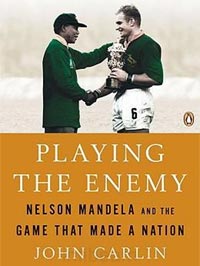
So it comes as no surprise that John Carlin’s “Playing the Enemy,” which forms the inspiration for Clint Eastwood’s recently-titled film “Invictus,” does little to change this, casting the first black president of South Africa less as a freestanding character than as a perma-haloed symbol of democratic benevolence. Of course, in this instance, Carlin’s intent was not to write another Mandela biography – just as it should be stressed that Eastwood’s film isn’t really a Mandela biopic.
In narrowing his focus to South Africa’s monumental victory in the 1995 Rugby World Cup, the currency of which extended beyond simple sporting patriotism to a kind of symbolic consolidation of the country’s international post-apartheid rehabilitation, Carlin’s aim is precisely to dehumanise Mandela to an extent. At the book’s core is the somewhat tenuous thesis that Mandela almost single-handedly enabled this against-the-odds triumph via an elaborately strategized charm offensive – though Carlin pays sporadic attention to Mandela the man, his chief interest lies in the mid-1990s invention of Mandela the brand, and the influence it could wield.
 Regular visitors to his entertaining blog will know that Nathaniel Rogers has