 Alfonso Cuarón’s is one of the most singular voices in the filmmaking community. Along with longtime collaborator, cinematographer Emmanuel Lubezki, the director has ushered forth textured visions of skewed fairytales for over a decade.
With “A Little Princess,” he took audiences into the mind of a little girl and her trying tenure at a miserable boarding school. In perhaps his most underrated work, “Great Expectations” (a loose adaptation of the Charles Dickens novel), he unveiled the mysterious and fateful journey of a dreamer.
“Y tu mamá también” brought the director’s choice of material into a more mature light, still keeping the exuberance of youth, while “Harry Potter and the Prisoner of Azkaban” became one of the most adult installments in a series aimed at a younger market.
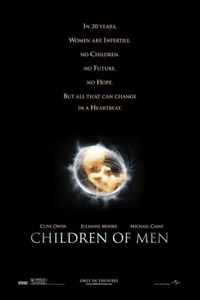
“Children of Men” fits rather paradoxically into these otherwise whimsical endeavors. Another sort of fairytale altogether, one cloaked in the mystique of dystopia, it is a film as unflinching in its bleakness as it is penetrating in its deep-seeded sentimentality. And in manifesting one of the most horrific visions of the future yet committed to film, Cuarón has given us his masterpiece, the crowning achievement of 2006.
Adapted from the P.D. James novel of the same name (and, through much arbitration, crediting some five writers on the screenplay), “Children of Men” reveals the hellish world of 2027. Baby Diego has died, the affectionately labeled youngest person in the world -– 18 years old. Fertility is an aspect of the past, and humanity’s time is clearly borrowed. The world’s nations have crumbled to apocalyptic ruin. England remains the last refuge for potential stability and order…but those days are quickly slipping away.
Theo Faron (Clive Owen) is a man lost in this sea of chaotic apathy, sliding amongst the beleaguered masses, one of the hordes, most concerned about his morning coffee and skipping out on work than with finding something of considerable happiness. His best friend, Jasper Palmer (Michael Caine), is a stoned hippie who listens to the oldies and laughs away the final years of human existence in the woods, surrounded by marijuana and nostalgia.
An immigrants’ rights terrorist organization headed by the mysterious Julian Taylor (Julianne Moore) kidnaps Theo in broad daylight one day in order to attain transport papers for an unnamed woman. Julian and Theo, we learn, once had a child together, a child they lost and whose memory haunts them equally.
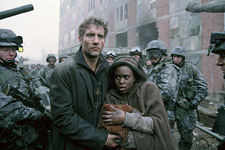 The unnamed woman is soon revealed to be Kee (Clare-Hope Asitey), a refugee holding the potential key (I feel as though I’ve just discovered the point of the character’s name) to the future of man: miraculously, she is pregnant, waiting to give birth to the first baby the earth has seen in 18 years.
It soon falls to Theo to protect Kee and her unborn child, a veritable political football, and smuggle her to the Human Project, a scientist organization bent on curing the world’s infertility crisis.
Through sheer drama and brutal tension, Cuarón sets about weaving a blistering yarn that draws parallels to current political climate. Truly penetrating visual cues bring the viewer’s mind to everything from ground assaults in Iraq to conditions at Abu Ghraib prison.
Clive Owen’s portrayal is largely physical, as Theo is an elusive character (even by the actor’s own admission). Even still, this is one of the year’s great performances, an immediately believable portrait of a hero called to unconscionable task. Asitey is equal parts preciousness and irreverence as Kee, and Caine has far too much fun for his own good in the role of Jasper. Moore’s turn is fleeting, but elevated by her own angelic screen presence.
Elsewhere, Peter Mullan has a great second act performance in store as one of Jasper’s amigos, while Chiwetel Ejiofor offers up yet another controlled supporting turn, this time as part of Julian’s terrorist organization. It is, however, the technical elements of the film that propel it head and shoulders above anything else in the market place this year.
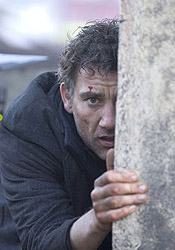 Some of the set pieces Cuarón orchestrates are the most electrifying, living and breathing sequences ever imagined in the history of cinema. Much credit here is due to Lubezki and camera operator George Richmond, not to mention a meritorious technical and stunt crew who must have rehearsed these moments into the ground.
You’ll hear it for the rest of the year, the cinematography on display in “Children of Men” is God-like in its skill and quality.
Equally impressive is the production design of Jim Clay and Geoffrey Kirkland. Dreary, decaying urban landscape spans the frame. Graffiti and bullet holes decorate sets constructed with a defining clarity of intent, and ultimately the world envisioned on the drafting table becomes a character in its own right.
The most interesting aspect of the mise-en-scène, however, has to be the director’s decision to litter the frame with various animals, usually dogs and cats. Representative of humanity’s longing and desperate need to replace children with something else, it is one of the more subtle aspects that isn’t brought out into the open for inspection, but upon examination is all too brilliant an element in the director’s arsenal for this, his finest film to date.
“Children of Men” is a shocking portrait, indeed. From an opening scene that grips you by the collar and never lets you turn away, it is stomach-churning in its abjection, and it is resonant in its refusal to buckle under the cynicism with which Cuarón paints his canvas. It is stark and it is pointed, but it is warm and full of hope all the same. It is a miraculous achievement.
 *All historical figures are adjusted to today’s dollars.