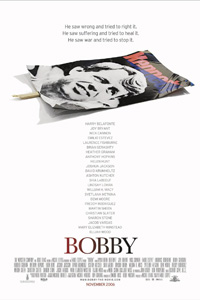
 Emilio Estevez’s third feature filmmaking endeavor is everything his prior work was not. It is both insightful and meaningful. It exudes passion and commands relevance. It represents a cross-section of a country battered and bruised, and emphasizes the beacon of light that hoped to usher it to greener pastures.
Crafted with graceful devotion and blistering sincerity, “Bobby” is not merely one of the most personal films of the year. In a season curiously dedicated to themes of compassion and understanding, it is one of the most resonant film-going experiences politically inclined cinema can aspire to be.
I know nothing of the pain of loss experienced the day Robert Kennedy was assassinated at Los Angeles’s Ambassador Hotel. I’m a part of a generation that cannot fully grasp the utter shattering of hope that event must have lain at the feet of a country in desperate need of tranquil leadership.
The memory is not mine to draw upon, but the change of the tide during those turbulent years, the late 1960s, forcibly molded the country we live in today. I am a byproduct of that result, and my generation is reflective in some way, however small, of that milestone era.
Estevez understood this as he set about constructing his film, one that really and truly feels as if it exploded from his heart and bled out onto the page. Set in the Ambassador on June 5, 1968, the story is conveyed through a sprawling, Altman-esque ensemble.
Twenty-two characters serve to represent America at one of its most defining thresholds, all preparing in one way or another for Senator Kennedy’s speech the night of the year’s senate elections. Kennedy was infamously gunned down by Sirhan Sirhan in the hotel’s kitchen following his spirited and awakening address.
It would be a daunting task indeed to account for each and every character. An overwhelming cast fills out the bill in a manner that makes it nearly impossible to distinguish a standout.
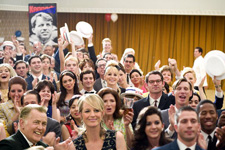 However, rest assured the actor/writer/director covered all bases, charting youthful aggression, elderly wisdom, minority rage and feminine anxiety amongst the numerous hot button issues of the day.
The speckled casting has caused many to wonder and expect half-baked representations, but rest assured, the work from Lindsay Lohan, Nick Cannon, Demi Moore and even the film’s director stands shoulder-to-shoulder with the likes of film awards regulars William H. Macy, Helen Hunt, Laurence Fishburne and Anthony Hopkins to form a truly organic ensemble. Before long, one settles into a state of watching characters, not actors.
It really is something special and it was always the most obvious hurdle, one capably cleared. If pressed to pick favorites (and the subjectivity of the matter will command favorites more so than definitive stand-outs), I would say I was most taken by the performances of Cannon, Hopkins and Freddy Rodriguez. But beyond performances, what is much more interesting is how much Estevez obviously cared about his film’s subject.
This isn’t a director merely showcasing his abilities and constructing a wonderful piece of filmmaking like a skilled craftsman cranking out another successful product. This is a film with stitches that show and blemishes for which it refuses to apologize. It is an effort as flawed as it is successful, and those touches of imperfection make it all the more powerful as a representation of humanity and the good fight.
Estevez is no auteur, and he does not always necessarily convey a riveting sense of artistry. What he does is allow his gut to do the work, and the effect is a rousing experience to say the least.
 The editing of the film is of the highest quality, coming under the acclimated hand of veteran Richard Chew (“One Flew Over the Cuckoo’s Nest,” “Star Wars”).
Also, though Mark Isham’s iconic score takes obvious leads from Thomas Newman’s work on “The Shawshank Redemption,” it nevertheless lends an element of prestige to what is an important piece of filmmaking.
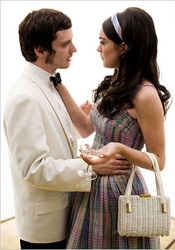
Michael Barrett’s camera captures the peculiarities of every character as it floats throughout the scenery, and Julie Weiss’s costumes do the film a spectacular service that truly transports the viewer back in time.
I expect and hope to be talking about “Bobby” for many months to come, as it is a definite threat in this year’s Oscar race – a film that could literally go all the way. But regardless of awards and reactions, the question is still asked to this day: What if Robert Kennedy had ultimately become president of the United States? Where would the country be today? And most especially, how would the country be viewed in the eyes of the rest of the world?
There are no answers to such queries, but “Bobby” goes to great lengths to perpetuate Kennedy’s lasting significance as a man of understanding – a true king in his time. Ultimately, the lively juxtaposition of his various speeches and audio clips dictating his rhetoric forty years later drive home the point viscerally as the narrative does so thematically.
Ours is a nation built on the understanding and empathy that is as close to godliness as man can hope to be. Let us please learn the lessons of the past.
 • Sasha Stone ponders Oscar possibilities for Jim Carrey in “I Love You Phillip Morris” as the hate-mongering right looks to block the repeal of Don’t Ask, Don’t Tell. [Awards Daily]
 Moving along at Toronto, it seems Mitch Glazer’s