 Jane Shilling has a piece at the Telegraph about the gender politics of “Chéri” — specifically, the social disruption engendered by a romantic relationship between a middle-aged woman and a young man.
Describing “Chéri” author Colette, and by extrapolation the character of Léa (played by Michelle Pfeiffer in the film), as “the original cougar,” Shilling suggests that the story of her love for a man half her age is more provocative to a contemporary audience than the first readers of the 1920 source novel:
A couple of weeks ago in Grazia magazine an article appeared about a fascinating modern phenomenon. “Until recently,” wrote the author, Rita Sangha, “a woman dating a much younger man was likely to be ridiculed. But things have changed. Thanks to stars like Madonna, a ‘cougar’ – an older woman dating a younger man – isn’t seen as desperate: she’s glamorous and in charge of her own destiny.”
Perhaps, she would have been amused – though not surprised – to discover that the seductive alchemy of a love affair between a middle-aged woman and a boy young enough to be her son would seem even more scandalous in 2009 than it did when she sat down to write it, 90 years ago.
Shilling’s rather sketchy argument fails to bridge these two contradictory points — how is the so-called “cougar” phenomenon both laudable and scandalous? — though that perhaps accidentally echoes Colette’s own ambiguity on the matter. As I discussed in my Page to Screen article on the novel, Colette both defends Léa and Chéri’s generation-crossing relationship, but condemns a similar dalliance by of one of Léa’s peers as grotesque; the principal difference, it seems, lying in the two women’s levels of physical attractiveness.
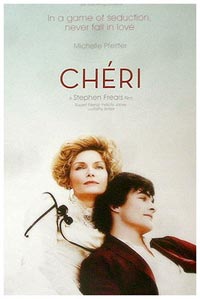 My first thought on leaving the theatre after watching Stephen Frears’ crisp, elegantly turned new effort is that it is, in many ways, a consummate Frears film. My second thought, however, ran counter to the first: it has, over the years, become increasingly difficult to define what “a Stephen Frears film” might be.
 Merely casual acquaintances of French literature will likely associate the name Colette with her short story “Gigi” – or rather, the flouncy musical film adaptation thereof that swept the board at the 1958 Academy Awards. A sunny, sanitized interpretation of an intricate study in sexual politics, it captured the author’s sensibility in its lavish set-dressing, but little else.