In Contention

Blog

  • INTERVIEW: Ryan Gosling

    Ryan Gosling is a smooth customer. Lacking pretension so much that one can’t even find a hint of his intending to steer clear of it, the actor recently celebrated his 26th birthday on November 12th. This following a year that has seen his directorial debut come to pre-production light, a coveted spot amongst GQ’s annual “Men of the Year” issue and, oh yeah, one of the most acclaimed performances of 2006.

    The critically hailed star of “The Believer” and “The Notebook,” Gosling finds himself in the thick of the year’s awards race for his riveting portrayal in Anna Boden and Ryan Fleck’s “Half Nelson.” The film received five Independent Film Spirit award nominations this morning, including Best Male Lead for Gosling.

    Greeting me via telephone from Toronto, where he is nearing the end of principle photography on Craig Gillespe’s “Lars and the Real Girl,” the actor seems to have tripped over his sister’s computer chord and is having some trouble with the usual “hellos.” It’s all for the best, really, because when you have a conversation with Ryan Gosling, the last thing you want to do is bog things down in formalities. Gosling is a real guy, attracted to real ideas and, above all else, real characters.

    “I had read the script and thought it was about people I had met, people I knew or was like in some way,” he says. “When I go to the movies, I want to feel like I’ve met someone. People who do things out of character, who don’t have a clear character arc, those are the people I’m interested in seeing in a film.”

    In “Half Nelson,” Gosling stars as Dan Dunne, a charismatic junior high school history teacher in a drab and dismal Brooklyn neighborhood. Dan’s professional environment is one of enlightenment for his pupils. He captures the spark of their educational hunger and even finds time to coach the girls’ basketball team. But personal demons can haunt even the saintliest of souls, and Dan’s crutch is drug addiction. The allure of the crack pipe frequently pulls him away from the buoyancy he works so hard to construct for his students, dragging him through the realities of crushed idealism.

    In some ways not the most sympathetic of individuals, Dan provided for Gosling a character of tangibility and truthfulness.

    “I think you have to love and hate the characters you play,” he says. “They’re people. It’s not as simple as sympathizing with them.”

    To prepare for the role, Gosling moved to New York for one month before shooting even began, immersing himself in the life of his character. He lived in a small apartment in Brooklyn and spent time shadowing 8th grade teacher David Easton. Speaking matter-of-factly about his methods, Gosling mentions, “There’s a million ways to get there, but it’s a challenge when there’s no real reference for the people you play.”

    What might also be considered a challenge for some actors is sharing the screen with untrained thespians. But Gosling seems to have found a preference of sorts, so much so that he plans on casting his upcoming directorial debut, “The Lord’s Resistance,” with non-actors across the board.

    “I love working with non-actors,” he says. “Actors are so manipulative, and non-actors are not. They push you in ways that the best actors in the world can’t.”

    One such non-actor is Shareeka Epps, receiving equal praise for her portrayal of Drey in the film. One of Dan’s students who happens upon his secret early in the first act, Drey seems weathered and accustomed for her years, but exuberant and youthful all the same – qualities Gosling also found bursting out of his co-star.

    “Shareeka has no reverence, which I really respected,” he explains. “She doesn’t approach any scene with any preciousness. She’s brutally honest and not ashamed of how she feels.”

    Finding himself in the heat of contention for Best Actor consideration at this year’s Oscar ceremony, Gosling is predictably apathetic about the awards process. One almost doesn’t want to approach the subject with him, given the expected response from an actor so obviously concerned with the work above anything else. But this is a business of sound bites, and even the most apprehensive awards hopefuls can give you gold in that regard.

    “It affects me,” he says of the Oscar race, “in the sense that I’m happy that a film that cost $500,000 can get to a point where this many people are aware of it. Awards – I don’t know who that’s up to, but I appreciate that the film is being received the way it is. I had one of the best experiences of my life on this. We never had to hit any marks. We never had to say anything twice or worry about continuity. You never felt like you were in a scene in a movie. A lot of directors never see it that way. Anna and Ryan have a great eye for the way that we are and the lies we tell about who we are, and that’s rare.”

    From here, Gosling will assuredly take it all in stride. The aforementioned “The Lord’s Resistance” is high on his list of priorities. Telling the story of the Lord’s Resistance militia in Uganda, the film looks to be another pointed political entry in the current canon of Africa-centralized cinema. Even still, don’t expect the actor to look too far ahead at the kinds of films he wishes to make, in front of or behind the camera. He holds such judgment to a case-by-case basis.

    “I’ll have to wait until I’m tested,” he says. “Films I love have a certain allowance for accidents. When I was a kid, my favorite films were the ‘Abbot and Costello’ movies. I love Werner Herzog’s films, Terry Malick, John Cassavettes. But I’ve got a lot of things I want to do in my life, and not just acting. There’s no anxiety about not having enough time to do all the movies I want to do or anything, but I have to keep it interesting for myself. I don’t want to make the same movie over and over again.”
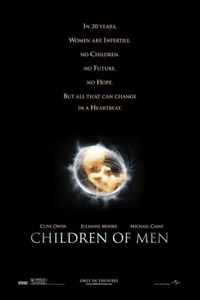
  • REVIEW: “Children of Men” (****)

    Universal Pictures' Children of MenAlfonso Cuarón’s is one of the most singular voices in the filmmaking community. Along with longtime collaborator, cinematographer Emmanuel Lubezki, the director has ushered forth textured visions of skewed fairytales for over a decade.
    With “A Little Princess,” he took audiences into the mind of a little girl and her trying tenure at a miserable boarding school. In perhaps his most underrated work, “Great Expectations” (a loose adaptation of the Charles Dickens novel), he unveiled the mysterious and fateful journey of a dreamer.

    “Y tu mamá también” brought the director’s choice of material into a more mature light, still keeping the exuberance of youth, while “Harry Potter and the Prisoner of Azkaban” became one of the most adult installments in a series aimed at a younger market.

    “Children of Men” fits rather paradoxically into these otherwise whimsical endeavors. Another sort of fairytale altogether, one cloaked in the mystique of dystopia, it is a film as unflinching in its bleakness as it is penetrating in its deep-seeded sentimentality. And in manifesting one of the most horrific visions of the future yet committed to film, Cuarón has given us his masterpiece, the crowning achievement of 2006.

    Adapted from the P.D. James novel of the same name (and, through much arbitration, crediting some five writers on the screenplay), “Children of Men” reveals the hellish world of 2027. Baby Diego has died, the affectionately labeled youngest person in the world -– 18 years old. Fertility is an aspect of the past, and humanity’s time is clearly borrowed. The world’s nations have crumbled to apocalyptic ruin. England remains the last refuge for potential stability and order…but those days are quickly slipping away.

    Theo Faron (Clive Owen) is a man lost in this sea of chaotic apathy, sliding amongst the beleaguered masses, one of the hordes, most concerned about his morning coffee and skipping out on work than with finding something of considerable happiness. His best friend, Jasper Palmer (Michael Caine), is a stoned hippie who listens to the oldies and laughs away the final years of human existence in the woods, surrounded by marijuana and nostalgia.

    An immigrants’ rights terrorist organization headed by the mysterious Julian Taylor (Julianne Moore) kidnaps Theo in broad daylight one day in order to attain transport papers for an unnamed woman. Julian and Theo, we learn, once had a child together, a child they lost and whose memory haunts them equally.

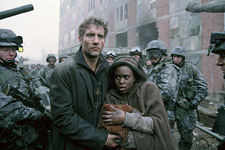
    Clive Owen and Clare-Hope Asitey in Children of MenThe unnamed woman is soon revealed to be Kee (Clare-Hope Asitey), a refugee holding the potential key (I feel as though I’ve just discovered the point of the character’s name) to the future of man: miraculously, she is pregnant, waiting to give birth to the first baby the earth has seen in 18 years.
    It soon falls to Theo to protect Kee and her unborn child, a veritable political football, and smuggle her to the Human Project, a scientist organization bent on curing the world’s infertility crisis.

    Through sheer drama and brutal tension, Cuarón sets about weaving a blistering yarn that draws parallels to current political climate. Truly penetrating visual cues bring the viewer’s mind to everything from ground assaults in Iraq to conditions at Abu Ghraib prison.

    Clive Owen’s portrayal is largely physical, as Theo is an elusive character (even by the actor’s own admission). Even still, this is one of the year’s great performances, an immediately believable portrait of a hero called to unconscionable task. Asitey is equal parts preciousness and irreverence as Kee, and Caine has far too much fun for his own good in the role of Jasper. Moore’s turn is fleeting, but elevated by her own angelic screen presence.

    Elsewhere, Peter Mullan has a great second act performance in store as one of Jasper’s amigos, while Chiwetel Ejiofor offers up yet another controlled supporting turn, this time as part of Julian’s terrorist organization. It is, however, the technical elements of the film that propel it head and shoulders above anything else in the market place this year.

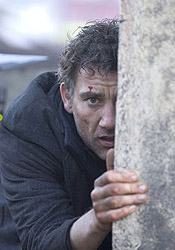
    Clive Owen in Children of MenSome of the set pieces Cuarón orchestrates are the most electrifying, living and breathing sequences ever imagined in the history of cinema. Much credit here is due to Lubezki and camera operator George Richmond, not to mention a meritorious technical and stunt crew who must have rehearsed these moments into the ground.
    You’ll hear it for the rest of the year, the cinematography on display in “Children of Men” is God-like in its skill and quality.

    Equally impressive is the production design of Jim Clay and Geoffrey Kirkland. Dreary, decaying urban landscape spans the frame. Graffiti and bullet holes decorate sets constructed with a defining clarity of intent, and ultimately the world envisioned on the drafting table becomes a character in its own right.

    The most interesting aspect of the mise-en-scène, however, has to be the director’s decision to litter the frame with various animals, usually dogs and cats. Representative of humanity’s longing and desperate need to replace children with something else, it is one of the more subtle aspects that isn’t brought out into the open for inspection, but upon examination is all too brilliant an element in the director’s arsenal for this, his finest film to date.

    “Children of Men” is a shocking portrait, indeed. From an opening scene that grips you by the collar and never lets you turn away, it is stomach-churning in its abjection, and it is resonant in its refusal to buckle under the cynicism with which Cuarón paints his canvas. It is stark and it is pointed, but it is warm and full of hope all the same. It is a miraculous achievement.

  • REVIEW: “The Painted Veil” (***1/2)

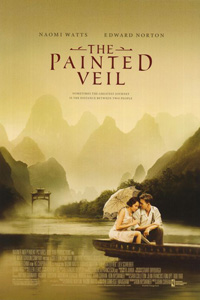
    Warner Independent Pictures\' The Painted VeilRomance seems to be the theme that sparks the most diverse reaction from the artistic community, filmmakers in particular.  There are various methods and structures utilized to tell tales of the elusiveness of love, and new, fresh takes on this binding structure of human interaction come into the cinematic arena every year.

    Some audiences prefer the restraint but equal probing of, say, “The Remains of the Day.”  Others might yearn for the creative ferocity of “Eternal Sunshine of the Spotless Mind.”

    John Curran’s “The Painted Veil” might not be as calm as the former, and certainly not as unique as the latter, but it is nonetheless a story fabulously woven and penetrating in its exhibition of a new kind of love story.  It is one of the year’s finest films.

    Based on the M. Somerset Maugham novel of the same name, “The Painted Veil” is a tale of forgiveness above all else.  It is a deconstruction of our surface frailties and a call to understanding the virtues that lie beneath, and certainly, the lessons that might be learned all too succinctly with the experience of poor decision.

    Conveyed through a creative structure and filmed with long, deep breaths of beauty and compassion, John Curran’s effort propels him from an independent background and into a stoic place of assured filmmaking competence.

    He might be a director to keep an eye on in the future.

    Naomi Watts stars in the film as Kitty, a spoiled and monetarily nurtured sort who longs to break away from her meddlesome mother and tiresome life in London.  She meets Dr. Walter Fane (Edward Norton) at a family gathering one night and the good doctor falls for her immediately.

    Inevitable courtship commences, though Kitty doesn’t seem to take a specific interest over the course of two years (which fly by in the tight structure of the first act) until Walter asks for her hand in marriage.

    Kitty agrees, if only to break free of the ties of London, and the doctor whisks her away to Shanghai, where he will be working and studying.

    All of this is told betwixt scenes depicting a very different Mr. and Mrs. Fane making an overland voyage to a Chinese village, a couple uncomfortable with one another and uninterested.

    This cross-editing comments directly upon the present in a structure recently apparent in Christopher Nolan’s “Batman Begins.”

    As the past blends with the here and now, the first act comes to a head with Walter’s discovery of Kitty’s affair with Charles Townsend (Live Schreiber), a popular diplomat in Shanghai who is also married.  Under the threat of divorce (and therefore scandal), Walter forces Kitty to accompany him to the faraway village where he will study and help treat a cholera epidemic, and in so doing, perhaps glean some sort of pleasure from Kitty’s distress at the expedition.

    Naomi Watts and Edward Norton in The Painted VeilTensions, meanwhile, are running high between nationalist Chinese and the westerners they feel are invasive to their way of life.  Held somewhat emotionally captive in this unfamiliar environment, Kitty spends her days and nights wasting away and feeling useless.
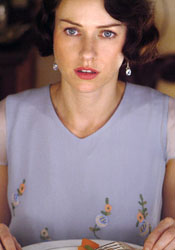
    Walter avoids her, quite clearly considering her with disgust and disdain.  But the man Kitty married, she never bothered understanding or even knowing, and so a trying excursion to the Far East, it seems, might reveal the good man she was too selfish to discover, and the life she has wasted on herself for far too long.

    “The Painted Veil” is a complicated but delicate film.  It really is a lasting sort of story, however, and credit seems to be best served to writer Ron Nyswaner.

    I personally have never read Maugham’s novel, so if the first act structure of the film is apparent therein, forgive my ignorance.  But my assumption is that is not so and it was the clever creation of Nyswaner to comment directly on the Fanes through a simple but purposeful structure from the first frame of the film.

    Whoever is responsible, the device is a brilliant one because it works on so many levels.  Nyswaner (who was nominated for an Oscar in 1993 for his original screenplay “Philadelphia”) also takes a certain care to pace the story with a sense of measure, but never at the expense of interest.  A film that might seem boring to some is in fact quite engaging throughout.

    Edward Norton and Naomi Watts have a specific chemistry that is extremely organic to the piece.  Norton in particular (who also served as one of the film’s producers) provides perhaps his best performance since “American History X,” and certainly his best since “25th Hour.”

    He trumps the quality he tends to have difficulty shaking, that tendency to be Edward Norton first, the character second.  Here, he is fully believable and lived-in as Walter.

    Naomi Watts in The Painted VeilNaomi Watts shines and has the clear character arc of a woman who grieves for her past mistakes.  Kitty is extremely child-like at the film’s start.  By the end, she is a woman with a life of experience and a future that would have been uncertain otherwise.
    It is a slow revelation for the character, which in some ways makes it more poignant.  To paraphrase, a convent nun puts it to her late in the film, “When duty and love are one, then you are truly full of grace.”

    And that is the lesson Kitty learns a thousand miles from familiarity.

    Another performance worth commenting upon is Toby Jones’s portrayal of Mr. Waddington, a liaison for the Fanes who is quite the warm friend of the family, so to speak.  It’s the kind of small but meaningful turn that Harvey Weinstein would have ushered to a supporting actor nomination in the 90s, one that typically slips under the radar in today’s movie-going environment.

    The technical elements of the film are quite lovely, hinting at the works of James Ivory or Anthony Minghella in some instances.  Stuart Dryburgh’s cinematography thankfully avoids the temptation of drowning the scenery out in golden hues and tonal recreations, rather depending on putting forth beautiful imagery to tell the story first.

    The work of editor Alexandre de Franceschi is some of the most understated but clearly exemplary efforts at the AVID this year, and Alexandre Desplat’s majestic score is his finest work to date, fit with soaring themes and delicate subtlety.

    “The Painted Veil” is the crowning jewel of producer Bob Yari’s output this year.  It is also a fantastic get for Warner Independent Pictures, who might try harder with the film than a larger distributor would (though that is yet to be seen).

    It is a comforting reminder of the filmmaking medium, that stories can be told with beauty and simplicity and still evoke effective emotional impact.  A fantastic effort.

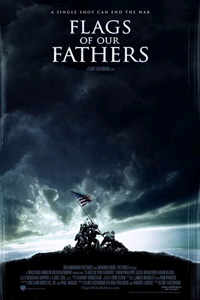
  • REVIEW: “Flags of Our Fathers” (***)

    Paramount Pictures\' Flags of Our FathersClint Eastwood is largely considered one of the most uneven directors working today.  For every probing piece of thematic greatness (“Unforgiven,” “Mystic River”) there are three or four considerable missteps, from “The Gauntlet” and “Heartbreak Ridge” to “Midnight in the Garden of Good and Evil” and “Blood Work.”
    Such inconsistency is the price a hard-working filmmaker pays, for anyone willing to crank out a new project every other year for three decades is bound to miss the bull’s-eye frequently.

    At the same time, amidst these lesser efforts, Eastwood has always shown a process of honing his artistry, remaining a singular talent and every once in a while experiencing the serendipity of matching that talent with exceptional material.  Indeed, more often than not, a failing Clint Eastwood film is doomed on the page before principle photography even begins.

    “Flags of Our Fathers” is certainly a singular figment of the war film oeuvre, fit with promising themes rather unrepresented in the genre’s history that speak eloquently to today’s environment of deception of the masses for the gain of the establishment.

    But it is also an exercise ultimately hampered by an unfocused and erratic narrative, one that constantly seems to be searching for itself and feels hastily lifted from the pages of James Bradley’s best selling book of the same name by William Broyles, Jr. and last year’s Oscar-winning scribe Paul Haggis.

    Bradley’s book was a personal endeavor for the author.  The son of John Bradley, one of the six infamous Iwo Jima flag-raisers immortalized by Associated Press photographer Joe Rosenthal in March of 1945, James Bradley crafted a human account of the lives of unassuming heroes captured in time.  Only three of them survived the war to see the image’s impact on the western world, and within the pages of “Flags of Our Fathers,” their stories are told with painstaking clarity and at times sluggish accuracy.

    The task in adapting the book as a film was to amplify the central theme of manipulation and marketing for the greater good.  Broyles and Haggis succeed in doing this to a point, but as the yarn unfolds, the depth of potential seems to thin out in the mix.

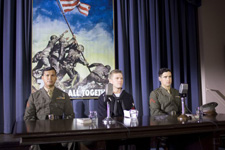
    The three survivors in the photo were John “Doc” Bradley (Ryan Phillippe), a medic who certainly saw his share of carnage on Iwo Jima; Rene Gagnon (Jesse Bradford), a man portrayed as intent on becoming a “hero”; and Ira Hayes (Adam Beach), a Pima Native American paradoxically proud to serve a country that had relegated his people to the confines of reservations.

    Upon their return to the United States, the flag-raisers find themselves ensnared in a publicity tour that represents the core of what Haggis is trying to get across.  Behind the scenes, the aim is for Rosenthal’s lasting image to spearhead a wave of hope and patriotism that will inspire citizens to purchase bonds as the country suffers financial asphyxiation four years into the war.

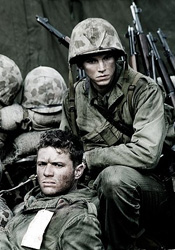
    (from left) Adam Beach, Ryan Phillippe and Jesse Bradford in Flags of Our FathersThe ubiquity of the photo puts Gagnon in the appreciated place he had sought to be, Hayes in the hesitant position he feels he doesn’t deserve, and Bradley as an awkward observer of it all, strangely passive as a character, given the book’s origins.
    This repetitive sense of exhaustive handling is intercut with the infamous battle that claimed the lives of over 27,000 human beings – three quarters of them Japanese.  More congressional medals of honor were awarded for the Battle of Iwo Jima than any other battle in American history.

    A large chunk of this military excursion is presented in the first act – a good ten or fifteen minutes of solid chaos.  Had Haggis chosen to tell the story in a more linear fashion, keeping the battle at the top and using its memory as a haunting element throughout the rest of the film, the pieces might have come together more organically.

    But the stink of manipulation and even amateurism emanates from the decision to continuously go back to Iwo Jima when it feels thematically relevant.

    Eastwood and his technical crew, not the least of which being cinematographer Tom Stern and film editor Joel Cox, do a marvelous job of conveying an unnerving and multi-faceted battle sequence that will draw comparisons to Steven Spielberg’s “Saving Private Ryan.”

    Eastwood is working with much more than land infantry here, however, mixing in air battalions, battleship artillery and the symbiosis of it all as it pertains to the taking of Mount Suribachi on the east side of the island.  Exceptional visual effects mix seamlessly with Stern’s washed out photography for a truly gripping and visceral experience.

    However, where Spielberg successfully utilized the Battle of Normandy to visually tell his story, Eastwood seems to get lost in the elements, sacrificing thematics for admittedly surprising capabilities in the trenches.

    All of this might have made for a much more tolerable, even above average war film had the third act not dived so gratuitously into the binding structure of the rest of the film.  Multiple perspectives and narrations carry the tale here and there through fleeting scenes depicting James Bradley (portrayed by Tom McCarthy) interviewing subjects and preparing his book.

    It was laid out from the start, and a return ought to have been expected, but regardless, once the final act commences, the screenwriters make the unwise decision to concentrate on this aspect of the story for purposes much more sentimental than thematic.  And each unrelenting cue of a typically repetitive Eastwood score amplifies this perception of the final leg of the film.

    The performances throughout represent a true ensemble, but the focal points are surely Phillippe, Beach and Bradford.  Phillippe handles an under-written leading role as well as can be expected (that’s really all that can be said), while Bradford puts forth a stock, self-serving and rather uncomplicated character that hedges its bets in an obvious attempt by the screenwriter to steer clear of disrespect.

    Ryan Phillippe in Flags of Our FathersElsewhere, John Slattery offers a great supporting turn as the point man on this public relations whirlwind.  Barry Pepper, in the role of flag-raiser Mike Strank, comfortably stifles the urge to take a tough-as-nails character to the same places he has taken numerous similar characters numerous times before.

    Neal McDonough and Robert Patrick fill out the higher military ranks accordingly, while Jamie Bell, Joseph Cross, Benjamin Walker and a thankfully muted Paul Walker (as mistaken flag-raiser Hank Hansen) seem to blend together in the surrounding scenery.

    The real find of the film, however, is Adam Beach, already a 16 year veteran in the business and on the cusp of a defining moment in his career.  Portraying an alcoholic Native American in Ira Hayes (a character that attempts to avoid cliché when it can), Beach’s role automatically exists as the most complicated of the lot.

    There are times when the viewer catches a whiff of over-reaching in his performance, but more often than not, the 33-year-old actor lands the right emotional notes in key scenes that will evoke the most heart-felt reaction from audiences.  Even amidst a continuously tepid reaction to the goings-on, this viewer felt the threat of a tear when Hayes visibly breaks down and hugs the mother of one of his fallen comrades with all the meaning in the world.

    As war films go, “Flags of Our Fathers” had the opportunity to speak to greater truths of the actual machine of war than any other film of its kind.  The John Ford “print the legend” quality of the story is definitely apparent, and as mentioned at the top, these notions speak volumes to the modern environment of vast manipulation, deceit and even celebrity.  But they seem to be fighting through the dense foliage of spectacle at times, and at other times, the elaborate design of unnecessary artistry.

    Much of this is ultimately forgivable, however, if somewhat hesitantly so.

    Eastwood is as surprising as he is predictable in that he never seems to fully collapse under the burden of something new or unfamiliar.  He has found himself adept at conveying epic stories through the intimate brushstrokes of character in the past, the truest examples being his early westerns “High Plains Drifter” and especially “The Outlaw Josey Wales.”

    “Flags of Our Fathers” feels like his third or fourth war film endeavor much more than it does his first.  It was a valiant effort and a unique experience, but it ultimately isn’t enough to stretch beyond definitive flaws in the screenplay.

    During the production of “Flags of Our Fathers,” Eastwood reportedly felt as if he wasn’t conveying the full story of the Battle of Iwo Jima.  With this in mind, he set about preparing “Letters from Iwo Jima” (formerly “Red Sun, Black Sand”).  Told from the Japanese perspective and releasing February 9, 2007 from Warner Bros. Pictures, “Letters” may or may not find itself more in tune with its own thematic structure than “Flags of Our Fathers.”

    Regardless, as a duet, the films will inevitably find themselves unique in the pantheon of anti-war cinema.  It’s nice to see a seasoned filmmaker being this ambitious, and no matter how you slice it, these two films are an ambitious enterprise to say the least.

  • INTERVIEW: Patrick Wilson

    Patrick Wilson’s star has steadily been on the rise following an on-screen debut in the 2003 mini-series “Angels in America.” Consistent work in John Lee Hancock’s “The Alamo” and Joel Schumacher’s “The Phantom of the Opera” have kept him in the game, but 2006 might be his year to really shine. Currently receiving considerable acclaim for his work opposite Kate Winslet in “Little Children,” the actor is entering a defining stage that could perpetuate that rise. I had the opportunity to sit and chat with Wilson while he was promoting “Little Children” at the Toronto International Film Festival.

    After earning a BFA at Carnegie Mellon University in 1995, Wilson, an unabashedly friendly and humble man, quickly made a name for himself as a stage performer. Only recently has he found his way to the film industry. Director Mike Nichols happened to catch Wilson in the Broadway production of “The Full Monty” in 2002, which inspired the filmmaker to cast him in the award-winning HBO mini-series, based on Tony Kushner’s revered play.

    “The transition from stage to screen was a smooth one,” Wilson explains. “Though for a while on ‘Angels in America,’ I did find myself asking the cinematographer where I should be in the picture. But I was fortunate enough to have an acting style already well-suited for cinema”.

    Though his segue from the stage to the big screen came relatively without fuss, Wilson admits considerable differences between the two mediums that remain striking.

    “With stage, you do it and it’s there. Watching ‘Little Children’ now, I’m seeing work I did a year ago”. The experience must certainly contrast with the immediate audience interaction he experienced on stage.

    Calling theater “the actor’s medium” with film being “the director’s medium,” Wilson praises filmmaker Todd Field for his work on “Little Children,” specifically admiring the editing of the film “to create a tension that was not there on the page”. And though acknowledging Field is obviously attracted to drama, he also says this was in many ways a departure for the director of “In the Bedroom.” “Some of the hardest laughs I have had came on the set of his movie,” Wilson reminisces. “Like Todd, I personally consider the film to be a satirical melodrama.”

    Satirical or not, “Little Children” boasts delicate subject matter that might have worked against the film without the proper care. While infidelity is surely an issue front and center in the screenplay (adapted from author Tom Perotta’s novel of the same name), the story also revolves around a convicted sex offender, portrayed in the film by former child actor Jackie Earle Haley.

    “I was never afraid of how the film would handle the subject matter,” Wilson explains. “Jackie was fantastic in the role. But even before that, Todd and Tom created a human out of a subject abhorrent and tough to watch.” And regardless of controversial elements, as he told the audience at the premiere the night before we spoke, “five, six, seven dynamic, intertwining characters is rare in a film.”

    Much of the buzz surrounding “Little Children” following showcases at the Telluride and Toronto Film Festivals has specifically been aimed at Wilson’s co-star, four-time Oscar nominee Kate Winslet. An actress Wilson acknowledges for continually taking roles to challenge herself, Winslet certainly has a clear trajectory for Oscar consideration once again. Wilson is clearly grateful for the opportunity to have worked with her on “Little Children.”

    “The great actors are the great actors because they want to become even better actors,” he begins, speaking fondly of his co-star. “We sat down together for several days before shooting started, getting to know each other and going over the script. Her dedication was infectious.”

    So where does Wilson hope to go from here? When asked if he has any desire for truly mainstream endeavors, his response is “a great part is a part. I go to movies all the time.” He also points out Russell Crowe’s Maximus, from Ridley Scott’s “Gladiator,” as being an example of a great role in what is clearly a mainstream movie.

    “I’m not at the top of the pecking order,” he continues. “Usually a role gets turned down before getting to me. ‘Little Children’ is the rare example of a director wanting me for the part from the get-go. But I’m fortunate that the opportunities I have had have been great ones. Some roles I have been intrigued by, and not been offered, have ended up being in less-than-great films. But I think I know where my strengths are.”

    No matter what roles Wilson ends up taking as his career continues to blossom – in film, television or stage – I have no doubt we’ll be seeing more of the already accomplished 31 year-old thespian in the future. Releasing this Friday and sure to make a mark on this year’s film awards season, “Little Children” could be that early turning point that keeps him on our radars for years to come.

  • INTERVIEW: John Cameron Mitchell

    John Cameron Mitchell might be one of the few true artists working in the film medium today. In his much celebrated feature debut “Hedwig and the Angry Inch,” the actor/director pealed his own creation from the stage and molded it into a cinematic experience that became one of the most accomplished films of 2001. His electric performance as a shafted transsexual (let’s say almost transgender) rock star reached new heights on celluloid, claiming a lion’s share of critical honors, while his efforts behind the camera announced the arrival of a promising new directorial talent.

    Now with “Shortbus,” one of the best films of 2006 and undeniably one of the most thematically potent, Mitchell has found his groove as a speaker to the metaphors of primal and cultural humanity. Glaring through, yet paradoxically past the cardinal sexual characteristics we share as frail co-inhabitants of a wicked world, he has tapped into a method of creativity that reawakens the senses to a commercial medium’s true potential.

    “It’s a film about the question we all have to ask of whether we’re going to be alone,” Mitchell explains with a staggering intellectual delicacy. “And sex is just one of the languages we use to not be alone.”

    Indeed, if unsuspecting viewers make it beyond “Shortbus”’s riveting opening sequence, they will find a central nervous system of artistry that speaks to deeper truths than the most well-intended of artfully-minded cinema. A bona fide explosion of sexual expression that dictates the film’s themes in vivid detail, the scene climaxes with a puzzling moment Mitchell describes with measured confidence and candor.

    “You meet James…who is sucking his own dick. It’s kind of comic but there’s this element of poignancy there, too. Who is someone in their 30s who would try that? Why is he trying to be self-sufficient at this point, to self-fertilize? And then burst into tears? That is my way of introducing the character. Sex can be used as metaphor.”

    Therein lays the workings of Mitchell’s unique genius. It’s the standard assumption that inter-character relationships are meant to reveal and reflect the themes of a given film, but to comment upon the human condition through a character’s relationship with him or herself is another level of artistic thinking altogether. Such a motif abounds in “Shortbus”’s eclectic ensemble.

    Mechanically, the film is a dissection of community, largely the result of collaboration and improvisation from amateur thespians. It looks at individual and group reality through the lens of sex, detailing an array of characters Mitchell is quick to admit ultimately represented various facets of his own personality.

    “There’s a part of me that’s like a stalker,” he admits. “There’s a part of me that’s like a non-orgasmic woman who can’t connect. And I’ve had a part of me that feels like I’ll never be with anyone. But everyone sort of brought their own stuff to it and I just directed it.”

    He continues: “We started working on it in 2003, which was when we had our website with our mission statement and our audition to send tapes. It was open call. We avoided agents. [We were looking for] people who could work in an improvisational way, who were smart, who were funny, who were charismatic in some way, a diversity of sexuality and gender.”

    The result was a meaningful interface of creative input, one the director found quite different from the experience of his first major creation.

    “‘Hedwig’ was kind of developed gig by gig,” he explains, “sort of a solo show with a composer. ‘Shortbus’ was through improv, borrowing a page from Mike Leigh and John Cassavettes. I’d love to work with a very tightly-honed script and very virtuosic actors next time. I’d like to do an opera some day. I’d love to write a novel, make an album. I like to work in a lot of different ways and I love to keep it diverse.”

    Set in the culturally booming setting of New York City, “Shortbus” also makes light of our society’s post-9/11 consciousness. One line that sticks out is “You’re taking a picture of yourself at Ground Zero. Do you smile?” It’s a delicate stick and move that actually speaks modestly to what Mitchell describes as President Bush’s favorite weapon: fear. And wrapped up in the natural reaction to what has been considered by many to be an emotionally oppressive regime, Mitchell identifies another pitfall altogether.

    “Cynicism seems to be the currency of the day,” he begins, “especially in such a weird, ‘Bush-whacked’ country. It’s like the only comfort some intelligent people have is cynicism, and certainly humor, but kind of a fatalistic humor where you’re powerless and you think nothing’s going to change, which is just as dangerous. I think there are incredible cultural critics today who point out the absurdity brilliantly – ‘The Daily Show,’ Steven Colbert – but the odd thing is there are not a lot of people presenting alternatives. Though our film has a very small audience and doesn’t provide solutions to problems, it provides perhaps a way of thinking that makes sense, which isn’t based on fear, and which is based on this understanding that we all ‘get it in the end,’ in many ways, and we’re all in the same boat.”

    Through a delicate assembly of organic ensemble interaction, Mitchell makes his points of love and acceptance, emotional necessity and the power of discourse at every step of the way. From his vantage point, there is hope in community, however one chooses to define it.

    “All of these characters are heroes, in a way,” he declares, “because they’re trying to connect. Those who don’t try, those who hide away behind their technology are ultimately not people I’d want to share a drink with. It’s like all this technology that is meant to connect us seems to separate us and just create another shield. The advantage of growing up a sexual minority is you can see there’s surface and then there’s what really is there. You understand metaphor at a younger age because you had to hide something. So art naturally is a refuge for sexual minorities, and all minorities, really, because you’re an outsider and you see it from the outside point of view: satire. Oscar Wilde, Dave Chappelle, all these people have an outsider’s point of view, which is the artist’s point of view.”

    There is a murmur of concern in the already growing positive critical assessment of “Shortbus” that the film will struggle to find an audience. Leaving alone the effort a true independent film has to make to stay above water in this era of faux indie excursions fronted by “dependent” arms of major studios, the sheer sexual intensity of the film will keep many at arms length sight unseen. Mitchell seems to understand his film’s place, however, with somewhat minimal concern for his film’s ultimate fate in the vast marketplace.

    “I try to have low expectations,” he offers. “There are some people who didn’t like ‘Hedwig.’ Some people won’t like this. Some people won’t like it because of the sex, and some won’t like it because it’s soft-hearted. It’s pretty warm and fuzzy compared to most films. But from my point of view it’s an awareness of gender and sexuality being things that unite and divide us and the humor that comes from that. It’s ultimately a boring thing, your sexuality – inherently neutral and kind of dull. It’s what you do with it that’s interesting.”

  • REVIEW: “The Departed” (****)

    Warner Bros. Pictures\' The DepartedOne of the most artistically ruthless films to be produced in decades, “The Departed” is a spike of adrenaline straight to the heart of an audience desperately in need of such rambunctious filmmaking.  A loose but paradoxically loyal remake of the Hong Kong thriller “Infernal Affairs,” the film is doused with a cast of familiar faces, each performer offering portrayals unique to anything in their respective repertoires.

    The script, tuned down to deafening perfection by screenwriter William Monahan, is as frenetic as director Martin Scorsese’s visual vernacular.  And the atmosphere, molded by Scorsese as if he were twenty years younger, is as saturating and penetrating as one could hope for out of a freewheeling, balls-to-the-wall entry in the cops and robbers genre.

    This is truly one of the best films of the year.

    Scorsese fell off his throne in the eyes of many when he began tackling epics like “Gangs of New York” and “The Aviator” in recent years.  Some felt the fixture of 1970s cinema was chasing awards glory in earnest and therefore watering down his artistic capabilities.

    Still, those films have much more to offer than most viewers allow, affording dense portraits of 19th century America and the unraveling world of Howard Hughes respectively.  But it admittedly goes without saying the director hasn’t been near the top of his game in well over a decade, and the worry was he might be slowing down.  With “The Departed,” that line of thinking flies right out the window.

    The story is one of deception and lies, the hardships of undercover life and the effect such particulars have on a human being.  The heights Michael Mann was aiming for in “Miami Vice” in this regard are cleared with considerable comfort by Scorsese’s effort.

    Leonardo DiCaprio stars as William Costigan, a good kid from a working class family who hopes to make a difference in the Massachusetts State Police.  But his superiors, Queenan (Martin Sheen) and Dignam (Mark Wahlberg), see through him immediately as just a kid playing the role of cop more so than living it.

    Undercover work in the Irish mafia, however, might be something up his alley.  After all, deception seems to be one of his outstanding qualities.

    Colin Sullivan (Matt Damon), meanwhile, is a young buck who was introduced to organized crime at an early age.  Presented as a surrogate son to Irish crime lord Frank Costello (Jack Nicholson), Sullivan also rises quickly through the ranks of the Boston Police Academy.  He is soon positioned as Costello’s mole on the inside, greasing the rails for the mob boss to live his evil and criminal life as he sees fit, without recourse or precaution.

    Leonardo DiCaprio in The DepartedAs the film pushes forward at an unforgivable pace, each respective mole becomes cognizant of the other’s existence.  The drama therefore introduces itself in the form of a race against odds (and in the most hair-raising of environments) for each to discover the other before their rapidly evaporating time expires.

    These are roles most actors spend a lifetime hoping to nail, but in “The Departed,” even the supporting elements are tough enough to chew and find significant flavor.

    Alec Baldwin, for instance, continues to tap into a post-Kim Basinger era of confident, sleazy, yet somehow appealing portrayals as Ellerby, an officer in charge of the building case against Costello.  Martin Sheen commands a father figure for DiCaprio’s Costigan with relative ease, while Mark Wahlberg sparks a curious foil to Sheen’s Queenan as a sharp-tongued Sergeant overseeing undercover operatives.

    Vera Farmiga adds another delicate and layered performance this year (along with work in Anthony Minghella’s “Breaking and Entering”) as Madolyn, a department psychiatrist who becomes involved with both Costigan and Sullivan.  And Ray Winstone fits comfortably into the mold as Costello’s right-hand man Mr. French.

    But DiCaprio and Damon’s front-and-center portrayals are what the film hinges on.

    Damon’s is a specific and moderately callous turn, one less merely villainous than it is antagonistic by necessity.  DiCaprio’s performance as Costigan, meanwhile, might be his most accomplished to date, or at least closely rivaling his work in “The Aviator” two years ago.

    An actor consistently relegated to the “pretty boy” column, DiCaprio proves time and again that he is a performer capable of reaching certain emotional depths that others in his generation can’t quite claim for themselves.  And though both of these performances are showcases for each actor, it’s still not enough to steal the show.

    If there is one thing audiences will be talking about regarding “The Departed” for years to come, it will be Jack Nicholson’s flagrant bloodlust and vicious insanity as Frank Costello.

    Costello is the vilest of human occurrences, a truly despicable creature whose sole purpose in the world is to rail against the status quo and push his own boundaries as far as he can to get the maximum stretch out of life.  As the character admits later on, “I haven’t needed the money since I took Archie’s milk money in the third grade.  I haven’t needed p***y either, but I like it.”

    Jack Nicholson in The DepartedIndeed, Costello is one of the true villains of the modern cinema, as morally filthy as he is fascinating.  And Nicholson wallows in the role like he was born to wear it, savoring every feral gaze and relishing every blood-splattered grin.  It might be his best work since “The Shining” 26 years ago, and a performance Academy voters are likely to eat right up like Ben Kingsely’s Don Logan in 2001’s “Sexy Beast.”
    William Monahan’s erratic screenplay is enough to give anyone an anxiety attack, but Scorsese plays the thing like a fiddle.  Utilizing a crew of usual suspects, the filmmaker finds the pulse of the tale in a hurry and never relents.

    Thelma Schoonmaker deserves awards consideration for piecing together parallel narratives while still implementing the greatest of techniques scene after scene.  Michael Ballhaus’s camera glides through each sequence and constructs time and space in a manner reminiscent of his work on “Goodfellas,” and most recently, Janusz Kaminski’s underappreciated efforts on Steven Spielberg’s “Munich.”

    And I can only hope theaters across the globe crank the volume up to the level it was at in the screening room on the Warner Bros. lot, because the soundscape of the film is as much a character in the tale as Costigan, Sullivan or Costello.

    But the real story of “The Departed” has to be Scorsese’s reclamation of his former relentless ways.  This is an effort that fills out a trilogy of sorts with “Mean Streets” and “Goodfellas,” further securing the director’s status as the greatest of urban film artists.

    What makes the accomplishment all the more appealing is the sense that Scorsese is a beast awakened, done with a slumber that appealed to some and still puzzled others.  “The Departed” is crafted like he just recently discovered the medium of cinema and all its wondrous possibilities, fresh out of film school and desperate to express himself.

    It’s energizing just thinking about it.

    And, like the best of Scorsese cinema, I expect “The Departed” could be largely ignored by the awards season outside of performance respect and potential craft consideration.  But it really doesn’t matter what happens to the film in the approaching Oscar derby, does it?

    This is as hard boiled as filmmaking can get, and it proves a talented director still has more finesse and spirited determination than half the industry around him.  So take note.  An old dog can teach as many new tricks as he can learn.

  • REVIEW: “Catch a Fire” (**)

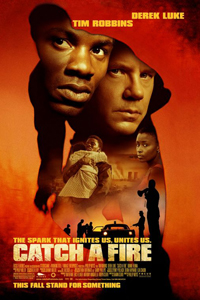
    Focus Features\' Catch a FirePhillip Noyce has made a relatively stealthy career of tackling political subject matter without being a blatant mouthpiece for the issues with which he sides.  Endeavors like “Patriot Games” and “Clear and Present Danger” approached agendas from a more entertaining standpoint, both being based on Tom Clancy best sellers.
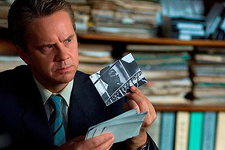
    Meanwhile, “The Quiet American” and “Rabbit-Proof Fence” were more specific and cultured in their perspectives of Vietnam and Australia respectively.  Now the director takes on the South African atrocity that was Apartheid in “Catch a Fire,” a film that seems too boiled down and ultimately resembling the shell of something much greater.

    “Catch a Fire” is the true-life story of Patrick Chamusso (Derek Luke), an oil refinery worker who witnessed a political awakening when his family was violated by government-sanctioned terror squads in 1980.  Misunderstanding him as a political enemy, the government created in Chamusso what they wrongly feared he might have been from the start: a driven and violent opponent of their racist regime.

    Under the guise “Hotstuff,” Chamusso joined a legion of freedom fighters led by collaborator Joe Slovo and wreaked havoc on the refinery that once employed him.  He was eventually apprehended and served ten years of a 25-year sentence, finally gaining passage back to his country when Apartheid disintegrated in 1991.

    The story is obviously a grand and epic one, yet the screenplay by Shawn Slovo (daughter of Joe), seems to be aiming for much more majesty than it ultimately reaches.  “Catch a Fire” actually feels like the first two acts of something larger and more cultivated, while various characterizations lie contradictory on the page.

    Nic Vos (Tim Robbins), for instance, is an immediate paradox.  Vos is presented as the anti-terrorist agent responsible for Chamusso’s apprehension.

    Tim Robbins in Catch a FireIn the beginning, Slovo attempts to place a sympathetic face on Vos, a man who supposedly sees his prey as human beings above and beyond terrorists.  Early scenes with his family reveal Vos as the diplomatic sort.
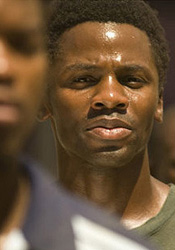
    But as the narrative moves forward, the screenplay takes the easy route and Vos winds up considered a two-dimensional “monster,” in the words of Luke’s narration in the denouement.  The result is a rather unbelievable character all around.

    Chamusso’s wife, Precious (Bonnie Henna), also feels ill conceived as a woman ultimately pitted against her husband and responsible for turning him into authorities.  This honest and human frailty doesn’t come across, and a simple “I’m sorry” in the end, even matched with the power of Chamusso’s own personal apology for past wrongs and dishonesty, does not feel satisfying in the least bit.

    Noyce does make a number of directorial choices that are interesting, however.  There are many moments equally promising in majesty and purpose that feel like portions of another movie entirely, building suspense with creative editing and thematic resilience.

    He utilizes Ron Fortunado’s camera in specific and unique ways as well, capturing performances from striking perspectives with surprising style.  But on the whole, the director’s creativity seems oddly stifled.

    Derek Luke in Catch a FireAs for performances, Tim Robbins feels terribly miscast in an underwritten role, while Bonnie Henna handles her own half-baked responsibility with a delicate ease.
    But Derek Luke is the real shining grace of the cast, proving that he is still one of the cinema’s best-kept secrets, waiting for a pivotal role in a special project that will place him on the A-list.  His layered and emotional portrayal of Chamusso lives and breathes on the screen as an efficacious representation, and likely the film’s solitary hope for film awards attention this year.

    If anything can be said of Slovo’s debut screenwriting effort, it is that she does a fine job of presenting a political awakening and qualifying that transition throughout.  Chamusso is a well-rounded character who has a very specific and thematic arc.

    But beyond her main character, the writer seems to push through the tale with reckless abandon, leaving a definite sense of want.  The script is certainly a labor of love, being based on recollections passed to Slovo from her father (to whom the film is dedicated).

    But labors of love can all too often blind the artistic eye to further potential or necessary restraint.  Such is the case with “Catch a Fire.”

  • REVIEW: “Breaking and Entering” (***1/2)

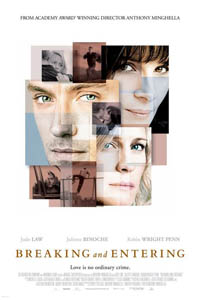
    The Weinstein Company\'s Breaking and EnteringAnthony Minghella’s “Breaking and Entering” is one of the most sincerely penetrating films of the year.  It’s most unique quality is the sense of legroom it provides, a healthy stretch of a film with deep breaths and drawn out considerations, as opposed to the typical anxiety of temperamental manipulation (which all film tends to be by nature).
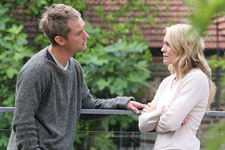
    The film cannot be approached by the director’s past offerings, most of them over-reaching in their intentions and ultimately short of greatness as a result.  “Breaking and Entering” is not a masterpiece, but it certainly treads such waters as an honest and tangible portrayal of mid-life confusion and crisis.

    In the film, Jude Law stars as Will, a London architect and head of a somewhat unorthodox household.  He lives with his girlfriend of ten years, Liv (Robin Wright Penn), yet they remain unmarried.  The two are at that point in a relationship when the boredom of familiarity have finally given way to something else, something utterly lacking and altogether confusing.

    Together, Will and Liv have raised Liv’s daughter, Beatrice (Poppy Rogers), a behaviorally dysfunctional teenager very representative of the trauma Will and Liv’s emotional schism has imposed on the family.

    Will’s company has recently set up new office space in a seedy district of London.  After receiving a large shipment of computer components, the office is burglarized one night by a team of acrobatic youngsters.  One such child is Miro (Rafi Gavron), a Bosnian refugee living with his mother, Amira (Juliette Binoche).

    Miro lost his father before fleeing his homeland, and his own story is not an unfamiliar one, one of longing and despair manifested in his getting himself into frequent trouble with the authorities.  He now thieves for his dead father’s brother, perhaps to keep some sort of touch with his former, all but forgotten life.

    Amira, meanwhile, is as sick with worry as one can imagine.  Making ends meet as a seamstress, she frequently expresses disgust with Miro’s extracurricular choices, but overshadowing that disappointment is an unwavering love for her child.

    Binoche’s more playful scenes with Gavron are the emotional center of the film, representative of a spirited devotion and affection that seems missing from Will’s life, and a sham if ever apparent therein.

    Jude Law and Robin Wright Penn in Breaking and EnteringAfter a series of such robberies, Will begins staking out the building with partner Sandy (Martin Freeman) and an inquisitive prostitute, Oana (a humorous and insightful Vera Farmiga).  He finally catches Miro in the act one night, and in chasing him he follows the boy to his home.  There Will encounters, from a distance, Amira and her concern for her son.
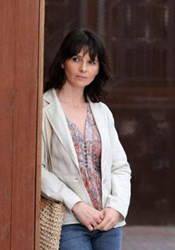
    The moment is the beginning of an emotional whirlwind that will become increasingly confusing before clarity will be restored.  Will ultimately engages in an affair with Amira, perhaps searching for love as he later will claim to Liv, but more likely discovering a void to fill, one he cannot seem to fill at home.

    “Breaking and Entering” is an awakening experience.  At its core, the film is about honesty.  It is about being truthful to yourself, your needs, your desires, your love, your family and your impulses.

    Will is a man turned around and without direction.  His confusion is not his fault, nor is it his family’s.  It is our very nature to search out our boundaries and our limitations.  It is also our very nature to seek assurance in where we find ourselves.

    In that light, “Breaking and Entering” has much in common with Todd Field’s “Little Children.”  Both films speak to mid-life indecision and discomfort, and both films weave tales of lost souls finding their way back to their life roles.

    Jude Law’s performance as Will might be the greatest performance of the year.  It is a textured and nuanced turn that has a blistering emotional veracity.

    I would perhaps go so far as to call it his best work to date, but his is still a resume bursting with diverse portrayals throughout.  In “Breaking and Entering,” however, Law has tapped into the leading man potential he has only threatened in efforts such as “Cold Mountain” and the phenomenal “Closer.”

    Juliette Binoche in Breaking and EnteringJuliette Binoche is appropriately self-aware and headstrong in her performance as Amira.  Driven yet still full of the youth she had ripped from her through tragedy, Amira is an extremely interesting creation and a vibrantly unique character.
    No one has carried across beautiful and tired so capably since Meryl Streep in “The Bridges of Madison County.”  She also works quite beautifully off of the balanced anxiety and mother-love of Rafi Gavron’s performance.

    Elsewhere, Ray Winstone turns in a cheeky performance as investigating CID officer Bruno, while Martin Freeman’s brief stint as Sandy is further proof he deserves more roles with meat on them.  Poppy Rogers has some integral scenes as Beatrice, but if there is a weak link in the cast, it pains me to say it might be Robin Wright Penn.

    Some may find her emotional recoil fitting and appropriate, but something about the performance feels as though the actress doesn’t fully understand her character.  The work recalls Patrick Wilson’s ambivalence in “Little Children.”

    The technical aspects of the film deserve accreditation of the highest order, most especially Gabriel Yared’s piano-infused original score and Benoît Delhomme’s subdued cinematography.  Each element goes toward making the piece a truly unique experience, and certainly a unique Minghella experience.

    “Breaking and Entering” really feels like Anthony Minghella’s most personal and convincingly sincere film yet.  It boasts a lived-in quality making it feel like a story the writer/director has been playing over and over again in his head, perfecting every glance and sigh, tuning every emotional pitch to tonal superiority.

    From an opening shot bleeding subtext and sporting an initial narration more enlightening than most, it is a film and, more importantly, a screenplay, that commands respect and appreciation.  In a year exploding with accomplished filmmaking, “Breaking and Entering” fits right in.

  • REVIEW: “Stranger Than Fiction” (****)

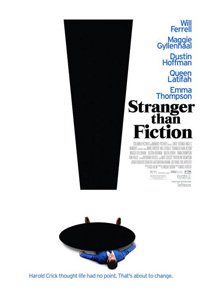
    Columbia Pictures\' Stranger Than FictionMarc Forster’s “Stranger Than Fiction” really ought to be referred to as Zach Helm’s “Stranger Than Fiction.”  While the “Finding Neverland” helmer does a sensational job conveying the brilliant and elaborate story to the screen, it is evident throughout that the writer’s intentions are being taken care of.
    And thank God for that, because Helm’s creation is ultimately one of the most potent, meaningful and literarily astute pieces of screenwriting in the medium.

    It might seem obvious that comparisons to Charlie Kaufman are in store for Helm and the resulting film.  It is true that the screenwriter reaches for certain human and social truths via his creatively unorthodox approach, much like Kaufman has done in his most recognizable work.

    But Helm also tackles his themes in a paradoxically accessible manner that can speak to larger numbers and to even larger truths.  With this debut feature, Helm has truly hit a grand slam.

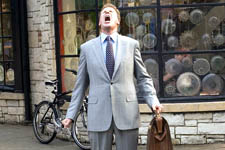
    In the film, Harold Crick (Will Ferrell) is an unspectacular IRS agent who lives each and every day by the book.  He isn’t the sort to color outside the lines, if you follow.  The world makes sense to him broken into a strict regimen inside his mind, a regimen that is so second nature it is almost appealing.  He counts steps, brushes his teeth with a consistent amount of strokes each morning and keeps track of every second to spare via his handy wristwatch alarm.

    These peculiarities are hammered home through the educated, cheeky narration of some omniscient presence, and it seems like another simple tale of a man and his wholesome life.  That is, until Harold becomes cognizant of the narration.

    As it turns out, Harold is the main character in the latest novel from author Kay Eiffel (Emma Thompson), whose voice provides the narration he hears day in and day out.  Harold isn’t aware of this, of course.  He just thinks he is losing his mind.

    The effect is merely annoying and diversionary for him to start, but Harold really begins to get nervous when the voice makes a passing comment on the foreshadowing of his “imminent death.”

    In disarray, Harold seeks out the advice of a literary scholar, Dr. Jules Hibert (Dustin Hoffman).  Dr. Hibert takes up the task of distinguishing what sort of story Harold is experiencing.  Is it a comedy or is it a tragedy?  Is he a specific figment of literary history or someone else?  Is there a specific author behind the tale?  Is Harold merely crazy?

    Will Ferrell in Stranger Than FictionMeanwhile, Harold has been given the task of auditing a feisty bohemian baker, Ana (Maggie Gyllenhaal).  Discontent with “the man” and certainly not afraid to speak her mind, Ana is, if anything, Harold’s polar opposite: hip, tattooed, free-spirited and boisterous.
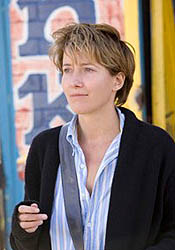
    He is, of course, immediately taken by her.  And maybe he could do something about it if that pesky voice would just leave him alone.  Or maybe hearing his seemingly aimless existence play out through mundane narration is the swift kick in the rear he needed to start living his life the way he wants to.

    For much of the narrative, “Stranger Than Fiction” is about just that.  It is about coloring OUTSIDE the lines and living life as you – not your schedule – see fit.

    When Harold meets Ana, he begins to find this perspective.  And when he finally decides to do all the things he wanted to do in his life, “I want you” is all he can say to her that conveys what he really feels.  It is a brief and ironic moment that cleverly speaks to the sexes’ tendency to play games through courtship.

    Who has time for such things – especially when your “imminent death” is upon you?

    All of this is told parallel to Eiffel’s story.  Suffering a terrible case of writer’s block and having been assigned an assistant, Penny (Queen Latifah), by her publisher, Eiffel can’t seem to figure out the best way to kill Harold Crick.

    She spends her days imagining automobile accidents and visiting hospital emergency wards, desperate for that spark of creativity that will ignite her novel’s conclusion.

    Eiffel is famous for killing people in her books, you see.  More specifically, she is famous for killing people she has created as noble, admirable individuals you’d hate to see go.  But perhaps the time has come for her to start doing things out of her typical order as well.

    And that’s when “Stranger Than Fiction” treads breathtaking territory.  What Helm’s screenplay does that takes it up a level in brilliance is present a third act that makes the film about something else entirely – something that almost flies in the face of the first two thirds of the story.

    Emma Thompson in Stranger Than FictionIt took two viewings to really grasp the importance of that shift in theme, and when it landed, it certainly had an impact.  In that final act, the film becomes a story about living for others as much as for yourself.
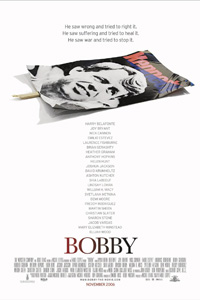
    Modest Christian symbolism, intended or otherwise, may or may not click with viewers (Eiffel sticks out as a deity capable of bestowing mercy on those who live unselfish lives), but regardless, Helm pieces together a story much denser than it would appear at an initial glance.  Such is the mark of artistry that is welcome and rare.

    The performances across the board are outstanding.  Will Ferrell presents Harold Crick as his finest portrayal to date, as fittingly awkward as he can be moving.  Maggie Gyllenhaal exudes a sexiness and charisma that plays fantastically off of Ferrell’s quirky charms.

    Dustin Hoffman seems born for the role of the dry-witted Dr. Hibert, and Emma Thompson’s hermitic author is at once peculiar and inspiring.  Queen Latifah, though in something of a throwaway role, somehow still feels like the perfect choice for Penny.

    Marc Forster, meanwhile, deserves a lot of credit for diversifying his directorial choices.  He seems to be gravitating toward stories that have a certain warm center, which can be appealing or annoying (depending on the viewer).

    Helm’s screenplay is the most accomplished the director has worked with thus far, and he does a flawless job of putting the script on the screen without fuss and without unnecessary trademark.

    “Stranger Than Fiction” will be about a number of different things for a number of different people.  For some it will be about living life to the fullest.  For others it will be about trusting your instincts and going after what you desire.

    For me, it is about recognizing the importance of the little things we encounter, day in and day out, that go toward creating the huge puzzle we spend most of our days trying to decipher.  Life really is what happens when you’re making other plans.

  • REVIEW: “Bobby” (***1/2)

    The Weinstein Company\'s BobbyEmilio Estevez’s third feature filmmaking endeavor is everything his prior work was not.  It is both insightful and meaningful.  It exudes passion and commands relevance.  It represents a cross-section of a country battered and bruised, and emphasizes the beacon of light that hoped to usher it to greener pastures.
    Crafted with graceful devotion and blistering sincerity, “Bobby” is not merely one of the most personal films of the year.  In a season curiously dedicated to themes of compassion and understanding, it is one of the most resonant film-going experiences politically inclined cinema can aspire to be.

    I know nothing of the pain of loss experienced the day Robert Kennedy was assassinated at Los Angeles’s Ambassador Hotel.  I’m a part of a generation that cannot fully grasp the utter shattering of hope that event must have lain at the feet of a country in desperate need of tranquil leadership.

    The memory is not mine to draw upon, but the change of the tide during those turbulent years, the late 1960s, forcibly molded the country we live in today.  I am a byproduct of that result, and my generation is reflective in some way, however small, of that milestone era.

    Estevez understood this as he set about constructing his film, one that really and truly feels as if it exploded from his heart and bled out onto the page.  Set in the Ambassador on June 5, 1968, the story is conveyed through a sprawling, Altman-esque ensemble.

    Twenty-two characters serve to represent America at one of its most defining thresholds, all preparing in one way or another for Senator Kennedy’s speech the night of the year’s senate elections.  Kennedy was infamously gunned down by Sirhan Sirhan in the hotel’s kitchen following his spirited and awakening address.

    It would be a daunting task indeed to account for each and every character.  An overwhelming cast fills out the bill in a manner that makes it nearly impossible to distinguish a standout.

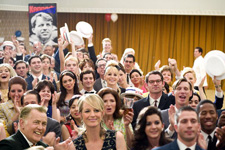
    The cast of BobbyHowever, rest assured the actor/writer/director covered all bases, charting youthful aggression, elderly wisdom, minority rage and feminine anxiety amongst the numerous hot button issues of the day.
    The speckled casting has caused many to wonder and expect half-baked representations, but rest assured, the work from Lindsay Lohan, Nick Cannon, Demi Moore and even the film’s director stands shoulder-to-shoulder with the likes of film awards regulars William H. Macy, Helen Hunt, Laurence Fishburne and Anthony Hopkins to form a truly organic ensemble.  Before long, one settles into a state of watching characters, not actors.

    It really is something special and it was always the most obvious hurdle, one capably cleared.  If pressed to pick favorites (and the subjectivity of the matter will command favorites more so than definitive stand-outs), I would say I was most taken by the performances of Cannon, Hopkins and Freddy Rodriguez.  But beyond performances, what is much more interesting is how much Estevez obviously cared about his film’s subject.

    This isn’t a director merely showcasing his abilities and constructing a wonderful piece of filmmaking like a skilled craftsman cranking out another successful product.  This is a film with stitches that show and blemishes for which it refuses to apologize.  It is an effort as flawed as it is successful, and those touches of imperfection make it all the more powerful as a representation of humanity and the good fight.

    Estevez is no auteur, and he does not always necessarily convey a riveting sense of artistry.  What he does is allow his gut to do the work, and the effect is a rousing experience to say the least.

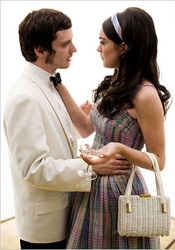
    Elijah Wood and Lindsay Lohan in BobbyThe editing of the film is of the highest quality, coming under the acclimated hand of veteran Richard Chew (“One Flew Over the Cuckoo’s Nest,” “Star Wars”).
    Also, though Mark Isham’s iconic score takes obvious leads from Thomas Newman’s work on “The Shawshank Redemption,” it nevertheless lends an element of prestige to what is an important piece of filmmaking.

    Michael Barrett’s camera captures the peculiarities of every character as it floats throughout the scenery, and Julie Weiss’s costumes do the film a spectacular service that truly transports the viewer back in time.

    I expect and hope to be talking about “Bobby” for many months to come, as it is a definite threat in this year’s Oscar race – a film that could literally go all the way.  But regardless of awards and reactions, the question is still asked to this day: What if Robert Kennedy had ultimately become president of the United States?  Where would the country be today?  And most especially, how would the country be viewed in the eyes of the rest of the world?

    There are no answers to such queries, but “Bobby” goes to great lengths to perpetuate Kennedy’s lasting significance as a man of understanding – a true king in his time.  Ultimately, the lively juxtaposition of his various speeches and audio clips dictating his rhetoric forty years later drive home the point viscerally as the narrative does so thematically.

    Ours is a nation built on the understanding and empathy that is as close to godliness as man can hope to be.  Let us please learn the lessons of the past.

  • REVIEW: “The Last King of Scotland” (****)

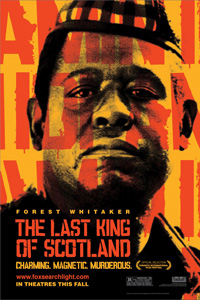
    Fox Searchlight Pictures\' The Last King of ScotlandEvery so often a film comes along that is so celebratory of the filmmaking process and fresh in its approach to visually conveying a story that it creatively demolishes anything within earshot.
    “Metropolis” was an early example, as Fritz Lang opened up the world in front of the camera like no one before.  Arthur Penn’s “Bonnie and Clyde” and William Friedkin’s “The French Connection” awakened the filmmakers of the 1970s to new boundaries willingly crossed.  And Quentin Tarantino brought unique and highly innovative ideas to light in the 1990s when he unleashed “Pulp Fiction” on the filmmaking community.

    Another such film has finally come along, and whether Kevin Macdonald receives the credit he deserves for melding the idiosyncrasies of documentation with the manner of narrative flow or not, “The Last King of Scotland” has become a landmark of ingenuity.  In this viewer’s opinion, it is the best film of the year thusfar.

    “The Last King of Scotland” was adapted from Giles Foden’s award-winning novel of the same name.  Charting the chaotic journey of Scottish doctor Nicholas Garrigan, Foden unveils the sadistic regime of Ugandan dictator Idi Amin in ways much less conventional than one would expect of such a tale.

    The fictional character of Garrigan was born out of the author’s many conversations with former Amin advisor Bob Astles, and the resulting tale is even, calculated and deliberately paced, very much a story meant for the page in its initial conception.  The process of adapting the material to the screen could have gone a number of typical ways, but the choices made by Macdonald and co-writers Jeremy Brock and Peter Morgan are exhilarating if nothing else.

    Scottish actor James McAvoy portrays Doctor Garrigan in the film.  Following an extremely brief introduction, and an equally swift scene conveying Garrigan’s place as his father’s son, the recent college grad rushes off to a new place in the world where he can be of service.  Anywhere but home will do, and the African country of Uganda becomes his new destination.

    All of this is carried across in a number of beats, not even necessarily scenes, and Garrigan is off on his journey within five minutes.  Lesser filmmakers would have taken inappropriate time establishing the character, meandering, before finally setting him off on his journey.  Macdonald trusts the viewer to stay with him, and unveils the events of the narrative through the eyes of his protagonist better than the most seasoned of directors.

    Garrigan soon settles into a missionary camp, providing health care for the few Ugandans willing to trust white doctors over village witch-doctors.  The camp’s head physician and his wife, Sara (Gillian Anderson), could certainly use the help.

    Meanwhile, political upheaval is the consistent state of affairs, as former president Milton Obote is overthrown by the regime of Idi Amin (Forest Whitaker), a “fighter for the people” – or so he would initially be considered.

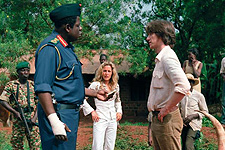
    (from left) Forest Whitaker, Gillian Anderson and James McAvoy in The Last King of ScotlandFollowing an automobile accident that is cleverly repositioned from its place in Foden’s novel, Garrigan and Sara are summoned to the aid of Amin.  The president has sprung his wrist in the process of ramming his Maseradi into a giant bull.
    Amin is immediately impressed by Garrigan’s tenacity and strength of mind, and he later offers the doctor a position as his personal physician.  So begins one of the most interesting relationships between two men captured on the page or on the screen in some time.

    Garrigan is abundantly charmed by Amin, a man who can seemingly see right through those at his side.  The depth of his personality clashes with the childish nature of his sensibilities to form a persona impossibly ignored.  But the longer Garrigan remains drunk with the importance of his position (soon considered an “advisor” by Amin), the longer it takes him to wake up to his complicity in a disastrous regime that will have been responsible for the deaths of over 300,000 Ugandans before Amin would finally be overthrown in 1979.

    Kevin Macdonald has made a name for himself as a documentary filmmaker for the better part of a decade.  Most notably, 1999’s “One Day in September” won the Oscar for Best Documentary, a painstaking dissection of the 1972 Munich Olympics tragedy.

    2004’s “Touching the Void” was one of the most acclaimed films of that year, blending dramatic recreation with first hand accounts of the treacherous ascent of Siula Grande by mountain climbers Joe Simpson and Simon Yates.

    What the director does so brilliantly in his first foray into narrative filmmaking is draw upon his instincts as a documentary filmmaker.

    “The Last King of Scotland” is not shot like a typical narrative political thriller.  The camera wanders frequently to various peculiarities in the scene, typically finding the motion of Amin’s hands, no matter how mundane the gesture.

    The usage of zooms and erratic camera movement recalls guerilla filmmaking above all else, and it really feels like we are watching true events unfold, not dramatic interpretations of them.  Danny Boyle and “Dogme” regular Anthony Dod Mantle served as cinematographer.

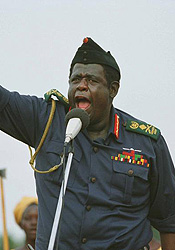
    Forest Whitaker in The Last King of ScotlandThe performances on the whole are fantastic, but the central tension and these two men’s effect on one another could not have been portrayed more succinctly.  James McAvoy is outstanding, and Macdonald should be applauded for casting someone so little-known.  One would expect a pseudo-star like Ewan Macgregor to be forced into such a scenario, but the right decision has been made and McAvoy holds his own opposite the most explosive on-screen incarnation of the year.
    Forest Whitaker’s Idi Amin deserves a place in filmmaking history as one of the more vibrant depictions of the medium.  One recalls the tagline of the film every moment he is on screen:  “Charming.  Magnetic.  Murderous.”  And when he enunciates each syllable of Garrigan’s name (“Nee-co-laas”), the chill rises up and down the viewer’s spine as it did when Sir Anthony Hopkins casually mentioned eating a man’s liver “with a side of fava beans and a nice Chianti.”

    Gillian Anderson and Kerry Washington (as Kay, one of Amin’s wives) are suited to the production, though Anderson’s sudden exit from the film early on feels as unnatural as it is in the novel.  It would have been nice to see more of her, and sporting a haphazard blonde hairstyle, she is sexier here than she has ever been.  However, Macdonald and his writers do a nice job of blending other characters and circumstances from the book into these two women, which makes for a fascinating adaptation on the whole.

    In fact, the biggest accomplishment outside of the style and innovation of the camera work would have to be the screenplay.  Foden’s novel, as mentioned, is deliberately paced.  But the writing team somehow made it much more electric and exciting, while at the same time combining various elements with the greatest of ease to make for a solid, swiftly-paced narrative.

    They utilize the Palestinian hijacking of an Air France flight in 1976, for instance, to its fullest effect as the climax of the film.  The flight was infamously held at Entebbe airport in Uganda while Amin, a PFLP supporter, supplied the hijackers with extra troops and weapons.  The event was the beginning of his downfall in the court of public opinion.

    Ultimately, “The Last King of Scotland” can work above or below the surface.  One could enjoy the film as a run-of-the-mill political thriller and be satisfied, taking nothing else away from it.  On the other hand, the depth present in the seamless creation of the story lies in wait for anyone willing to notice.

    It really is a staggering initial narrative outing, and if this is the talent Kevin Macdonald has been incubating while documenting the real world, we can only consider ourselves lucky that he has finally crossed over into the imaginary world.  He is truly an artist to watch.

  • REVIEW: “The Queen” (***1/2)

    Miramax Films\' The QueenStephen Frears is one of the most versatile working directors in the industry.  With that versatility comes the inevitable misstep from time to time, sure.  But also with it comes a high order of professionalism and a certain amount of confidence that can manifest the most precise of cinematic creations.
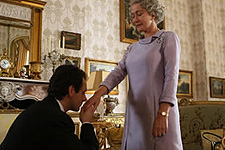
    “The Queen” is just such a film.  Carefully calibrated and wound to a specific 103 minutes, it is a modest and fine hour for a director who has been cranking out work of the highest quality for over two decades.

    “The Queen” tells the behind-the-veil story of the days following Princess Diana’s tragic death in August of 1997.  As the world mourned the passing of one of the most important political figures of the 20th century, Queen Elizabeth II (Helen Mirren) and her family holed up in their Scotland compound, choosing to handle matters with restraint, dignity and in privacy.

    Newly appointed Prime Minister Tony Blair (Michael Sheen), with his sites set on modernizing the outdated government and bringing it back in touch with the people of the land, felt the decision to refrain from public access was detrimental to a country that desperately needed guidance and to share in the grief.

    The “black sheep” opinion the family had of Diana was an unpopular stance to say the least.  While they always saw her as a blight on the crown, the citizens of England saw her as the people’s princess, one of their own, and a woman unwavering in her desire to make the world a better place.

    Only a year divorced from Prince Charles (portrayed in the film by dead ringer Alex Jennings) when she died, Diana had endured public embarrassment after Charles’s well-publicized, long-term affair with Camilla Parker-Bowles.  Diana herself admitted to her own extra-marital affair as well, but it goes without saying, the marriage was an unhappy one.

    Hounded by the media and ultimately the most photographed person ever, Diana’s life was never her own.  That turbulent year was perhaps the most difficult for her in that regard and it might be too easy to say the media killed her in the end.  It may be more applicable to say the very nature of celebrity killed her, but regardless, even in death, she would rally the attention of a billion people who tuned in to view her public funeral (a festivity proposed by Tony Blair and fought against by the Royal Family).

    Michael Sheen and Helen Mirren in The QueenThe relationship established between Elizabeth and Blair is a delicate one, and certainly a dramatic one.  It might be the oldest story in the book, but it is still one of the most relevant.  The clashing of policies is something the world will struggle with until we are no longer the dominant species.
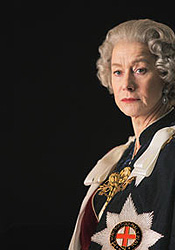
    Blair’s progressive ideas about leading with the people, not ahead of them, was outlandish to the Queen and, most especially, to Prince Phillip (James Cromwell).  Those disagreements truly came to a head that week, and their focus was rightly on the well-being of William and Henry, two boys who lost their mother and should be shielded from the poisoning words of the media.  But as they retreated, their country grew impatient and, ultimately, aggressively disappointed.

    Dame Helen Mirren is absolutely irresistible in the role of Queen Elizabeth II (she ironically just won an Emmy for portraying Elizabeth I).  Though it is not the powerhouse, Oscar-lock performance that shatters perceptions and announces itself with determination, it is nevertheless a collected and well-maintained turn.

    The stiff upper lip of the Royal Family really is carried across well in this regard.  James Cromwell’s Prince Phillip is specific in his conservatism, while the humor of Charles’s paranoia provides a nice balance.

    As Prime Minister Tony Blair, Michael Sheen does a capable job of conveying a political figure who would become increasingly controversial himself.  Frears’s film hits a thunderous note in that light during a coda in which Elizabeth looks Blair square in the eye and tells him his country will turn on him, too, one day, “Quite suddenly, and without warning.”

    These are the delicate touches of meaning that go toward crafting an exemplary film.  The screenplay was penned by Peter Morgan, who also co-wrote the amazing adaptation of Kevin Macdonald’s “The Last King of Scotland.”  His work comes as a result of extensive interviews and information from discreet, informed sources inside the momentous event.

    Helen Mirren in The QueenStephen Frears does what he is best at in “The Queen.”  He steps aside and lets the story tell it self.  He has always been what I consider a “screenwriter’s director,” as he seems ever capable of letting the writer’s words play on the screen as they should.  He never leaves a fingerprint, other than the strong scent of competence that can be found even in his lesser efforts.
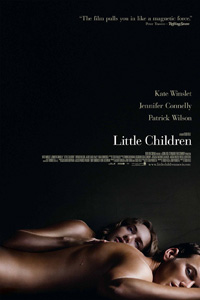
    He also handles the material without fuss, getting out of dodge when the work is complete.  You’ll never find a Frears film meandering or losing itself, and that’s a trait most directors never exhibit with such consistency.

    Though it revolves around an event that occurred nine years ago, and prior to the post-9/11 environment we endure today, “The Queen” is very much a current piece of filmmaking.  It is about the necessity for a leader to be in touch with his or her people.  It is about respecting tradition while understanding the need to extinguish it all the same.  It is about finding a balance and, if not maintaining that balance, at the very least striving for it at all costs.

    “The Queen” could be seen as quite applicable to our current domestic political environment, or it could simply be enjoyed as an airy, pleasant endeavor with no frills.  But isn’t it the best of cinema that finds <em>that</em> balance?

  • REVIEW: “Little Children” (**)

    New Line Cinema\'s Little ChildrenTom Perrotta’s novel “Little Children” is a visceral reading experience.  A smart and casually brilliant work of fiction, the author’s characters exude a demand for understanding and compassion above all else in a narrative flow that is forgivably meandering.

    Todd Field’s adaptation (co-written by Perrotta) in the form of New Line Cinema’s film of the same name keeps these crucial elements in tact during a transition to the screen, but the end result is sadly nothing approaching the exuberance of imagining Perrotta’s world in one’s mind.  Questionable directorial decisions and, at times, a tendency to follow too close to the tread of Perrotta’s novel (yet straying much too far when the need arises) ultimately hinder “Little Children” from the suburban poignancy it aspires to be.

    The story is one of contained souls desperate for alleviation.  Sara Pierce (Kate Winslet) is a mother of one, visibly bored with the life she leads.  Spending afternoons at a neighborhood playground with other mothers, representing varying degrees of personality disorder, Sara is the most homely of the bunch but the most irreverent all the same.  Her daughter, Lucy (Sadie Goldstein), humorously reflects her mother’s irreverence.

    Sara yearns for something more than the by the numbers set-up she has made for herself, along with husband Richard (Gregg Edelman), and this spark of disinterest makes itself visible in her consistent challenging of her acquaintances’ points of view, most notably lashing out intellectual artillery here and there on one of the typically bitchy, blonde-haired, blue-eyed sort.

    Brad Adamson (Patrick Wilson), or the “Prom King,” as he has been dubbed by the troupe of housewives, is equally confused about his life having turned out so tedious and passionless.  Having failed the bar exam twice and gunning for one more attempt in a do or die situation, Brad seems to be questioning not merely his desire to be a lawyer, but his desire to be who he is in any case.

    His wife, Kathy (Jennifer Connely), wears the pants in the family leaving him as the primary caregiver to an adorable son, Aaron (Ty Simpkins).A casual meeting of the minds between Brad and Sara will spark light in their lives they each had thought gone forever, each seemingly the answer to the other’s personal doubts and emotionally dire circumstances; Sara, the frumpy, bushy-eye browed scholarly sort, Brad the golden bodied, handsome former jock: a mismatch made in heaven.

    Meanwhile, Ronald James McGorvey (Jackie Earle Haley, who is likely to garner Oscar buzz for his performance), formerly convicted of exposing himself to a young girl, takes up residence in this otherwise quiet community with his mother, May (Phyllis Sommerville).

    The news shakes the neighborhood to the core, the anger visibly presenting itself in the form of former cop Larry Hedges (Noah Emmerich), who frequently harasses the McGorveys and defaces their property with various forms of propaganda.  Larry and Ronald have a delicate relationship, however, as a result, one reflective of the other’s inner turmoil in many ways, undoubtedly flawed humans each of them.

    Jackie Earle Haley in Little ChildrenAll of this could certainly be gleaned from reading any synopsis of Perrotta’s novel, and obviously, the makings of a brilliant film are quite apparent.  But somewhere along the way, “Little Children” lost its freshness.
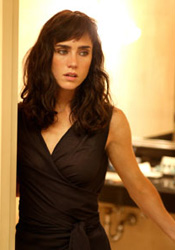
    Todd Field’s directorial debut “In the Bedroom” in 2001 was a brooding dissection of the nature of revenge, hatred, anger and despair.  It seems to be territory in which the director is quite comfortable, as he takes Perrotta’s novel to darker levels than even the author might have intended on the page.  He builds layers into the characters that are vibrant, but at many times, rather unnecessary, and his adaptation (again, co-authored by Perrotta) ultimately takes the story to a place far too dreary for its own good.

    It is surprising that such an ending (which I dare not spoil) would have been deemed appropriate by the novel’s author, and the influence of Field’s darker tendencies seems to be the culprit of such a design.  In fact, Field makes a number of directorial decisions throughout that impede the process of the story’s conveyance.

    He chooses, for instance, to let his camera linger on his actors too long at times, capturing the awkward aspects of performance that are meant to be trimmed from a film product.  He allows over-the-top characterizations to go undeterred, the most notable case being Noah Emmerich’s over-acting every scene when he very clearly has the ability to relay his character in much more appropriate ways.

    The most disastrous decision was to employ the usage of a third party narrator, essentially reading the words from Perrotta’s page in a low, ironic voice.  Anyone will tell you narration is the mark of an amateur, sure, but the decision was made here to be somewhat humorous.  The effect is a maddening sense that the film is a work in progress with elements to later be filled in to satisfaction.

    The performances are, by and large, lacking in some form or another.  Whether it is Patrick Wilson’s apparent lack of understanding his own character’s motives (some might think this works for the part; I would disagree), Phyllis Sommerville’s questionable histrionics or Jackie Earle Haley’s awkward self-awareness, the actors seem to have what it takes, but apparently lack the guidance to reach that plateau.

    Jennifer Connelly in Little ChildrenJennifer Connelly threatens depth with her character, though a sub-plot involving Kathy’s mother was largely omitted which might have helped in that regard.  Connelly is, as always, a beautiful and talented actress, but here she’s simply relegated to being a hottie.  The role doesn’t call for much else.
    Kate Winslet, however, is quite obviously incapable of poor acting.  Her performance as Sara is one of her very best to date and one of the most believable characterizations of her career.  Even surrounded by what feels like amateur night at a local acting theater, Winslet maintains a control over Sara that screams professionalism and artistry.  She has to be considered one of the greatest, most fearless actresses of her generation.

    Finally, Thomas Newman’s score is less derivative than normal, considering the source.  The music works to the film’s favor, organic and apparent all the same.  The cues recall his work in Sam Mendes’s “American Beauty,” in fact, a film of similar themes and characterizations.

    This comparison to Mendes’s film will be drawn over and over again as critics begin reacting to “Little Children” in the coming weeks.  However, while “American Beauty” ages quite poorly and never seems to retain the immediacy it boasted in 1999, it still remains something defining in a sub-genre that inherits a new entry every few years or so.  “Little Children” fits this mold of suburban despair, its characters clenching to their youth, and it also brings more valid and insightful aspects to the table.

    These are individuals discontent with their lives, but who travel hard and tiresome roads to discover they are in fact lucky to lead the subjectively boring existences they do.  It’s a beautiful theme that seems to be of a piece with the majority of film product this year, if one were to thoroughly examine various entries.

    However, the film is still an uneven exercise in frigidity, something Perrotta’s novel could never have been accused of.  Field is certainly an interesting director who is sure to continue creating unique character studies, but one can only hope that “In the Bedroom” was no fluke.  “Little Children” is something of a sophomore slump that I would still venture to say will be embraced by the critical masses.  It seems sometimes simply being unique is good enough, no matter how second-rate the artistry.

  • REVIEW: “Hollywoodland” (***)

    Focus Features\' HollywoodlandThe death of George Reeves, television’s original Superman, in 1959 defined the loss of innocence for a generation.  There are many who remember where they were the moment they discovered Reeves’s body had been found, the victim of an apparent suicide.
    The lore surrounding the event has even wound itself into incorrect information that perpetuates itself mythically, forever living on as one of Hollywood’s greatest mysteries –- or is there a mystery at all?

    “Hollywoodland” is a project that has seen a long road to the screen, bouncing from one studio to another and back again, enduring rigorous casting scrutiny and a number of raised eyebrows regarding the direction a screenplay based on these questionable events would take.

    Now the feature film debut of television veteran Allen Coulter, “Hollywoodland” is a vivid and self-propelling experience that lingers much longer than you would expect it to.

    In the film, Adrien Brody portrays the fictional private investigator Louis Simo, who makes his way from buck to buck stringing along suspicious husbands and picking at closed LAPD cases like a scavenger of public enforcement.  When he is tipped off to the notion that, following a quick investigation deeming Reeves’s death a suicide, Reeves’s mother believes her son was murdered, Simo embarks on a journey that will become much more personal than he would have ever intended.

    The Reeves story is told through flashback, with Ben Affleck (in his career best work) taking on the role of the tragically typecast actor who rose to stardom as television’s Superman.  Parallel to Simo’s investigation, we’re made witness to the long, inevitable and sad road Reeves travels, at once a handsome lady-killer and a depressed dreamer.

    You see, Reeves was cut from the classic movie star mold.  Cary Grant, Clark Gable and Spencer Tracy would have been fitting company for the talented thespian.  However, such stardom always seemed just out of Reeves’s grasp, and after ambivalently taking the role of the Man of Steel merely to make ends meet, he would endure the sort of fame that would forever seem cheap and lacking artistic context.

    Adrien Bridy in HollywoodlandWhen audiences were distracted by the actor’s iconic image during his scenes in Fred Zinnemann’s “From Here to Eternity,” the director inevitably had the work Reeves had put into the picture removed.  Suicide, it seemed, made complete sense to the community at large.
    The film takes time to properly examine three popular theories about how Reeves actually met his end.  The perspectives stem from a raucous girlfriend (Robin Tunney) peeved at the actor’s refusal to marry her being responsible, to former mistress Toni Mannix (Diane Lane) becoming so grief-stricken over his leaving her that her husband, MGM general manager Eddie Mannix (Bob Hoskins), had Reeves murdered – not the most implausible act in the eyes of many Angelenos.

    And, of course, the script – written by Paul Bernbaum – takes a thorough look at the classically accepted suicide theory, which certainly carries more legitimate pathos than any other.

    Brody’s work in the film takes a moment to really fit the character, but once he gets into the groove of a divorced father struggling to make his own ends meet, he taps into the personal ferocity that really begins to drive Simo after a tragedy late in the second act propels him to reassess his own perspective.  This is his first true starring role since his Oscar winning performance in “The Pianist,” and he reminds us exactly why he is worthy of the distinction.

    The supporting cast fills out in typical fashion, with Bob Hoskins and Diane Lane seemingly phoning their work in.  Though Robin Tunney really stands out as Reeves’s fiancé, Lenore Lemmon.  The real story, however, is certainly Ben Affleck, in a role that could easily be seen as too demanding given the work we’ve seen out of the actor in recent years.

    Ben Affleck in HollywoodlandNo, in “Hollywoodland,” Ben Affleck shows us what he can do when he really wants it.  The actor took a sizeable upfront pay cut on the film (as did pretty much everyone), and while at first glance it may seem that his beefcake persona would laughably overpower the mythos of George Reeves, we soon discover just how tailor-made his screen presence is for the role.

    He captures the man in spirit, voice and mannerism like I certainly wouldn’t have expected, and perhaps many other filmgoers, casual and otherwise, will see the same awards-caliber work.

    When the film opens on September 8th, the Best Supporting Actor race may have truly commenced — or maybe the film will just stay low on everyone’s radar altogether.  But this is a savory, layered performance that does its job in context and is commanding as a supporting turn, giving us a character on which to base the events of the present – a character to care about, to root for and, all at once, to mourn.

    All things considered, Allen Coulter’s work on his first feature is capable and smooth-sailing, if unremarkable by virtue of necessity.  He never gets overly fancy, even with the unique structure, and he guides the film with the anonymous sort of hand that is certainly a positive thing.  This may well be the only cinematic testament to the legacy of George Reeves, and it is as thorough a testament as one could have asked for, despite dramatic twists and turns that might have been more suitably trimmed for a tighter overall experience.

    In the end, however, a focused performance in the film’s background works off of a truly driven performance in the foreground to give an appropriately rounded take on what has to be considered one of the most devastating events in television history.

  • REVIEW: “World Trade Center” (***1/2)

    Paramount Pictures\' World Trade Center“World Trade Center” is a nearly flawless account of something so personal, yet so universal, that it leaves the instigating events of September 11, 2001 almost as an afterthought – lipstick on the rim of a wineglass long emptied.

    he triumph of commanding such humanity in the face of a story that could have easily been played up as the rah-rah “9/11 MOVIE” some might have expected belongs in large part to screenwriter Andrea Berloff, who pitched a striking and rich tale to producers Michael Shamberg and Stacy Sher before burying herself into the lives of Will Jimeno and John McLoughlin (the two Port Authority survivors upon which the film is based).  A huge chunk of that glory, however, deserves to be placed into the hands of Oliver Stone, a filmmaker who shows in this latest effort (in a career speckled with films that were his own, if nothing else) that he retains the professionalism to tell a story free of artistic whimsy or personal commentary.

    The film tells Jimeno (Michael Peña) and McLoughlin’s (Nicolas Cage) story in a straightforward manner free of any fuss, unnecessarily schmaltzy or otherwise.  The drama of this story is not manufactured and is very much real.  Of the 20 individuals successfully retrieved from the rubble of the World Trade Center, Jimeno and McLoughlin were numbers 18 and 19.

    Part of a confused and unprepared Port Authority team hastily assembled (as most efforts inevitably were that day), the two officers were in the lobby of Tower One when its fatal collapse ensued.  Along with three other officers, the two men successfully retreated into an elevator shaft as the concrete jungle descended upon them.  They had no idea what was happening, and indeed would not be aware that the World Trade Center had been obliterated until they were pulled from the rubble an ungodly number of hours later.

    I read Berloff’s screenplay a few months ago and I found the material somewhat insipid upon an initial assessment.  However, I must say I was more than pleasantly surprised to see the tale ultimately lifted so vibrantly off the page by Stone and the actors involved, finding the true pulse of the screenwriter’s work.

    Berloff chooses to reveal Jimeno and McLoughlin’s story in the manner I reported on at that time, something of an “Apollo 13” template, cutting from the men in peril, to their wives, Allison (Maggie Gyllenhaal) and Donna (Maria Bello) respectively.  Trapped, in their own way – on the outside, Allison and Donna waited in vain for word of their husbands’ survival, their demise, anything beyond the insistence of their simply being “missing.”

    Nicolas Cage in World Trade CenterMeanwhile, the longer Jimeno and McLoughlin remained submerged, the stronger their hope became in the face of losing the lives they loved, the lives in which they belonged more so than any other place on Earth.  As their bodies physically gave way to the unforgiving pressure and internal bleeding, their spirits remained as solid as ever.

    Nicolas Cage portrays McLoughlin with the steely sense of awareness and second-nature knowledge that seems about right.  McLoughlin has seen much in his many years at the Port Authority, and if any man was the one to look to in such a crisis, he was the guy.  He drafted the emergency scenarios relevant to another Word Trade Center attack following the 1993 bombing, but no one saw this event coming.

    There simply was no plan.  But McLoughlin dove in as if he just did not know what to do otherwise, and it takes a certain acceptance of whatever might come one’s way to be that headstrong and that assured without the slightest trace of self-awareness.  Cage portrays as much with a delicate ease that is at once arresting and relaxing.

    Jimeno, the rookie of the crew, was out to prove himself like any other new kid on the block.  He wanted the acceptance of his comrades but he also knew where the boundaries of his job were drawn.  The respect he unabashedly held for authority is present in Peña’s portrayal, as well as a certain, at times infectious, positivity that shines through the thickest of rock and dust debris covering the actor’s face.

    Gyllenhaal and Bello portray two women cosmically intertwined who would not meet one another, nor know of their fated connection until the whole ordeal was resolved.  As the pregnant and sometimes hysterical Allison, Gyllenhaal steps her game up a notch (and will do so further later this year in Marc Forster’s “Stranger Than Fiction”), while Bello (donning eerie yet somehow strangely appealing blue contacts) portrays the rock of a mother of four you’d expect Donna McLoughlin to be; she certainly seems like the sort of woman the thought of whom would keep a man alive.

    The rest of the cast most notably includes an unrecognizable Stephen Dorff as the officer in charge of Jimeno’s and McLoughlin’s extraction once they were discovered, as well as a nice cameo from Stone staple Frank Whaley as a helpful paramedic who seemed to have a story worth telling of his own.  Michael Shannon also co-stars as Dave Karnes, a former marine who, desperate to help the situation, drove from Connecticut to New York and made his way to ground zero.  Had he not taken that moment to rediscover his passion for serving his country, Jimeno and McLoughlin might never have been found alive.

    I have to mention clearly that, while such thematics as “serving one’s country” or “the brotherhood of many to save a few,” or what have you, might seem potentially over-bearing, they are not as much in this film.  These strands and basic facts come together on screen in “World Trade Center” less as manipulation than they do as insistent historic rhetoric.  And the old-fashioned relating of the story from the hands of director Oliver Stone is at times stunning.

    Michael Pena in World Trade CenterHumility is the most endangered trait amongst the filmmaking community today, and perhaps since the dawn of the medium.  That Stone could so humbly remove himself and his ego from the spotlight in order to convey Jimeno’s and McLoughlin’s story is striking, not only due to the fact that this is Oliver Stone we are talking about, but I venture to say because few, if any other filmmaker, would have been so selfless about such a film.  This will widely be reported as the most un-Oliver Stone film of the director’s career, and while that statement is true, it should not be seen as a slight, as if to say he finally came around or some such nonsense.

    Stone is one of the most artistically gifted filmmakers of his generation, responsible for some arousing innovations in visually storytelling.  But he is also capable of the basest aspects of the field, and “World Trade Center” is his charcoal sketch; it is his watercolor with primaries.  He left the fancy toolkit at home this time around, and he may have found something invigorating lurking in his long-abandoned primitive brushstrokes.

    Before closing here I think it is worth pointing out that, all due respect to the cinematography of Seamus McGarvey or the score from Craig Armstrong, Jan Roelfs’s painstaking recreation of ground zero is worth a specific mention above all else.  The work put into the rubble trapping Jimeno and McLoughlin, not to mention the practical usage of set materials during the collapse of the first tower, are design elements of the highest order, and should “World Trade Center” become an awards giant this Oscar season, I should certainly hope Roelfs and his team will be remembered.

    Ultimately I must say I am very proud of the Hollywood establishment for handling 9/11 in the successful manner we’ve seen this year.  Universal’s “United 93” and Paramount’s “World Trade Center” are two drastically different films with drastically different themes.  One is about dread, the other about hope.  However, just as those two feelings can go hand in hand, so do these two films, serving as serendipitous compliments to one another.

    “That day” was very much about dread and hope, and now that those two surface level, primal aspects of the event have been handled so capably, the filmmaking community is free to express itself through 9/11 in much more visceral, peripheral ways.  Mike Binder’s upcoming “Reign Over Me” might just be that first step.  In the meantime, “World Trade Center” is a beautiful, engaging and affecting experience, one of the very best films of the year.

  • What a guy

    Adrien BrodySo I’m on the phone today with Adrien Brody, interviewing him for that New York Times piece I’m putting together on “Hollywoodland.” We’ve had some delays in connecting – the poor guy has been traveling a lot – and we finally got a block of time on the calendar this afternoon, both of us in traffic in our cars (well – I was parking, to be fair).

    “There are many pitfalls in life,” Mr. Brody begins, in response to one of my queries. He then trails off and begins to verbally signify that something is vehicularly amiss on the assuredly crowded New York street he was on. Apparently some poor girl on a scooter went unseen by a cab driver pulling out onto the street, and after what must have been an uncomfortable collision, she was left eating the pavement.

    “Hang on a second, Kris,” Mr. Brody says to me. He then goes to assist in helping the girl and her scooter off the street and give a helpful hand to the entire situation like he was born to do so.

    AB: “You there, Kris?”
    KT: “Yeah, pal. Everyone okay?”
    AB: “Like I was saying…there are many pitfalls in life.”

  • SHORT TAKE: “Talladega Nights: The Ballad of Ricky Bobby” (***)

    Columbia Pictures\' Talladega Nights: The Ballad of Ricky BobbyI’m no fan of Will Ferrell’s comedic sensibilities in the slightest, but “Talladega Nights: The Ballad of Ricky Bobby” is probably the best film of his typical mold to hit screens yet.  I know “Anchorman” has its devoted, and “Old School” was apparently good enough in the eyes of Bravo to make it to an obscenely high position on their recent (awful) list of the best comedies of all time.

    But “Talladega Nights” has the right mixture of peripheral comedic brilliance that Ferrell has needed for some time, to off-set that “me, me, me” schtick that hasn’t worked since Jim Carrey started talking out of his ass.

    Nothing in the way of a full review here, but a few thoughts can’t hurt.  Not only does John C. Reilly prove himself something of a hilarious comedic sideman once again (playing a similar character to his “Days of Thunder” role, only this guy ate paint chips as a kid), but he at times beats Ferrell at his own game.  Gary Cole, meanwhile, is becoming the master of the extended cameo yuk-yuk.

    Sacha Baron Cohen (along with on-screen hubby Andy Richter) gives enough reasons to slap your knee – and expect him to blow up even more once “Borat” hits cinemas, giving the actor a nice one-two punch this year).  It’s always great to see Pat Hingle on screen, no matter how inconsequential the part, and Amy Adams…Amy Adams has just…never been sexier.  It’s like a new breed.  Subjective, of course…

    Ferrell is what you would expect, though he really nails that southern fried cluelessness that has become it’s own standard.  Once “Stranger Than Fiction” releases in November, showcasing acting chops that ought to turn a head or two, the Golden Globe nominee will have potentially started the crossover that can be a painful process for comedians, bridging the gap to dramatic tendencies.  We’ll see how that flies with the critics and public at large.

    In the meantime, go out and enjoy a laugh or two when “Talladega Nights” hits theaters next weekend.  I’m fairly certain the appeal will be there for Ferrell fans, but this viewer, not one to jump in line for the comedic stylings of the Saturday Night Live alumn, was pleasantly surprised by some nice goofball entertainment.  Take it for what it’s worth.