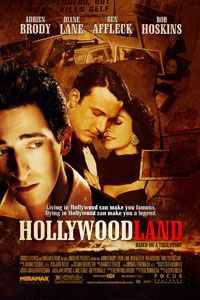
In Contention

Author: Kristopher Tapley

  • REVIEW: “Hollywoodland” (***)

    Focus Features\' HollywoodlandThe death of George Reeves, television’s original Superman, in 1959 defined the loss of innocence for a generation.  There are many who remember where they were the moment they discovered Reeves’s body had been found, the victim of an apparent suicide.

    The lore surrounding the event has even wound itself into incorrect information that perpetuates itself mythically, forever living on as one of Hollywood’s greatest mysteries –- or is there a mystery at all?

    “Hollywoodland” is a project that has seen a long road to the screen, bouncing from one studio to another and back again, enduring rigorous casting scrutiny and a number of raised eyebrows regarding the direction a screenplay based on these questionable events would take.

    Now the feature film debut of television veteran Allen Coulter, “Hollywoodland” is a vivid and self-propelling experience that lingers much longer than you would expect it to.

    In the film, Adrien Brody portrays the fictional private investigator Louis Simo, who makes his way from buck to buck stringing along suspicious husbands and picking at closed LAPD cases like a scavenger of public enforcement.  When he is tipped off to the notion that, following a quick investigation deeming Reeves’s death a suicide, Reeves’s mother believes her son was murdered, Simo embarks on a journey that will become much more personal than he would have ever intended.

    The Reeves story is told through flashback, with Ben Affleck (in his career best work) taking on the role of the tragically typecast actor who rose to stardom as television’s Superman.  Parallel to Simo’s investigation, we’re made witness to the long, inevitable and sad road Reeves travels, at once a handsome lady-killer and a depressed dreamer.

    You see, Reeves was cut from the classic movie star mold.  Cary Grant, Clark Gable and Spencer Tracy would have been fitting company for the talented thespian.  However, such stardom always seemed just out of Reeves’s grasp, and after ambivalently taking the role of the Man of Steel merely to make ends meet, he would endure the sort of fame that would forever seem cheap and lacking artistic context.
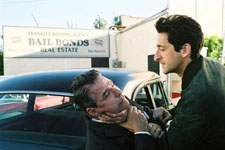
    Adrien Bridy in HollywoodlandWhen audiences were distracted by the actor’s iconic image during his scenes in Fred Zinnemann’s “From Here to Eternity,” the director inevitably had the work Reeves had put into the picture removed.  Suicide, it seemed, made complete sense to the community at large.

    The film takes time to properly examine three popular theories about how Reeves actually met his end.  The perspectives stem from a raucous girlfriend (Robin Tunney) peeved at the actor’s refusal to marry her being responsible, to former mistress Toni Mannix (Diane Lane) becoming so grief-stricken over his leaving her that her husband, MGM general manager Eddie Mannix (Bob Hoskins), had Reeves murdered – not the most implausible act in the eyes of many Angelenos.

    And, of course, the script – written by Paul Bernbaum – takes a thorough look at the classically accepted suicide theory, which certainly carries more legitimate pathos than any other.

    Brody’s work in the film takes a moment to really fit the character, but once he gets into the groove of a divorced father struggling to make his own ends meet, he taps into the personal ferocity that really begins to drive Simo after a tragedy late in the second act propels him to reassess his own perspective.  This is his first true starring role since his Oscar winning performance in “The Pianist,” and he reminds us exactly why he is worthy of the distinction.

    The supporting cast fills out in typical fashion, with Bob Hoskins and Diane Lane seemingly phoning their work in.  Though Robin Tunney really stands out as Reeves’s fiancé, Lenore Lemmon.  The real story, however, is certainly Ben Affleck, in a role that could easily be seen as too demanding given the work we’ve seen out of the actor in recent years.
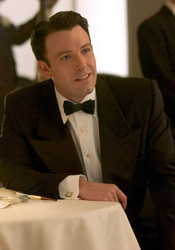
    Ben Affleck in HollywoodlandNo, in “Hollywoodland,” Ben Affleck shows us what he can do when he really wants it.  The actor took a sizeable upfront pay cut on the film (as did pretty much everyone), and while at first glance it may seem that his beefcake persona would laughably overpower the mythos of George Reeves, we soon discover just how tailor-made his screen presence is for the role.

    He captures the man in spirit, voice and mannerism like I certainly wouldn’t have expected, and perhaps many other filmgoers, casual and otherwise, will see the same awards-caliber work.

    When the film opens on September 8th, the Best Supporting Actor race may have truly commenced — or maybe the film will just stay low on everyone’s radar altogether.  But this is a savory, layered performance that does its job in context and is commanding as a supporting turn, giving us a character on which to base the events of the present – a character to care about, to root for and, all at once, to mourn.

    All things considered, Allen Coulter’s work on his first feature is capable and smooth-sailing, if unremarkable by virtue of necessity.  He never gets overly fancy, even with the unique structure, and he guides the film with the anonymous sort of hand that is certainly a positive thing.  This may well be the only cinematic testament to the legacy of George Reeves, and it is as thorough a testament as one could have asked for, despite dramatic twists and turns that might have been more suitably trimmed for a tighter overall experience.

    In the end, however, a focused performance in the film’s background works off of a truly driven performance in the foreground to give an appropriately rounded take on what has to be considered one of the most devastating events in television history.

  • REVIEW: “World Trade Center” (***1/2)

    Paramount Pictures\' World Trade Center“World Trade Center” is a nearly flawless account of something so personal, yet so universal, that it leaves the instigating events of September 11, 2001 almost as an afterthought – lipstick on the rim of a wineglass long emptied.

    he triumph of commanding such humanity in the face of a story that could have easily been played up as the rah-rah “9/11 MOVIE” some might have expected belongs in large part to screenwriter Andrea Berloff, who pitched a striking and rich tale to producers Michael Shamberg and Stacy Sher before burying herself into the lives of Will Jimeno and John McLoughlin (the two Port Authority survivors upon which the film is based).  A huge chunk of that glory, however, deserves to be placed into the hands of Oliver Stone, a filmmaker who shows in this latest effort (in a career speckled with films that were his own, if nothing else) that he retains the professionalism to tell a story free of artistic whimsy or personal commentary.

    The film tells Jimeno (Michael Peña) and McLoughlin’s (Nicolas Cage) story in a straightforward manner free of any fuss, unnecessarily schmaltzy or otherwise.  The drama of this story is not manufactured and is very much real.  Of the 20 individuals successfully retrieved from the rubble of the World Trade Center, Jimeno and McLoughlin were numbers 18 and 19.

    Part of a confused and unprepared Port Authority team hastily assembled (as most efforts inevitably were that day), the two officers were in the lobby of Tower One when its fatal collapse ensued.  Along with three other officers, the two men successfully retreated into an elevator shaft as the concrete jungle descended upon them.  They had no idea what was happening, and indeed would not be aware that the World Trade Center had been obliterated until they were pulled from the rubble an ungodly number of hours later.

    I read Berloff’s screenplay a few months ago and I found the material somewhat insipid upon an initial assessment.  However, I must say I was more than pleasantly surprised to see the tale ultimately lifted so vibrantly off the page by Stone and the actors involved, finding the true pulse of the screenwriter’s work.

    Berloff chooses to reveal Jimeno and McLoughlin’s story in the manner I reported on at that time, something of an “Apollo 13” template, cutting from the men in peril, to their wives, Allison (Maggie Gyllenhaal) and Donna (Maria Bello) respectively.  Trapped, in their own way – on the outside, Allison and Donna waited in vain for word of their husbands’ survival, their demise, anything beyond the insistence of their simply being “missing.”

    Nicolas Cage in World Trade CenterMeanwhile, the longer Jimeno and McLoughlin remained submerged, the stronger their hope became in the face of losing the lives they loved, the lives in which they belonged more so than any other place on Earth.  As their bodies physically gave way to the unforgiving pressure and internal bleeding, their spirits remained as solid as ever.

    Nicolas Cage portrays McLoughlin with the steely sense of awareness and second-nature knowledge that seems about right.  McLoughlin has seen much in his many years at the Port Authority, and if any man was the one to look to in such a crisis, he was the guy.  He drafted the emergency scenarios relevant to another Word Trade Center attack following the 1993 bombing, but no one saw this event coming.

    There simply was no plan.  But McLoughlin dove in as if he just did not know what to do otherwise, and it takes a certain acceptance of whatever might come one’s way to be that headstrong and that assured without the slightest trace of self-awareness.  Cage portrays as much with a delicate ease that is at once arresting and relaxing.

    Jimeno, the rookie of the crew, was out to prove himself like any other new kid on the block.  He wanted the acceptance of his comrades but he also knew where the boundaries of his job were drawn.  The respect he unabashedly held for authority is present in Peña’s portrayal, as well as a certain, at times infectious, positivity that shines through the thickest of rock and dust debris covering the actor’s face.

    Gyllenhaal and Bello portray two women cosmically intertwined who would not meet one another, nor know of their fated connection until the whole ordeal was resolved.  As the pregnant and sometimes hysterical Allison, Gyllenhaal steps her game up a notch (and will do so further later this year in Marc Forster’s “Stranger Than Fiction”), while Bello (donning eerie yet somehow strangely appealing blue contacts) portrays the rock of a mother of four you’d expect Donna McLoughlin to be; she certainly seems like the sort of woman the thought of whom would keep a man alive.

    The rest of the cast most notably includes an unrecognizable Stephen Dorff as the officer in charge of Jimeno’s and McLoughlin’s extraction once they were discovered, as well as a nice cameo from Stone staple Frank Whaley as a helpful paramedic who seemed to have a story worth telling of his own.  Michael Shannon also co-stars as Dave Karnes, a former marine who, desperate to help the situation, drove from Connecticut to New York and made his way to ground zero.  Had he not taken that moment to rediscover his passion for serving his country, Jimeno and McLoughlin might never have been found alive.

    I have to mention clearly that, while such thematics as “serving one’s country” or “the brotherhood of many to save a few,” or what have you, might seem potentially over-bearing, they are not as much in this film.  These strands and basic facts come together on screen in “World Trade Center” less as manipulation than they do as insistent historic rhetoric.  And the old-fashioned relating of the story from the hands of director Oliver Stone is at times stunning.

    Michael Pena in World Trade CenterHumility is the most endangered trait amongst the filmmaking community today, and perhaps since the dawn of the medium.  That Stone could so humbly remove himself and his ego from the spotlight in order to convey Jimeno’s and McLoughlin’s story is striking, not only due to the fact that this is Oliver Stone we are talking about, but I venture to say because few, if any other filmmaker, would have been so selfless about such a film.  This will widely be reported as the most un-Oliver Stone film of the director’s career, and while that statement is true, it should not be seen as a slight, as if to say he finally came around or some such nonsense.

    Stone is one of the most artistically gifted filmmakers of his generation, responsible for some arousing innovations in visually storytelling.  But he is also capable of the basest aspects of the field, and “World Trade Center” is his charcoal sketch; it is his watercolor with primaries.  He left the fancy toolkit at home this time around, and he may have found something invigorating lurking in his long-abandoned primitive brushstrokes.

    Before closing here I think it is worth pointing out that, all due respect to the cinematography of Seamus McGarvey or the score from Craig Armstrong, Jan Roelfs’s painstaking recreation of ground zero is worth a specific mention above all else.  The work put into the rubble trapping Jimeno and McLoughlin, not to mention the practical usage of set materials during the collapse of the first tower, are design elements of the highest order, and should “World Trade Center” become an awards giant this Oscar season, I should certainly hope Roelfs and his team will be remembered.

    Ultimately I must say I am very proud of the Hollywood establishment for handling 9/11 in the successful manner we’ve seen this year.  Universal’s “United 93” and Paramount’s “World Trade Center” are two drastically different films with drastically different themes.  One is about dread, the other about hope.  However, just as those two feelings can go hand in hand, so do these two films, serving as serendipitous compliments to one another.

    “That day” was very much about dread and hope, and now that those two surface level, primal aspects of the event have been handled so capably, the filmmaking community is free to express itself through 9/11 in much more visceral, peripheral ways.  Mike Binder’s upcoming “Reign Over Me” might just be that first step.  In the meantime, “World Trade Center” is a beautiful, engaging and affecting experience, one of the very best films of the year.

  • What a guy

    Adrien BrodySo I’m on the phone today with Adrien Brody, interviewing him for that New York Times piece I’m putting together on “Hollywoodland.” We’ve had some delays in connecting – the poor guy has been traveling a lot – and we finally got a block of time on the calendar this afternoon, both of us in traffic in our cars (well – I was parking, to be fair).

    “There are many pitfalls in life,” Mr. Brody begins, in response to one of my queries. He then trails off and begins to verbally signify that something is vehicularly amiss on the assuredly crowded New York street he was on. Apparently some poor girl on a scooter went unseen by a cab driver pulling out onto the street, and after what must have been an uncomfortable collision, she was left eating the pavement.

    “Hang on a second, Kris,” Mr. Brody says to me. He then goes to assist in helping the girl and her scooter off the street and give a helpful hand to the entire situation like he was born to do so.

    AB: “You there, Kris?”
    KT: “Yeah, pal. Everyone okay?”
    AB: “Like I was saying…there are many pitfalls in life.”

  • SHORT TAKE: “Talladega Nights: The Ballad of Ricky Bobby” (***)

    Columbia Pictures\' Talladega Nights: The Ballad of Ricky BobbyI’m no fan of Will Ferrell’s comedic sensibilities in the slightest, but “Talladega Nights: The Ballad of Ricky Bobby” is probably the best film of his typical mold to hit screens yet.  I know “Anchorman” has its devoted, and “Old School” was apparently good enough in the eyes of Bravo to make it to an obscenely high position on their recent (awful) list of the best comedies of all time.

    But “Talladega Nights” has the right mixture of peripheral comedic brilliance that Ferrell has needed for some time, to off-set that “me, me, me” schtick that hasn’t worked since Jim Carrey started talking out of his ass.

    Nothing in the way of a full review here, but a few thoughts can’t hurt.  Not only does John C. Reilly prove himself something of a hilarious comedic sideman once again (playing a similar character to his “Days of Thunder” role, only this guy ate paint chips as a kid), but he at times beats Ferrell at his own game.  Gary Cole, meanwhile, is becoming the master of the extended cameo yuk-yuk.

    Sacha Baron Cohen (along with on-screen hubby Andy Richter) gives enough reasons to slap your knee – and expect him to blow up even more once “Borat” hits cinemas, giving the actor a nice one-two punch this year).  It’s always great to see Pat Hingle on screen, no matter how inconsequential the part, and Amy Adams…Amy Adams has just…never been sexier.  It’s like a new breed.  Subjective, of course…

    Ferrell is what you would expect, though he really nails that southern fried cluelessness that has become it’s own standard.  Once “Stranger Than Fiction” releases in November, showcasing acting chops that ought to turn a head or two, the Golden Globe nominee will have potentially started the crossover that can be a painful process for comedians, bridging the gap to dramatic tendencies.  We’ll see how that flies with the critics and public at large.

    In the meantime, go out and enjoy a laugh or two when “Talladega Nights” hits theaters next weekend.  I’m fairly certain the appeal will be there for Ferrell fans, but this viewer, not one to jump in line for the comedic stylings of the Saturday Night Live alumn, was pleasantly surprised by some nice goofball entertainment.  Take it for what it’s worth.

  • REVIEW: “Lady in the Water” (**1/2)

    Warner Bros. Pictures\' Lady in the WaterM. Night Shyamalan is an artist like any other.  There are a lot of potent ideas and whims of fancy bouncing around inside his inarguably creative mind.  He is, in all likelihood, just as his representation in the American Express commercial, discovering vibrant new details worthy of expansion at every step of the way.

    However, as a filmmaker, Shyamalan has never found the appropriate balance for fully realizing his themes and notions.  For all of the discussions he wishes to have with his audience, for all his attempts to represent each of them completely, the insularity of his concepts gets the better of him every time out.  Such is the case with “Lady in the Water,” a film far less deserving of the inevitable wave of detest coming its way, whatever level of failure it may exist upon.

    In the film, Paul Giamatti plays Cleveland Heep, a man lost in his own sorrows and retreating to the far reaches of an anonymous apartment complex in Philadelphia.  As superintendent, Cleveland has carved out a position of semi-importance and purpose, but one easily filled by anyone, as he well knows.

    That would be, in Cleveland’s mind, the point –- the more invisible his existence the better.  Why that is, we are left only to imagine for a while, but we discover the tangibility of Cleveland’s discontent in due time.

    The complex itself is filled with an assortment of colorful characters, from the raucous and inebriated band, to the unnecessarily unique father specializing in crossword puzzles, to the former author and current animal-loving old lady, to the Asian mother and her wacky/sexy daughter.  Then there is the scientifically driven young man committed to working out only the right side of his body, the Latin family fit with five daughters…oh, and let us not forget the disenchanted and wonderfully cynical film critic, truly obvious in its purpose as a character.

    The writer/director himself, of course, turns up in the film, in a much more layered role than he has filled in the past, proving that sometimes he just might be a better actor than he is a writer.

    Late one night, Cleveland discovers a girl swimming past curfew in the swimming pool of the complex.  After a routine slip-and-fall on the deck, Cleveland is rescued, as it would seem, by the mysterious girl.  He is then left to wonder who this odd, comfortably naked and somewhat aloof individual is.  We learn this information through the (at first glance) woefully expository story from the Asian firecracker, a story held amusingly out of context for much of the film.

    Bryce Dallas Howard and Paul Giamatti in Lady in the WaterHowever, critiquing the story of “Lady in the Water” from this point forward in any traditional sense would be a drastic mistake.  It is at this moment – discovering the girl is a sea nymph named Story hailing from The Blue World – that you truly have to let yourself be taken with the fantasy of it all if you are to derive any enjoyment in the matter.

    And that statement reads much more typically than it should.

    The point is there are elements at work here that command a literal release of the plot.  You really and truly must reduce yourself to childhood.  No one would look for sensible justification in a big, bad wolf dressing in a grandmother’s night gown, but there are lessons there to be learned all the same.

    Fortunately, the above-mentioned humor is a tool Shyamalan uses quite well to keep the balance on the ludicrous nature of this yarn.  It isn’t lost on him that his story is terribly contrived, even for a “bedtime story.”  But it isn’t the plot he is interested in here, so much as the characters.  In this fashion, “Lady in the Water” is perhaps the first true character study of Shyamalan’s career.

    The film is not merely about finding one’s place in the world.  It is about having the courage to face that place, and assuredly, much as with “Signs,” the filmmaker uses this opportunity to speak to fate and faith throughout.  Cleveland is a man with a painful past, one that he believes will abandon him if he abandons it.  But such considerations are inherently foolish.  We are not only sculpted by our past, we are owned by it.  We are owned by it until we sum up the fortitude to accept it, and through a fantastical, absolutely incoherent fable, Shyamalan makes this point clearly.

    What will certainly be lost in the shuffle of criticism of is the conviction and passion that is more apparent here than in past efforts from the director, efforts that were drastically obvious attempts at capitalizing on that fated moniker “The Next Spielberg.”  It will be more fun in our typically lazy analytical film community to draw blood.  Ironically enough, most points of negative concern will be viable.  But they will be defeatist all the same.

    Paul Giamatti truly is a saving grace here in many respects.  As a stuttering, introverted and simple man, Cleveland is a curious anchor for such a story.  However, dazzling as always, Giamatti sells his side of things like a champ.  Conversely, the rest of the cast is filled out on the page in an extremely flat manner, all of them serving a pre-ordained purpose in the story.  But Cleveland is a complex and interesting character whose ins and outs deserved the right attention.

    Bryce Dallas Howard in Lady in the WaterAs the mysterious Story, Bryce Dallas Howard is appropriately creepy, and, I guess, appropriately detached.  However, I don’t know how one would begin to critique a performance like this.  When you get right down to it, it’s all external – every bit of it.
    Jeffrey Wright, Bob Balaban, Bill Irwin, Freddy Rodriguez and Sarita Choudhury fill out the rest of the principle supporting cast, elementarily conceived characters on the whole, but organic to the tale all the same.  And, in most cases, the actors do a fine job of elevating their roles ever-so-slightly.

    The problem with “Lady in the Water” is a rather significant one, though.  Tonally, it is even.  Thematically, it could use some work, but the elements are there and coherent.  Performances are as good as they were going to get.  The filmmaking is, as always with Shyamalan, top notch.  He remains visually dynamic as a director.

    No, the problem with Shyamalan and his latest effort is the same issue he has had for six years.  He cannot seem to understand that the role of the artist is not infinitely solitary.  That, my friend, would be a real “bedtime story.”  If you roll with something as risky as this on your own, you are bound to trip and stumble, and who will be there to catch your fall?  Better yet, who should be?

    Maybe that is the sort of risk Shyamalan is attracted to taking, but you can only fall so many times before you can’t help yourself up anymore.  Shyamalan is getting to that point.

    Ultimately, this is a filmmaker with a choice to make.  With “Lady in the Water,” he has concocted, again, a string of interesting ideas that he cannot fully develop.  His central theme rings true.  However, there are so many particulars that threaten depth and yet remain on the periphery, it becomes apparent that Shyamalan is a director, however talented, lacking the maturity to understand that art is not a singular achievement – and a film is anything but.

    It is the mark of professionalism to trim the fat.  This seems to be lost on Shyamalan.  Furthermore, the lessons he learned (or perhaps did not learn) on “The Village” were taken personally and manifest themselves in aspects of “Lady in the Water” in very petty ways.  The lessons he has been avoiding on his latest effort already show the signs of potential insularity once again, taking to chastising a studio that had every right not to believe in a project that, however booming in potential, just wasn’t there yet.

    The golden child simply hasn’t allowed the industry to break him, and his humility is nowhere to be found.  That vicious cycle has produced terrible filmmaking since the dawn of cinema, and Mr. Shyamalan is dangerously close to the same precipice.  Perhaps it is time for him to stop listening to the voices inside his head, and start lending credence to the voices outside.

  • REVIEW: “Babel” (****)

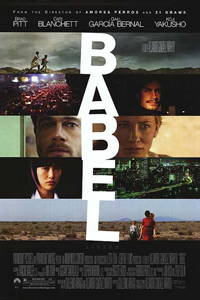
    Paramount Vantage\'s Babel“Babel” is the crowning achievement in the early careers of writer Guillermo Arriaga and director Alejandro González Iñárritu.  It will deservedly be seen as that defining moment which took them out of personal thematic expression -– the mark of a true artist -– and into the arena of global and human consciousness through artistic dexterity -– the mark of something much more.

    It is the most particular specimen, yet the most universal, in the long line of socially and/or politically inquisitive filmmaking we’ve experienced over the last two years.  And it goes without saying, “Babel” is the first real masterwork of 2006.

    As outlined in the eleventh chapter of the book of Genesis, the Tower of Babel was a creation built by the collaborative forces of a united humanity.  Having it in their hearts to emulate the Creator, the text reveals, “they said, Go to, let us build us a city and a tower, whose top may reach unto heaven.”   As the legend states, God halted the project by confusing the languages of the united, so that they could no longer communicate with one another.

    God then scattered the people throughout the land, forever disconnected, yet still of a similar and undeniable origin.

    The Tower of Babel is a narrative used to explain the diversity of languages and race throughout the world.  It is also a rather obvious warning that any who would attempt greater personal standing than that which God has outlined for them is doomed to failure.  However, at its core resides another illustrative failure begging thematic expansion: We as humans are furthermore doomed to eternal miscommunication, so long as we maintain the literal and figurative borders of our own design.  This thematic is the central focus of Arriaga’s and Iñárritu’s brilliant film.

    “Babel” tells four stories set in the lands of Morocco, Mexico and Japan.  Each of the stories, in typical Arriaga/Iñárritu fashion, shares common strands, continuing their trilogy of interconnectivity and fateful consequence (themes also found in 2000’s “Amores Perros” and 2003’s “21 Grams”).

    Two Moroccan brothers, testing the range of a firearm purchased for them by their father for the purposes of killing jackals, instigate the events of the film which will outline the filmmakers’ tale.  A single gunshot rings out in the Moroccan desert, spiraling the lives of Richard and Susan (Brad Pitt and Cate Blanchett, respectively) into a dizzying and confusing abyss of political turmoil, paranoia and, assuredly, dire straits.

    Adriana Barazza in BabelVacationing and searching in vain for themselves and their emotional connection once again, Richard and Susan have recently lost one of their children.  Neither has recovered, and neither has found the ability to forgive the other.

    Meanwhile, at the couple’s home in San Diego, their illegally employed Mexican nanny, Amelia (Adriana Barazza), is anxious to make it to her son’s wedding back home.  Against the advice of her nephew, Santiago (Gael García Bernal), she makes the fatal decision to bring Richard and Susan’s children –- whom she has raised for eleven years –- with her across the border.

    The more politically relevant of the three tales, Amelia’s journey is reflective of current foreign policy as it relates to border concerns, and the heartbreaking consequences potentially harsh edicts can manifest in that regard.

    Concurrently, in the communicative and technological Eden of Tokyo, Japan, Chieko (Rinko Kikuchi, the film’s unparalleled standout), is a deaf-mute girl exploring herself sexually as an adolescent, but ever lost in her own paralyzing world.  Chieko is the true heart of the film, lacking the ability to communicate, not merely emotionally, with her widowed father, Yasujiro (veteran Japanese thespian Kôji Yakusho), but quite literally, with the people who surround her in one of the most populated cities in the world.

    The performances in the film are all of an organic whole, but as undoubtedly diverse as the characters being portrayed.  As Richard, Brad Pitt finally puts forth a commendable and saturated performance to stand alongside his best work (“12 Monkeys,” “Seven,” “Seven Years in Tibet”), while Cate Blanchett, largely relegated to painful cries and disappointed outbursts, is ever-commanding as she continues her lineage of impressive portrayals.

    The actors cast as the two Moroccan brothers and their father (with whose names, I’m embarrassed to say, I am not familiar) offer performances that are fascinatingly tangible and, in many ways, the most reflective of human frailty.  Meanwhile, Gael García Bernal has a comfortable supporting opportunity to give the hint of depth, but still keep his cards close to the vest.

    Rinko Kikuchi in BabelThe most captivating and award-worthy performances in the film, however, come from Adriana Barraza and, most especially, Rinko Kikuchi.  Barraza’s conflict is so frightening, and eventually, so terribly desperate, that it could burden the shoulders of the most gifted of actresses.  She commands the role in such a way that we feel for her wholly, in ways both humanitarian and political in nature.
    Kikuchi, on the other side of the world, provides a venue for us to experience the film’s themes ourselves.  So much of her performance comes through her eyes and through her visual reaction to the events around her that the audience is forced to partake in her journey as well.  Seemingly we feel no such personal connection to any other character in the film.  It can be no coincidence that that character is the one so drastically isolated from the world six inches in front of her face.

    “Babel” pushes through the journeys of its inter-connected characters toward its own vibrant, certainly logical, but altogether ideal (if profound) conclusion.  Through their usual heart-wrenching tactics, Arriaga and Iñárritu paint the portrait of humanity scattered, just as in the days of Genesis, but not at all lacking the promise of rediscovery.

    Though not nearly as dark as their last two efforts, and certainly more accessible on the whole, “Babel” concludes in the most uplifting of fashions.  The film’s closing moment at once draws the sigh of hope and a tear of thankfulness that Pandora closed her box in time, another legend entirely, yet one as applicable to humanity as that of the tower which represented man’s original arrogance.

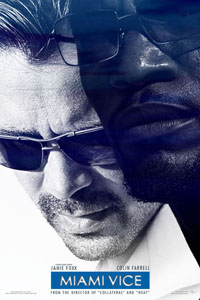
  • REVIEW: “Miami Vice” (**1/2)

    Universal Pictures\' Miami ViceMichael Mann’s “Miami Vice” is a terribly anxious piece of filmmaking.  By its own erratic and rote design, the film marks, at once, a substantial step down for the writer/director, and merely a lateral move in the realm of stylistic representation.

    Boasting a curious mish-mash of caricatures and equally original representations, it is certainly the most uneven work he has offered to date, and most assuredly the worst film he has produced since the horror of 1983’s “The Keep.”  Then again, the “worst” of Michael Mann would usually be a point of envy for most of today’s working filmmakers.

    Based on the Anthony Yerkovich-created television series of the same name, “Miami Vice” is a meditation on deception and trust.  The film wears its themes on its sleeve, though forgivably so, as, if anything is spread evenly and accomplished absolutely throughout, it is that very concept.

    But Mann’s film has an eagerness to it, a misplaced ardency, that leaves the impression of a movie with something to prove.  Its chest seems puffed outward from the moment the Universal Pictures logo disappears (immediately bursting into the sounds of Jay Z and Linkin Park at a Miami nightclub), to the slow fade of the closing title screen (a tonally ironic deep, cool blue).

    In the adaptation, Colin Farrell and Jamie Foxx fill the classic roles of Sonny Crockett and Ricardo Tubbs respectively.  As partners, this aspect of the story provides at least a basis for further exploring the notions of trust and deceit at the film’s core.  When Tubbs says to Crockett “I would never doubt you,” it represents the reality of their lives, the only tangible aspect of their profession.  It is a point, however, glossed over somewhat and certainly not capitalized upon as it could have been.

    A thorough examination of their relationship is not needed, but an understanding of consequence of that relationship is certainly a must, and it is really nowhere to be found, even within the confines of subtext (something at which Mann has proven himself an expert time and again).

    The nuts-and-bolts plot of the film plays itself out seemingly as an expansion of one of the series’ various faceless scenarios.  After a former informant compromises an FBI undercover operation, Crockett and Tubbs, being a part of the Miami-Dade Police Force and existing outside the confines of any possible leak, are recruited by the Bureau to investigate further – and deep undercover.

    Gong Li and Colin Farrell in Miami ViceThere is then an assortment of expected character types, from the introverted, consistently pondering drug kingpin (Lois Tosar), to the weasel-ish middle man who smells something fishy (a rather diabolically entertaining John Ortiz), to, of course, the tough-as-nails businesswoman-slash-kingpin girlfriend (Gong Li).  This triumvirate of typicality is painfully derivative from the get-go, but we’ve seen Mann take the cliché and turn it into stylistic substance before in “Collateral,” so assuredly one could expect as much once more.  Sadly, no such turn of events is in store.
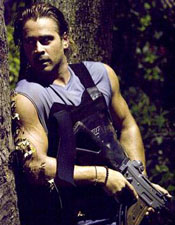
    The film is truly owned by Colin Farrell, regardless of whose name appears first on the poster and which Oscar-winning actor whined for more prominent status on the film’s payroll.  Farrell in fact acts Foxx off the screen for the most part, though Tubbs is admittedly an awkwardly designed character.

    He boasts a quasi-romance that is ill-defined with fellow teammate Trudy Joplin (Naomie Harris), and he turns to comedic sensibilities a bit too often in his “undercover” guise, so much so that, were I Crockett, I’d demand a less obvious partner for fear of being gutted by a suspicious drug lord.  No matter how rewarding the one-liners might be on one hand, on the other, they simply represent one more wrinkled aspect of the piece that could have used some ironing.

    Farrell, however, lives and breathes inside Crockett in perhaps his best performance yet – though his accent does slip at times from the Bronx to the south, oddly enough.  He gives us the complexities of the character that are not found on the page (unlike Foxx), and even when the forced romance with Gong Li’s Isabella rears its trying head, we believe the loneliness and the despair that drives Crockett to seek out that connection.

    At the very same time, we can sense him reciting the words of Neil McCauley in his head: “Don’t let yourself get attached to anything you are not willing to walk out on in thirty seconds flat if you feel the heat around the corner.”  Even still, it is a different idea at work here, one about longing and necessity more so than discipline and detachment.

    Colin Farrell in Miami ViceLi, however, seems forever uncomfortable in a position we are meant to believe is some saving grace for her.  She shares the solitude of Crockett, the loneliness.  That is their common denominator, and the single thread with which we are to buy this romance.  But she does not sell that notion in the slightest.  She seems almost lost in her character’s dialogue and motives.  Who is this woman?  Beyond a random anecdote about her mother – a lone wolf in her own right, it seems – from whence does Isabella come?  We do not know.
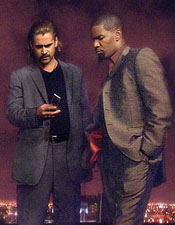
    Nor do we know much about Crockett.  However, even when he is given the interesting task of peering longingly out of a window in the film’s first act, we know there is something there.  But even then, why?  What – even possibly – haunts this man?  Did his career create a rift between himself and another lover?  Various other lovers?  Does he pursue a life of lies and deception undercover to escape the realities of his own anonymity?  What are the realities of his anonymity?

    These themes never even threaten exploration, and the sound of air rapidly filling the space vacated by such dearly departed intricacies of character is all we can hear indeed.

    Elsewhere in the cast, John Ortiz weaves a truly villainous serpent, fit with hypnotic syntax and devilish grins.  Though his character is painfully ordinary, Ortiz makes him eminently watchable – as does Tom Towles as a despicable and somewhat terrifying man who chews gum as if it were his sole purpose on earth.  Furthermore, Barry Shabaka Henley, always a delight, provides a steadfast Lieutenant, a serious and driven man to trust.  Even when his dialogue seems forced, we still believe every syllable.

    The rest of the cast is somewhat anonymous by Michael Mann’s standards.  Here is a director who has always been adept at filling the frame with a variety of characters, but however minute their bearing on the story, there was always dimension to be found.

    Domenick Lombardozzi (you’ll recognize him from a cameo performance in this season of “Entourage”), Elizabeth Rodriguez (“ER”), Harris (“28 Days Later”), Tosar (“Los Lunes al Sol”) and Ciarán Hinds (“Munich”) fill their positions by the book.  However, the loss of substance in the peripheral cast is felt most painfully in the fact that Justin Theroux (“Mulholland Drive”) is just there, taking up space.

    Theroux is one of the most striking and interesting actors of the underrated lot today –- potential movie star material.  A Michael Mann film should be his playground, yet there he is, forever an afterthought.

    All of that said, John Hawkes’s oh-so-brief work in the film’s opening scenes soaks up the role of Alonzo for all it is worth.  It is rare to understand a character so thoroughly in such a brief amount of time, and with such a consistency of emotion and complexity.  You’ll recognize Hawkes from last year’s “Me and You and Everyone We Know” and television’s “Deadwood.”

    Colin Farrell and Jamie Foxx in Miami ViceAll this talk of the varied cast (however clichéd) has left me little time to fully discuss the technical aspects of the film, all a step down from the vibrant “Collateral,” yet still a move in the right direction for digital cinema.
    Dion Beebe’s lensing still lacks the thematic composition of Mann’s work with Dante Spinotti in years past, and even of Emmanuel Lubezki on the underrated “Ali.”  However, the juxtaposition of the imagery by way of William Goldenberg’s and Paul Rubell’s film editing keeps the pacing relentless and creative, as always.

    Additionally, it seems as if Mann has found a new musical muse in Audioslave, the remnants of a singerless Rage Against the Machine with Soundgarden’s Chris Cornell at the mic.  Mann has always been a fan of Moby (and seemingly still is, given the inclusion of “Anthem” and “One of These Mornings”), but this is the second time Audioslave has been featured so prominently in one of his films (following the potent usage of “Shadow on the Sun” in “Collateral”).  The band contributes two new and appealing songs to the film’s soundtrack, but sadly, said soundtrack feels like a mix CD, a new track every other minute.

    Mann is a master of aural atmospherics, and the sparse score even recalls the majesty of Elliot Goldenthal’s work on “Heat” at times.  However, such things seem entirely rushed and thoughtless in his latest effort.

    The question with which one is left after viewing “Miami Vice” is “Why did Michael Mann want to make this film?”  Was it the desire to dig into the theme of lies through the world of undercover policing, as has been reported?  Likely.  But if so, where is the passion we’ve come to expect of his work when he is so focused, so driven?  Where is the touch of humanity that seems almost organic?  Why does this script feel as if Syd Field deserves a credit?  Why such typicality?

    These all become rhetorical questions in the final analysis, but as filmgoers, we will be quite the lucky when Mann decides to leave the desire for romp behind and tackles much more personal and engaging fare once again.

    “Miami Vice” is anything but personal.  It is a – sometimes – gratuitously violent (Verhoeven-level), generally by the numbers actioner with elements of depth and promises of texture that are more often teased than explored.  It is vacant and even elementary on as many levels as it hopes to be poignant and thematically authoritative, and though it concludes with the emotional tinge that recalls Michael Mann cinema, it fails to reach the bar he has set for himself.

    It is a high bar indeed.  Perhaps he is doomed to chase it forever.

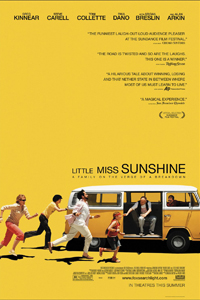
  • REVIEW: “Little Miss Sunshine” (***1/2)

    Fox Searchlight Pictures\' Little Miss SunshineJonathan Dayton’s and Valerie Farris’s “Little Miss Sunshine” is the rare example of the quirky and fringe actually having something to say.

    It melts away the infection of suspicion and invariably lets itself into our hearts without the stench and waxing effect of sentimentality rearing its ugly head.  It takes on human frailty and maintains relevance, all the while introducing absurdity to realism like they were long lost friends.  As one of the definitive indie experiences of 2006 thus far, the film is certain to stand out as unique against whatever fray of cinematic output awaits us the rest of the year.  Regardless, at this, the mid-way point, it has to already be considered the high-water mark for films in release.

    It has been a few weeks since I screened the film, but I have to admit it remains as fresh and as popping in my mind as the vibrant yellow of it’s advertising campaign.  Coming off the festival circuit (including an oft-covered standing ovation at Sundance) and entering the marketplace July 26, “Little Miss Sunshine” is the feature film debut of commercial and music video helmers Dayton and Farris.

    They’ve made the smart decision of choosing a quaint but subtly complex yarn for their first film, steering clear of any desire to show off those surely honed skills of visual artistry.  That said, the duo still finds a way to capture screenwriter Michael Arndt’s world within a unique and meaningful frame every step of the way, filling it with performances that meld together into the finest of ensembles.

    We’re first introduced to Sheryl (the continuously underrated Toni Collette), who has come to the hospital to pick up her suicidal and woefully depressed brother, Frank (Steve Carrell).  You see, Frank is the victim of the most widespread crime of them all — heartbreak.  Upon losing the love of his life to another man, Frank has attempted to end his own suffering in the most classic of fashions by slitting his wrists and hoping the despair would drain from his body along with his life force.  Sheryl is here to take him home, to be monitored for fear of emotional relapse, but amongst family all the same – though it’s not the most settling environment, as we soon discover.

    At the homestead we meet the host of characters who will accompany us throughout, including a trying and as of yet unsuccessful paterfamilias, Richard (Greg Kinnear -– never a wrong step taken).  The irony of his lack of success spells Richard’s painful reality as he tries in vain to sell his “9 Steps to Success” workshop for greener pastures.

    Richard’s father, the sharp, yet somewhat asinine, and altogether freewheeling Grandpa (Alan Arkin) never misses an opportunity to be unnecessarily impudent, or, specifically, to make digs at Frank’s sexual orientation.

    (from left) Alan Arkin, Steve Carrell, Paul Dano, Abigail breslin, Toni Collette and Greg Kinnear in Little Miss SunshineRichard and Sheryl’s son, Dwayne (Paul Dano), has taken a vow of silence in preparation for his dream of becoming an air force pilot, fit with a “fuck off” attitude and a token bedroom poster depicting the iconic image of Friedrich Nieztche.

    And then there’s Olive (Abigail Breslin), the heart and soul of the film who defines the determination that lies at the center of Arndt’s work.  Olive has made it, via technicality, into the finals for the “Little Miss Sunshine” pageant in Redondo Beach, California, and she’s ready and willing to step up and take advantage of the opportunity.  She’s rehearsed her routine with Grandpa for weeks.  She’s honed, prepared, and damned excited.  Soon enough, a road trip, from the blistering desert of Albuquerque to the sparkling coast of Redondo Beach, lays out the film’s brightest and darkest themes, with plenty of self-discovery and familial-examination filling out the scenery along the way.

    Greg Kinnear seems to find the delicate ins and outs of every character he portrays, however miniscule the part.  Here he balances Richard’s deep-seeded love for his family with the tendency to forget all of that due to the grime and build-up of personal gratification and professional ascendancy.

    Toni Collette finds the middle ground of Sheryl, the anchor of the family and yet the most frayed of the lot.  Together she and Kinnear make for a terrifically believable couple entering the apex of their lives, perhaps fearful of the other side of life, casting a watchful and ambivalent eye toward the descent that is sure to follow middle age.

    On the other side of things is Grandpa, long past that first jolting drop and having the ride of his life.  Alan Arkin really cuts loose and allows all of the character’s irreverence to show itself, irreverence seen as nearly commendable in the final analysis.

    Abigail Breslin and Paul Dano in Little Miss SunshineDano exudes the sarcastic Cobain lyric “teenage angst has paid off well” with every hooded glance or unaffected beat.  Most will remember him for his stirring work opposite Brian Cox in 2002’s “L.I.E.,” but his performance here is of a completely different emotive breed.
    Then there is Steve Carrell.  Certainly taking on the most contrasting role of his young cinematic career, he keeps the reins close on the comedy like most actors in his position could only dream.  He affords layers for Frank that are very real, yet remains mysterious enough to surprise us when he is at his most endearing.  In many ways the most balanced character of the lot, Frank is still the guy that tried to snuff it, and that irony couldn’t have been lost on Mr. Arndt as he crafted a truly contradictory experience to mirror the contradictory nature of life itself.

    The determining facet of this ensemble, however, was always going to be the casting decision for Olive, and Breslin steals our hearts and ignites our passion effortlessly in that regard.  A true mark of excellence in screenwriting is a hero worth caring for, and though the case could be made for the family as a whole being the protagonist in “Little Miss Sunshine,” it is ultimately Olive for whom we root, for whom we hope, and in whom we lose ourselves.

    “Little Miss Sunshine” is a romp as penetrating as it is sentimental.  At its core, first-timer Arndt’s screenplay is about the necessity of understanding, making some valid and, at times, poignant assertions about the importance of family.  And there is a reason it takes everyone offering a collective push to get that troublesome Volkswagon bus on the road each time.

    The script further maintains ideas concerning the support and empathy that can sometimes only come from those sharing the same blood, while simultaneously illustrating the notion that individuals in a family are still just that, individuals – separate entities with their own sets of issues and worries.  In so doing, he inevitably paints a portrait of the vilest yet most unavoidable aspect of human nature: selfishness.  But you have to love us for it, right?

  • REVIEW: “Superman Returns” (***)

    Warner Bros. Pictures\' Superman ReturnsWhen he was appointed to bring one of the most socially complex comic book series to the screen in the form of 2000’s “X-Men,” director Bryan Singer had in front of him the opportunity to usher realism and tangibility into the genre.
    While that first installment in a franchise that has this year gone terribly awry was still rather over-blown and theatrical (studios must cover their bases), it still provided a sturdy base for Singer to create a near masterpiece with the film’s sequel. “X2” made some of the most un-relatable of characters inherently familiar and brought them off of the page and into the real world in what was one of the best films of 2003.

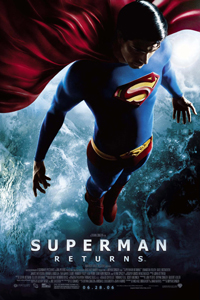
    This year Singer takes to task an entirely different sort of superhero, the world’s most recognizable man of steel. And while the work he puts into “Superman Returns” doesn’t necessarily make for the perfect blending of thematic resilience and organic spectacle found in the “X-Men” series, he finds a way to define and illustrate fully the character of Kal-El like no other filmmaker before him, a character as cursed as he is gifted.

    The story of “Superman Returns” is quite simple, really. Superman (Brandon Routh) has abandoned the world for the past five years, disappearing to the farthest reaches of the universe to see for himself the remnants of his long destroyed, but not long forgotten home world, the planet Krypton. In his stead, the world of the yellow sun has moved forward and has learned to live without the comfort of a savior.

    The construct is fully symbolized in the love of Superman’s life, mild-mannered reporter Lois Lane (Kate Bosworth), who has hardened her heart and pushed ahead, becoming engaged to Richard White (James Marsden), nephew of Daily Planet editor Perry White (Frank Langella), raising a child and winning a Pulitzer Prize for her work on a story entitled “Why the World Doesn’t Need Superman.” But, as irony would have it, Lois is herself in need of such a savior just twenty minutes into the film, as Superman “returns” during one of the most exciting action set pieces we’ve seen in a number of years.

    Meanwhile, in perhaps one of the biggest “isn’t it obvious?!” moments you could imagine, Clark Kent reports back for duty at the Daily Planet amidst all this commotion. Clark is enthusiastically welcomed by his good friend Jimmy Olsen (gleefully portrayed by Sam Huntington) and, pretty much no one else, as Jimmy drops the news that “fearless reporter Lois Lane is a mommy.”

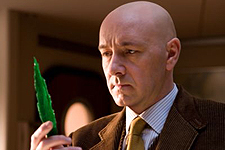
    Also popping back onto the scene is the diabolical Lex Luthor (Kevin Spacey), who has finagled his way out of prison whilst wooing a rich and foolish dying woman, taking her for everything she has on her deathbed. Talk about despicable! The first five minutes of “Superman Returns” exhibits a Luthor more treacherous than Gene Hackman’s original incarnation could have ever dreamed. And that is, perhaps, quite the point.

    Kevin Spacey in Superman ReturnsWasting away in prison, formulating a plot for revenge all along, Luthor has grown to despise the Man of Steel and everything he represents more than ever. And we believe it. Gone is the zaniness of Hackman’s comic relief (mostly, anyway) and in its place we are met with a true testament to the viciousness this character is and has been capable of.
    Luthor has surrounded himself with the usual thugs, as well as the catty Kitty Kowalski (Parker Posey), a character who is shamelessly the same creation as Valerie Perrine’s Eva Teschmacher from the original Richard Donner-directed film. She is, in fact, representative of a number of nostalgic references that come off as too frequent and indeed somewhat unforgivable given the amount of freshness on the periphery.

    Once the table is set, the screenplay (by “X2” scribes Michael Dougherty and Dan Harris) comfortably settles into a character study, observing Kal-El’s feelings toward a woman and a world that has learned how to live without him. The Jesus parallels come and they come fast, in both subtle and obvious ways, but the point is made clearly regardless. While the world may have learned how to live without a savior, they still yearn for one every day. This film nails the idea of such a responsibility weighing heavily on Kal-El’s shoulders.

    In the title role, Brandon Routh hits the performance out of the park. Much of what he offers is a Christopher Reeve impersonation, but that isn’t to say he doesn’t fully embody both the character and the subtext. He is as great a find as Reeve was in 1978, and in this, a demanding role (despite what nay-sayers might think), he seems as comfortable as can be. That has to be seen as a mark of professionalism first and foremost.

    Bosworth, while appropriately stand-offish at first, seems much too emotionally fluffy on the outside to be fully believed as a living God’s heartbreaker. But then, Lois Lane is simply a role that has never been adequately cast. Margot Kidder got some things right, but mostly wrong. Same thing this time around. But Bosworth makes the best of it given her talents and what the script affords.

    Spacey keeps his character relatively in check for much of the film, though he does spill over the top here and there. However, where arch villains are concerned, one couldn’t ask for much more. And when these two rivals finally confront one another, the venom that roars through Luthor’s veins pops out of the screen like licks of flame from a furnace.

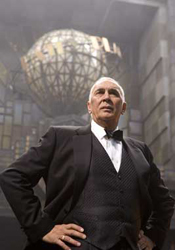
    Frank Langella in Superman ReturnsThe rest of the ensemble rounds itself out quite nicely. Frank Langella is a wonderfully hard-nosed Perry White, while James Marsden embodies a man with many of Kal-El’s characteristics –- we can see why Lois would have fallen for him. Sam Huntington puts forth a fun Jimmy Olsen and Eva Marie Saint (though lacking in screen time of consequence) is a warm spot in the film as Martha Kent to say the least.

    Finally, Tristan Lake Leabu continues the broad tradition of inappropriately awkward kids on celluloid. Most of the time he works, but generally, something just seemed — off. And no, I don’t think that was the point…

    (On a side note – please let me know if you are as distracted by Kal Penn as I was. All I could think of every time he was on screen was “where’s Harold?”)

    On the whole, “Superman Returns” is at once a tale of redemption and a tale of beginnings. Though drastic plot contrivances in the second act keep it from being truly great, the same could have been said of the first installment of “X-Men.” Bryan Singer has, regardless, taken the Man of Steel and shown us a story of his growing up, organically situating the tale against the backdrop of an already successful series.

    “Superman” was about Kal-El finding his abilities in the world and understanding what he can do. “Superman II” –- shop-lifted somewhat by the writers of “Spider-Man 2” –- was about Kal-El rejecting his abilities and trying in vain to adapt to the normalcy around him. “Superman Returns” –- in becoming a potent starting point for revamping the franchise –- is about Kal-El embracing both the joy and the horrors of his role in the world, leaving the past behind him and finding the conviction to face whatever might come his way. The words he offers in that final speech could just as easily have been redirected toward himself.

    It will be very interesting to see where Singer takes us, and Superman, next.

  • SHORT TAKE: “United 93” (***)

    Universal Pictures\' United 93I finally got around to seeing the first 9/11 theatrical release earlier this week, Universal’s “United 93,” and the feelings it digs up, the questions it actually asks without hitting us over the head, and the overall commitment to ultra-reality that director Paul Greengrass is proving himself to be the master of, will all make it a unique entry in the coming wave of films rooted in that horrific day.
    The film’s best moments reside in the mass confusion of Cleveland, Boston, and New York air traffic control centers, making it clear that orders and procedures failed miserably in the wake of an event that had not occured in 20 years – the hijacking of a domestic flight. It actually makes the blood boil to watch the clock tick as people second and third guess. In fact, one of the things “United 93” does so well is expand the timeline of all four crashes in our minds. To most, 9/11 was a quick moment. We discovered a plane had hit one of the towers – 15 minutes later, another plane, and within the next hour, we learned of the next two planes. It was all fleeting. But a lot was going on in that space of 60 minutes, and some of it can be downright infuriating – and it all makes those extra seven minutes he spent looking around a classroom like a lost kid seem all the more painstaking.

    I love that Greengrass fills his frame largely with the actual individuals in these scenes, rather than casting them with known or even unknown actors. The effect is kind of staggering, and when you get right down to it, the best possible decision. The decision to choose his moments on the actual flight 93 wisely, keeping most of the action in the control rooms, was also wise, steering clear of presuming too much about events we’ll never fully know.

    I don’t want to get into a full review here, and I want to see the film again before really forming an opinion. The sense I take from “United 93,” however, is less about the film’s subject matter than it is about the director’s talents. If Michael Mann is a director that glamorizes ultra-reality, Greengrass is a director who utilizes it like a tool in his arsenal. It’s a commanding sort of helming that seems to almost recall the notion of autuerism.

  • REVIEW: “Inside Man” (**)

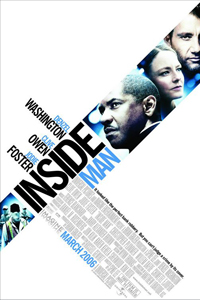
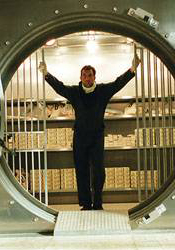
    Universal Pictures\' Inside ManSpike Lee’s “Inside Man” is an embarrassment of devices from start to painstakingly anti-climactic finish. As a run-of-the-mill heist romp, it still falls prey to a dedicated intention to distinguish itself, both thematically and stylistically.
    Thinking it over, I’ve come to the conclusion that it is rather impossible to write a negative review of “Inside Man” without spilling the beans here and there, so I’ll leave it to you to decide whether to venture into the spoiler territory below. If you’re ducking out now, suffice it to say, Spike Lee picked a rather sluggish screenplay to be his first foray into mainstream genre fare, and leaves a bloated two plus hours on the screen that could have been much more effective at a slim, tight 90-100.

    So, you’ve been warned…

    SPOILERS BELOW

    What writer Russell Gewirtz is asking of his audience in his terribly contrived (though I can forgive contrivances alone) screenplay is to shift their sense of antagonism from the right place to the wrong place for the sheer reason that it makes for an intriguing turn of events in the third act.

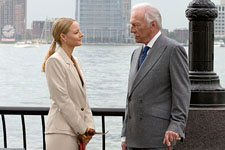
    Christopher Plummer co-stars in the film as a philanthropist and owner/board director of the bank being robbed by Dalton Russell (Clive Owen) and his team of trim-the-fat operatives. We come to discover that one of his deep, dark secrets lies hidden in safe deposit box #392, and that it is enough of a concern for him to call upon the services of Madeline (Jodie Foster), a friends-in-high-places “glorious cunt,” as our screen mayor describes her, to assure its safe keeping.

    This “secret,” mind you, amounts to something major enough, but is still physically little more than documents in an envelope that, as Russell candidly observes, probably should have been burned. Let’s set aside the “probably.” A secret like this – you don’t leave it lying around in a safe deposit box. Why the hell would you? There is certainly no upside to such a thing, and while, as I said, contrivances and plot devices can be forgiven, in my book of brainless spring screen entertainment, they ought to be more cleverly thought through than this.

    Not to mention, Madeline’s efforts come up short to the point that her character could have easily been written out of the script and the dough tossed Foster’s way could have been spent on a few re-writes.

    Jodie Foster and Christopher Plummer in Inside ManOn top of it all –- and you’ll make your mind up for yourself on this one -– the secret, which Gewirtz feels is strong enough in and of itself to make the viewer root for Russell’s thief, doesn’t exactly do that job in full. I was left siding with Plummer’s philanthropist in some small way in the matter. Gewirtz gives us every reason to forgive him, to be honest, as he paints the character in a manner that is becoming of someone who has atoned. The sheer fact that he would expect me to turn an about face is somewhat insulting. The world isn’t black and white. But, again, you’ll make your mind up on this one.
    END SPOILERS

    But let’s get into what really makes “Inside Man” an empty romp as opposed to a satisfying one. If I had to really put a point on it, before the lapses in reason, before the unbearable pacing concerns, before the insulting expectations of the screenwriter, it would have to be the overall bland nature of the characterizations, from tone, to performance, to direction.

    Denzel Washington is one of the most charismatic actors of his generation. He has carved a niche of fandom for his stellar, rounded portrayals. Whether it is above-average work in “Malcolm X” or “Philadelphia” or by-the-numbers turns in “Crimson Tide” and “Out of Time,” Washington typically adds dimension to what’s on the page. The majority of his work lies in a middle ground between good and really good (saving the great stuff for here and there), an arena I would venture to say even includes his Oscar winning performance in “Training Day.” But he is regardless an actor who can find the intriguing emotional crevices of the most mundane of characters.

    Now in “Inside Man,” teaming with Lee (a director who has brought out the actor’s best) for the fourth time, Washington (as Detective Keith Frazier) seems to have hit the snooze button and lazily translated an already innocuous character to the screen in a sluggish fashion. His performance slips and slides from controlled and cocky to wounded and concerned, smart and assured to confused and lost, and not at all in the good, dramatic way. It’s evident that neither Lee nor Washington really have a hold on who Keith Frazier is, and the anchoring of the film suffers because of it.

    This brings me to the biggest waste of the film, and yet still, the best performance of the lot. Clive Owen is cold as ice, determined and unwavering. He’s everything you want out of a bank robber who is on top from start to finish. But why the hell is he doing this???

    Clive Owen in Inside ManThis is not nearly the sort of ambiguity and anonymity of intentions that speaks truths to the human condition or anything of that nature. This is a character, intriguing in his actions and objectives as it is, painfully lacking back story and motivation. There is no question that molding the character out somewhat in this regard would have done wonders for the overall thrust of the plot, but this is screenwriting 101 if you ask me.
    And don’t blink or you’ll miss Willem Dafoe picking up a paycheck as a uniform cop with little to offer other than the film’s funniest punch line.

    I have to say that, while Lee time and time again proves that he is quite uneven as a filmmaker, his work putting “Inside Man” together visually is absolutely commendable. I’m confident in saying he’d rival the greats of heist cinema (Lumet, Mamet, Mann) were he to springboard from a good screenplay. “Inside Man” pops and cracks and we can see he is confident in his direction, staying ahead of the game and not letting the audience catch on too easily. Outside of one terrible choice, the camerawork in the film accelerates from the first frame. With some of the more unnecessary fat cut from the gut of this bloated tale, at about 20-30 minutes shorter, it might have gone down a little easier.

    Lee uses Terence Blanchard again for scoring duties. As he did on 2002’s “25th Hour,” the composer lends a majesty and exuberance to Lee’s film that unquestionably makes it more operatic and fuller on the whole. Without it, the film would undoubtedly have been a lesser one.

    All things considered, “Inside Man” is going to do exactly what it is meant to do, and what Universal and Brian Grazer expect of it. It’s going to pull down a decent box office take and line the producers’ pockets nicely, as you can’t go wrong marketing something like this. It’s just foothills enough to satisfy the average moviegoer, even if it doesn’t do much in the way of a true cineaste’s desire for the towering peaks of the Rockies.

  • INTERVIEW: Three 6 Mafia

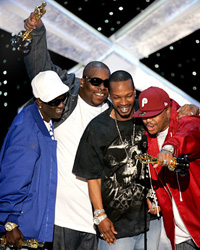
    Three 6 MafiaWhen hip-hop artist Eminem was nominated in 2002 for the Best Original Song Oscar for his track “Lose Yourself” from Curtis Hanson’s 8 Mile, he did not attend the ceremony and therefore the song was not performed per tradition. Musician and co-nominee Luis Resto was on hand to accept the award.

    Three years later, the door is open for Memphis rap group Three 6 Mafia to become the first hip-hop artists ever to perform at an Oscar ceremony.

    Jordan “Juicy J” Houston takes charge in an interview setting, speaking with a rapid fire delivery that gets his point across with the right balance of professional sincerity and conversational candor. His fellow nominee Paul “DJ Paul” Beauregard casually adds to the discussion here and there, remaining quiet the majority of the time. Nominated along with Cedric “Crunchy Black” Coleman for their song “It’s Hard Out Here for a Pimp” from the Hustle & Flow soundtrack, the group seems genuinely moved by the attention.

    “That’s so big,” Houston says. “Right now I think I’m dreaming. And it’s going to be a clean show, you know. No one’s got anything to worry about.”

    Swept up in a media frenzy following the nod to the film’s organic track, Houston and his collaborators can’t seem to go a waking moment without further exposure and regard for the accomplishment.

    “It’s a blessing, man. We’ve been getting a lot of congratulations from our hometown. It seems like we’ve been on the news every day. As a matter of fact, I was on the news just yesterday giving an interview. It’s crazy, man.”

    Craig Brewer’s sophomore effort also received a nomination for Best Actor for the film’s breakout star, Terrence Howard. The film debuted at Sundance over a year ago and has generated genuine love and respect, both for the performances (nominated en masse by the Screen Actors Guild in the Best Ensemble category), and for the music so integral to the viewing experience.

    The nominated song’s key moment in the film comes during an in-studio collaborative session that sees actors Howard, Taraji P. Henson, Anthony Anderson and DJ Qualls putting the track together piece by piece. Houston and Beauregard had plenty of experience working with established musicians, but this proved to be slightly unfamiliar territory.

    “We’ve dealt with all types of artists,” Houston affirms. “Working with artists like Ludacris and then working with the actors, Terrence and Taraji, it was a little different. Terrence is a musician. He plays guitar and he knows music, and Taraji is a singer, so they picked it up fast.”

    He continues, “They told us what the film was going to be about – a pimp struggling to be a rapper – and then we went and wrote the song. I wasn’t there when they filmed the scene, but Craig took it like it was a missing piece in a puzzle and fit it right in. He’s a brilliant director.”

    If you haven’t had the pleasure as of yet, Hustle & Flow tells the story of a Memphis pimp, DJay (Howard), who dreams of reaching higher and making something more of himself. Witnessing the quick success of hometown hero Skinny Black (Ludacris) in the hip-hop arena, DJay discovers he has a voice and he wants it to be heard as well. The question is how accurate is the film to a true hip-hop artist’s experience?

    “It’s real accurate,” Beauregard chimes in immediately. “It’s very real.” Houston backs him up, adding “That’s pretty much how every rapper got started. And that concept goes farther, into filmmaking, or doing what you do, everything’s a struggle. I’ve been through every single thing in that movie, trying to get your demo out there, get someone to play it…I’m not going to say I’ve been a pimp or anything, but the rest of it, yeah.”

    Working on the film gave Houston the chance to talk with one of his personal icons, Isaac Hayes, who plays the role of dive owner Arnel.

    “My influences are Al Green, B.B. King, you know, all the Memphis musicians. But Isaac Hayes has always been my favorite. I’d seen him before around town, you know, at the car wash. I was in the scene in the bar, I played Ludacris’s brother, and me and Isaac got a chance to talk. That was big.”

    The most colorful scenario one could imagine involving Three 6 Mafia this year would have to be the annual nominees’ luncheon, which saw the group in the same room as Hollywood’s elite. It was a surreal experience for Houston and the rest of the group to say the least.

    “I was thinking, ‘What am I doing here?’ You know, you’re used to sitting in the studio with a bunch of guys drinking beer and smelling like something they shouldn’t be smelling like, and then you pull a switcheroo and you’re in Hollywood in a room with Steven Spielberg and Reese Witherspoon. And she’s sexy, man.”

    I had to include that last bit, as it goes to show the genuine awe the Memphis group finds themselves in while still maintaining their personal sense of reality. Fish out of water? Perhaps. But still surrounded by fellow artists nonetheless.

    The Hustle & Flow experience has been a welcome one and an exciting one for Three 6 Mafia. As is typical in the city of dreams, further doors have been opening upon the success of the film. Houston isn’t too keen on talking specifically, but the ball seems to be rolling regardless.

    “Right now we have some stuff on the table. We’ve had some meetings at Paramount and Revolution Studios. I hope you’ll be hearing our songs in some future films.”

    In the meantime, Houston, Beauregard and Coleman are off to the Kodak Theater. They’ll be performing “It’s Hard Out Here For a Pimp” along with actress Taraji P. Henson (Howard opted out of performing at the ceremony, but looks forward to Three 6 Mafia’s performance all the same). Many think they have a genuine shot at taking the gold, as very few songs are such a hot button topic of discussion around town. But winning the award seems to be the furthest thing from Houston and Beauregard’s mind.

    “We really haven’t made an acceptance speech. We’re real superstitious. We’re not really thinking about winning, we’re just having fun. But if we win, we’ll know who we’ll thank when we get up there.”

    The Oscar ceremony is this Sunday, March 5, and one thing is certain. Three 6 Mafia’s mark will be left when the show draws to a close, win, lose or draw. Hip-hop will have arrived at the Kodak Theater in the form of Memphis crunk.

  • ‘Syriana’ suddenly deemed an original screenplay by the Academy

    This story will break in the trades tomorrow, but here’s the scoop.

    In a rather shocking turn of events, the screenplay for Stephen Gaghan’s Syriana, a Golden Globe winner for Best Supporting Actor Monday night, was apparently classified by the Academy as an original screenplay in a meeting held in mid-December.

    The Academy’s decision, which is obviously a month old at this juncture, was not revealed in any way as awards season accelerated through the last 30 days. Gaghan himself was not even made privy to the classification until today. Meanwhile, his work as writer of the screenplay has seen recognition from the Writers Guild of America in the adapted category, and was also a nominee for the USC Scripter Award which recognizes the writers of heralded adaptations each year in addition to the source material that spawned them. Syriana was even a finalist for the Scripter win along with Capote, a competition that came down to the latter taking the award earlier this afternoon.

    (more…)

  • Best in show 2005: the year in superlatives

    It’s time to really round out the year and offer up my picks for awards in 2005.
    In addition to the typical categories – which finally see their winners announced today – you’ll find some other fun arenas for awards citation. Call it a mish-mash of MTV-Awards-type kudos and other frequently heralded categories we find time to time in various critics’ awards and precursor ceremonies.

    No one is better at this sort of thing than Nat Rogers over at The Film Experience, so I recommend you all take a look at his Film Bitch awards when he dishes them out in the coming weeks.

    These will likely be my last extensive thoughts on the awards season this year, barring any brief comments I may or may not make here and/or there. There will, of course, be one final predictions update before the end of the year.

    It feels good to wrap everything up before Christmas vacation, I have to tell you. But the Oscar season is by no means over, so I’ll be diving right back in once 2006 finally rolls around.

    (more…)

  • If I had a ballot

    Customarily, here in the midst of our year in review, it is time for me to fill out my ballot.

    I do this every year, pretending, for one brief moment, to be one of the 6,000 members of the Academy of Motion Picture Arts and Sciences and fulfilling my own fantasies about who does and does not deserve Academy recognition in their numerous categories.

    Be sure to check back on Friday as we wrap up the “Year in Review” with a list of superlatives. There you will find the respective winners of the categories listed below (given the top ten list you can easily discern Best Picture), as well as a bevy of other random categories for your reading pleasure.

    If I had a ballot:

    Best Picture
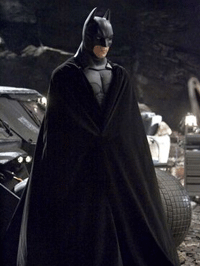
    Batman Begins (Warner Bros. Pictures)
    Crash (Lions Gate Films)
    A History of Violence (New Line Cinema)
    Last Days (Fine Line Features)
    March of the Penguins (Warner Independent Pictures)

    (more…)

  • Are we there yet?: the best films of 2005

    Not to start my “Best of the Year” column off on a down note, but from the word go I had the slightest, nagging inclination that 2005 was going to be one of the most disappointing cinematic years we’ve come across. In many ways, my fears were realized – in some cases ten-fold.
    It all began with my annual glance ahead at the Oscar race, what may or may not figure into the hunt, what this film or that had to offer. What I saw so long ago looked to be a fairly non-eventful race. All of the givens seemed too familiar, too apparent. Even with recent lessons learned like Oliver Stone’s Alexander, it seemed to me a rather clearly discerned awards season was on the horizon. We now find ourselves in an intriguing pickle, but even still, nothing not organic to the season has cropped up on the “surprise” meter, as it were.

    Searching elsewhere I hoped at least for some popcorn fun to start the year. The Michael Keaton starrer White Noise had a cool premise and a sufficiently creepy trailer. But it wound up remaining one of the worst films of the year without question – even from an entertainment standpoint.

    (more…)

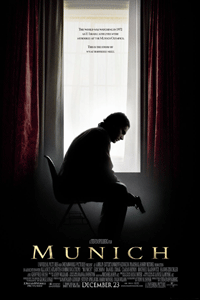
  • REVIEW: “Munich” (**1/2)

    MunichSteven Spielberg’s “Munich,” the big, mysterious player in this year’s Oscar game, has come. And as anyone could have expected, no film could have held up to the expectation.

    Not only, however, does the film fail to reach the spot reserved for it in everyone’s mind throughout the summer and fall shoot, but it settles in as a slightly misguided and confused tale oblivious to its own potential.

    The screenplay, by Tony Kushner and Eric Roth, is based on the extremely provocative book titled “Vengeance” by George Jonas. These two tyrants of storytelling bravado are a wet dream for those hoping for potent, pointed commentary mixed with fascinating storytelling. The mixture is, in effect, not so potent. Not so pointed.

    A story about the fallout of the Palestian execution of Israeli athletes at the 1972 Munich Olympics is a thematically risilient one to be committed to film in today’s times. Mossad agents seeking out – vengeance – for the heinous murders in retaliation is an eye-for-an-eye and we’d all be blind sort of reality that deserves more than the boilerplate of a squad of assassins and their tasks at hand, intricacies and all.

    These men could have served as such lighting rods as to bury any writing effort ever attempted, to be blunt, but they are rather characters to fill the void of plot instead.

    (more…)

  • SHORT TAKE: “King Kong” (***)

    King KongI don’t feel like writing passionately about “King Kong” in the slightest. What I can say with utmost conviction is that the film affords too much of EVERYTHING. The story is bloated, with subplots that could have been fleshed out more succinctly by capable hands (I contend that Peter Jackson is not the most gifted director when it comes to combining the dramatic and the spectacle, even if he is quite gifted at relaying them separately).

    I will, however, say what no one will have the guts to say. 80% of the visual effects in the film are not worth the saliva they will induce. The heart and soul of the budget in this arena was obviously afforded to the Kong close-ups, which, by and large convey one hell of an intimately realized animated creature, but I will stand firm and offer that 12 years later, no filmmaker has flawlessly combined the elements of CGI the way Steven Spielberg’s team did with “Jurassic Park.” These are green screen environments that recall the “Star Wars” prequels – I’m sorry to say.

    Much will be written about a dynamic duel between Kong and a trio of Tyranosaurs. And with good cause. The scene is pulse-racing, and along with the rest of the film’s action sequences, it is exhausting. But for this viewer, not necessarily in a good way. Not all of the time.

    (more…)